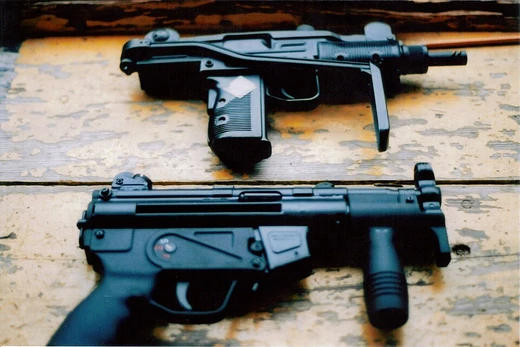
MAC-11
Sub-compact machine pistol chambered in .380 ACP.

The MAC-11 is a compact machine pistol, also classified as a submachine gun, developed in the 1970s by Gordon Ingram at the Military Armament Corporation in Powder Springs, Georgia. It is a smaller version of the MAC-10 and fires the .380 ACP cartridge. Officially designated the M11 or M-11, it is often confused with later 9mm variants like the Sylvia & Wayne Daniels M-11/9, the Leinad PM-11, or the Vulcan M-11-9. Cobray also produced a .380 version called the M12.
Like the larger M-10, the M-11 uses an open-bolt design with iron sights welded to the receiver. These sights are intended for use with the folding stock; without it, the weapon’s initial jump makes them nearly useless. Two safeties are present: a charging handle that rotates 90 degrees to lock the bolt forward, and a slider that locks the trigger and pins the bolt to the rear, preventing accidental discharge from drops.
The M-11A1’s high cyclic rate of 1,200 rounds per minute is a frequent criticism. It can empty a 32-round magazine in about two seconds, demanding extreme trigger discipline for short bursts. Inexperienced shooters often empty the magazine in one pull, with poor accuracy due to recoil. The rate of fire varies with bullet weight, and a selector switch allows semi-automatic fire. In the 1970s, police weapons researcher David Steele described the MAC series as “fit only for combat in a phone booth.” The M-11 is the least common version in the MAC family.
A dedicated suppressor was developed for the MAC-11, using wipes as baffles instead of the reflex baffles used on the MAC-10. Though less durable, the wipes made the MAC-11 quieter. The suppressor is 224 mm (8.8 inches) long and covered with Nomex for heat resistance.
Manufacturers of MAC-type firearms include Military Armament Corporation, RPB Inc., Cobray (later Leinad, then Sylvia/Wayne Daniel Inc.), Jersey Arms, MasterPiece Arms, and Vulcan.
Users include Argentina (20 for police and intelligence in 1972, 24 for army and air force in 1973), Brazil (SWD M11/9 formerly used by GRUMEC), Colombia (25 for police in the 1970s), Chile (Cobray M11/9 formerly used by special forces), the Dominican Republic, Guatemala (135 for police in 1973), Haiti, South Korea (28 for special forces in the 1970s), Slovenia, and Venezuela (used by the Cuerpo de Investigaciones Científicas Penales y Criminalísticas).
Quick Facts
- Origin
- United States
- Is Ranged
- Yes
- Service
- 1972–present
- Wars
- Lebanese Civil War
- Designer
- Gordon Ingram
- Design Date
- 1972 · A prototype was in development in 1964 and 1965
- Manufacturer
- Military Armament Corporation / Cobray Company / RPB / SWD Inc. / Jersey Arms / Leinad / MasterPiece Arms
- Variants
- MAC-11A1 / MAC-11/9
- Weight
- 1.59 kg (3.50 lbs)
- Length
- 248 mm (531 mm stock extended) (9.76 in/20.90 in)
- Part Length
- 129 mm (5.08 in)
- Cartridge
- .380 ACP (9×17mm) / 9×19mm Parabellum
Facts from the source article.
Lore & Background
The MAC-11 is a sub-compact variant of the larger MAC-10, designed by Gordon Ingram at the Military Armament Corporation in Powder Springs, Georgia, during the 1970s. It operates on an open-bolt design with iron sights that include a rear pinhole sight welded to the receiver, intended for use with the folding stock; without the stock, the sights are nearly useless due to the weapon's initial jump. The M-11A1 features two safeties: a charging handle that rotates 90 degrees to lock the bolt forward, and a slider that locks the trigger and pins the bolt to the rear when cocked, preventing discharge from drops.
The weapon's high cyclic rate of 1,200 rounds per minute empties the 32-round magazine in about two seconds, a common complaint among users. Extreme trigger discipline is required for short bursts, as inexperienced shooters tend to hold the trigger and empty the magazine with poor accuracy. The rate of fire varies with bullet weight, and a selector switch allows semi-automatic fire. A specific suppressor was developed for the MAC-11, using wipes as baffles for quieter operation, measuring 224 mm (8.8 in) and covered with Nomex.
The MAC-11 is the least common version in the MAC family. It is sometimes confused with the Sylvia & Wayne Daniels M-11/9, the Leinad PM-11, or the Vulcan M-11-9, which are later 9 mm Parabellum variants. Cobray also made a .380 ACP variant called the M12.
Reader's Guide
The MAC-11 occupies a distinct niche as the smallest and least common member of the MAC submachine gun family. Its development in the 1970s by Gordon Ingram at Military Armament Corporation produced a compact .380 ACP weapon intended for close-quarters use, though its performance drew criticism. The high cyclic rate of 1,200 rounds per minute, while allowing rapid fire, was often viewed as a drawback because it could empty a 32-round magazine in roughly two seconds, demanding exceptional trigger control for effective bursts. David Steele, a weapons researcher for the International Association of Police Chiefs in the 1970s, described the MAC series as 'fit only for combat in a phone booth,' highlighting the weapon's poor accuracy.
The MAC-11 saw limited adoption by various state users, including Argentina, Brazil, Colombia, Chile, the Dominican Republic, Guatemala, Haiti, South Korea, Slovenia, and Venezuela, as well as the non-state Lebanese Forces. Its suppressor, using wipes instead of reflex baffles, offered quieter operation but reduced durability. The weapon's legacy is tied to its compact size and high rate of fire, which made it notable but also controversial among users. Later variants and manufacturers—such as RPB Inc., Cobray, Leinad, Sylvia/Wayne Daniel Inc., Jersey Arms, MasterPiece Arms, and Vulcan—continued the design lineage, though the original MAC-11 remains the least common version.
Did You Know?
- Its rate of fire is listed as 1,200 rounds per minute, emptying a 32-round magazine in about two seconds.
- A specific suppressor for the MAC-11 used wipes as baffles and was covered with Nomex.
- The weapon is sometimes confused with the Sylvia & Wayne Daniels M-11/9, a later 9 mm variant.
More in Submachine Guns 1-24
Spotted an error? Know more?
Reader corrections go straight into our review queue. Suggest an edit · How this site is sourced