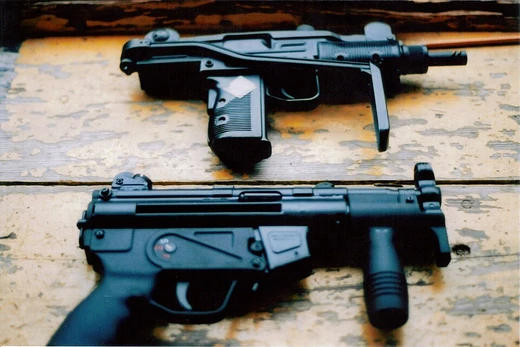
MAC-10
Compact blowback machine pistol with distinctive two-stage suppressor.

The MAC-10, officially the M10 or M-10, is a compact machine pistol and submachine gun designed by Gordon Ingram in 1964. It operates via blowback and is chambered for either .45 ACP or 9mm. The weapon is known for its two-stage suppressor from Sionics, which reduces noise and helps control recoil during automatic fire, though it makes the gun much less compact and harder to conceal. Military Armament Corporation never used the name "MAC-10" in its own catalogs, but the term is common among dealers, writers, and collectors. For ten years starting in 1994, a semi-automatic version was banned in the U.S. under the federal assault weapons ban.
The MAC-10 is mostly made from steel stampings. A notched cocking handle on top of the receiver can be turned 90 degrees to lock the bolt and indicate the weapon cannot fire. It uses a telescoping bolt that wraps around the rear of the barrel, making the gun more compact and shifting weight over the pistol grip, where the magazine sits. The weapon fires from an open bolt, and the light bolt gives a high rate of fire. A built-in feed ramp is part of the trigger guard, a new idea at the time, and the magazine design was taken from the M3 Grease Gun to save money. The barrel is threaded for a suppressor, which lowers the sound of firing without slowing the bullet. The .45 ACP version works especially well with a suppressor because most .45 loads are naturally subsonic, unlike the specialized ammunition often needed for suppressed 9mm guns. At the U.S. Army’s suggestion, the suppressor also serves as a foregrip to reduce muzzle rise. Ingram added a small bracket with a strap under the muzzle to help control recoil during automatic fire. The .45 ACP model fires at about 1090 rounds per minute, the 9mm at about 1250, and the smaller MAC-11 in .380 ACP at 1500 rounds per minute. In the 1970s, weapons researcher David Steele of the International Association of Police Chiefs described the MAC series as "fit only for combat in a phone booth," noting its poor accuracy.
The suppressor, designed by Mitchell WerBell III of Sionics, uses a two-stage design with a wider first section and a narrower second section, giving it a stepped look. With subsonic ammunition, it greatly reduces firing noise, often making the bolt’s mechanical sound louder than the muzzle report.
Quick Facts
- Origin
- United States
- Is Ranged
- yes
- Service
- 1970–present
- Wars
- Vietnam War / The Troubles / Cambodian Civil War / Lebanese Civil War / Salvadoran Civil War / Crips-Bloods gang war / Miami drug war / Invasion of Grenada
- Designer
- Gordon Ingram
- Design Date
- 1964
- Manufacturer
- Military Armament Corporation
- Production Date
- 1970–1973
- Unit Cost
- $120
- Weight
- 2.84 kg empty without a suppressor
- Length
- 269 mm with stock removed / 295 mm with stock retracted / 548 mm with stock extended / 545 mm with stock retracted w/suppressor / 798 mm with stock extended with suppressor
- Part Length
- 146 mm
Facts from the source article.
Lore & Background
The MAC-10 is built predominantly from steel stampings. A notched cocking handle protrudes from the top of the receiver; turning the handle 90° locks the bolt and indicates the weapon cannot fire. It uses a telescoping bolt that wraps around the rear face of the barrel, allowing a more compact weapon and balancing weight over the pistol grip. The MAC-10 fires from an open bolt, and the light bolt results in a rapid rate of fire. The design incorporates a built-in feed ramp as part of the trigger guard, and the magazine design was recycled from the M3 Grease Gun. The barrel is threaded to accept a suppressor, which reduces discharge sound without reducing bullet speed. The .45 ACP models are well-suited for suppression, as most .45 loads are naturally subsonic. At the suggestion of the United States Army, the suppressor also acts as a foregrip to inhibit muzzle rise. Ingram added a small bracket with a strap beneath the muzzle to aid recoil control during fully automatic fire.
The suppressor uses a two-stage design with a wider first section and narrower second section, giving it a distinctive stepped profile. When used with subsonic ammunition, the mechanical noise of the bolt cycling is often more noticeable than the muzzle report. A heat-resistant Nomex cover can be fitted over the suppressor, allowing it to be used as a forward gripping surface. During the 1970s, U.S. export restrictions on suppressors led several international customers to cancel orders, contributing to the financial failure of the Military Armament Corporation.
Noting the weapon's poor accuracy, in the 1970s International Association of Police Chiefs weapons researcher David Steele described the MAC series as 'fit only for combat in a phone booth.' Military Armament Corporation never used the 'MAC-10' nomenclature in its catalogues or sales literature, but the term is frequently used by Title II dealers, gun writers, and collectors.
Reader's Guide
The MAC-10's significance lies in its compact, high-rate-of-fire design and its distinctive suppressor system, which brought early attention to the weapon. The suppressor, designed by Mitchell WerBell III of Sionics, was a key feature that influenced international sales; when U.S. export restrictions on suppressors were imposed in the 1970s, several customers canceled orders, contributing to the financial failure of the Military Armament Corporation. The weapon's open-bolt operation and light bolt produced a very high rate of fire—approximately 1090 rounds per minute in .45 ACP and 1250 in 9mm—but also drew criticism for poor accuracy. The MAC-10's design spawned a series of variants, including the scaled-down MAC-11 in .380 ACP and the M-11/9, and influenced foreign copies such as the South African BXP, the Rhodesian Cobra carbine, the Argentine Patria, and the Brazilian Enarm MSM. In the United States, the civilian semi-automatic pistol version was prohibited under the 1994 Federal Assault Weapons Ban until 2004, and the ban prompted Wayne Daniel to redesign the M-11 platform into the compliant PM11/9. Today, while civilian manufacture and possession of post-1986 select-fire MAC-10 variants is prohibited, it remains legal to sell templates, tooling, and manuals for such conversions to Federal Firearm Licensees for law enforcement, military, and overseas customers.
Did You Know?
- The original rate of fire for the .45 ACP MAC-10 is approximately 1090 rounds per minute.
- The Sionics suppressor measures about 29.1 cm (11.44 in) in length and weighs 0.54 kg (1.20 lb).
- The civilian semi-automatic MAC-10 was banned in the U.S. under the 1994 assault weapons ban, which remained in effect until 2004.
More in Submachine Guns 1-24
Spotted an error? Know more?
Reader corrections go straight into our review queue. Suggest an edit · How this site is sourced