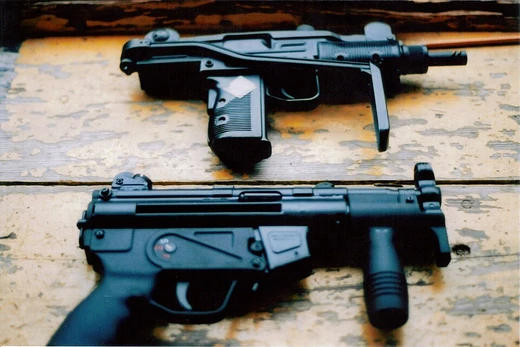
M56 submachine gun
Yugoslavian MP 40 derivative chambered in 7.62×25mm Tokarev.

The M56 is a submachine gun from Yugoslavia, firing the 7.62×25mm Tokarev cartridge and built for the Yugoslav People’s Army. It began as a state-funded project and later entered production at Zastava Arms, eventually seeing action in several conflicts after Yugoslavia’s breakup. Its design borrows heavily from the German MP 40, captured during World War II, but the M56 stands apart with a longer frame and a curved magazine.
Compared to the MP 40, the M56 was cheaper and easier to build and maintain. It also performed better at longer distances, thanks to its 7.62×25mm round, which travels much faster than the 9×19mm Parabellum used by the German gun. Inside, the M56 lacks the MP 40’s telescoping recoil spring. The magazine release is positioned directly behind the magazine, not on the receiver’s side. It uses a double-feed magazine, similar to the Soviet PPS, instead of the MP 40’s single-feed design. A fire selector switch lets the operator choose between semi-automatic and fully automatic fire—a feature absent on the MP 40. Disassembly also differs: the M56 comes apart via a rear end cap that separates the upper and lower receivers, whereas the MP 40 uses a button on the lower receiver behind the magazine well. Finally, the M56 omits the Bakelite resting bar found under the MP 40’s barrel.
Quick Facts
- Origin
- SFR Yugoslavia
- Is Ranged
- yes
- Service
- 1961–Present
- Used By
- see users
- Wars
- Vietnam War / Yom Kippur War / Lebanese Civil War / Gulf War / Yugoslav Wars
- Design Date
- 1955–1959
- Manufacturer
- Crvena Zastava
- Production Date
- 1960–1975
- Number
- 88,998
- Weight
- 3 kg
- Length
- 870 mm stock extended / 591 mm stock folded
- Part Length
- 250 mm
Facts from the source article.
Lore & Background
The M56 was developed from the MP 40 submachine gun captured from Nazi Germany, incorporating several design changes. It is longer than the MP 40 and uses a curved magazine. Internally, the M56 lacks the telescoping recoil spring found in the MP 40. The magazine release is located directly behind the magazine, unlike the side-mounted release on the MP 40. The M56 uses a double feed magazine, similar to the Soviet PPS, whereas the MP 40 uses single feed magazines. A fire selector switch allows the operator to fire in either semi or fully automatic, a feature the MP 40 did not have. Disassembly is performed via a rear end cap, separating the lower and upper receivers, while the MP 40 is disassembled by a button on the lower receiver behind the magazine well. The M56 also lacks the Bakelite resting bar below the barrel found on the MP 40.
Reader's Guide
The M56 was inexpensive and simple to produce and maintain, making it a practical weapon for the Yugoslav People's Army and later users. It proved to be quite effective at range over its German counterpart due to its 7.62×25mm cartridge having significantly higher velocity than the 9×19mm round used by the MP 40. The weapon saw use in a number of conflicts following the breakup of former Yugoslavia, and its user list includes Bosnia and Herzegovina, Iraq, Lebanon, Vietnam, Yugoslavia, and Zambia. The M56's design, based on a captured German weapon but adapted with a more powerful cartridge and simplified internals, reflects a pragmatic approach to small arms production. Its legacy is tied to the conflicts of the former Yugoslavia and its continued presence in various military inventories.
Did You Know?
- The M56 is based on the MP 40 submachine gun captured from Nazi Germany.
- It is easily distinguished from the MP 40 by its increased length and curved magazine.
- The M56 has a fire selector switch allowing semi or fully automatic fire, which the MP 40 did not have.
More in Submachine Guns 1-24
Spotted an error? Know more?
Reader corrections go straight into our review queue. Suggest an edit · How this site is sourced