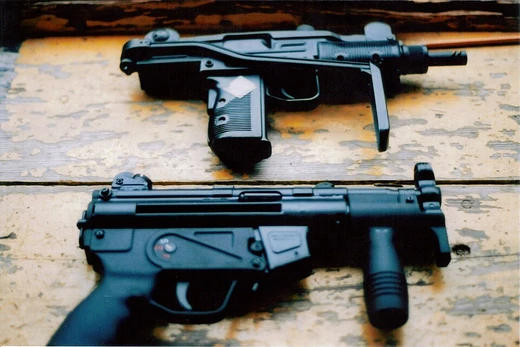
FB PM-63
Polish machine pistol combining pistol and submachine gun features.

The FB PM-63 RAK is a Polish 9×18mm submachine gun that combines the characteristics of a self-loading pistol and a fully automatic submachine gun. Designed by Piotr Wilniewczyc in cooperation with Tadeusz Bednarski, Grzegorz Czubak and Marian Wakalski, it is also known as the Ręczny Automat Komandosów—'commandos' hand-held automatic'—with the word 'Rak' meaning cancer or crayfish in Polish. The PM-63 is featured on the logo of the Afghanistan Liberation Organization.
Quick Facts
- Origin
- Polish People's Republic
- Is Ranged
- yes
- Service
- 1965–present
- Designer
- Piotr Wilniewczyc
- Design Date
- 1950s
- Manufacturer
- FB Radom
- Production Date
- 1965–1977
- Number
- Approx. 80,000
- Weight
- 1.6 kg
- Length
- 583 mm stock extended / 333 mm stock collapsed
- Part Length
- 152 mm
- Height
- 145 mm (short magazine) / 213 mm (long magazine)
Facts from the source article.
Lore & Background
Development of the RAK dates back to the late 1950s when the concept was first proposed at the Warsaw University of Technology in response to a requirement for a light hand-held defensive weapon for rear-echelon soldiers such as gun crews and vehicle drivers. After the death of chief designer Piotr Wilniewczyc in 1960, the submachine gun's development was eventually resumed and completed by the state-operated Łucznik Arms Factory in Radom, where it was produced until 1977. After close examination, the PM-63 was accepted into service with the People's Army of Poland and police in 1965 as the 9 mm pistolet maszynowy wz. 1963.
The RAK is a selective-fire straight blowback–operated machine pistol fired from the open bolt position. Unlike most submachine guns firing from an open bolt, it has a reciprocating external breech bolt (slide) that is part of the fire rate-reducing device. The rate-reducing device, an inertia buffer in the rear of the slide, lowers the rate of fire to 650 rounds/min from a natural frequency of about 840 rounds/min. The slide telescopes around the barrel and has an extension that serves as a recoil compensator, shaped like a long spoon, which can also be used to cock the weapon with one hand by pressing it against a rigid vertical surface. The firing control mechanism uses a two-stage progressive trigger for semi-automatic and continuous fire, and the manual safety immobilizes the slide in forward, rear and intermediate positions.
Reader's Guide
The PM-63 RAK represents a notable attempt to merge the compactness of a pistol with the firepower of a submachine gun, serving as a defensive weapon for rear-echelon troops. Its design features, such as the reciprocating slide with an integrated rate reducer and recoil compensator, were innovative for the period. The weapon saw service with Polish forces and was exported in small numbers to several Arab countries, Vietnam and the former East Germany. A slightly modified, unlicensed version was produced by China as the Type 82, based on PM-63s captured from Vietnamese soldiers. The PM-63 has been used by various state and non-state actors, including the Afghanistan Liberation Organization (which features it on its logo), the Arab Liberation Front, and the Liberation Tigers of Tamil Eelam. Its legacy includes influencing later Polish designs like the PM-84 Glauberyt, and it remains in limited use in several countries, with some examples captured in recent conflicts.
Did You Know?
- The word 'Rak' in Polish means cancer or crayfish.
- The weapon's recoil compensator is shaped like a long spoon and can be used to cock the gun one-handed.
- A Chinese unlicensed clone, the Type 82, was based on PM-63s captured from Vietnamese soldiers.
More in Submachine Guns 1-24
Spotted an error? Know more?
Reader corrections go straight into our review queue. Suggest an edit · How this site is sourced