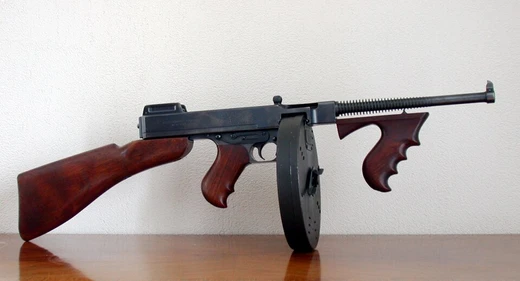
Star Si 35
Spanish submachine gun with selectable dual rate of fire.

The Star Si-35 is a submachine gun introduced in 1935 by the Spanish company Star Bonifacio Echeverria of the Basque Region, Spain. It is a classically designed weapon with a wooden stock and a cylindrical metal tube containing the barrel, and features a bayonet lug for mounting a Mauser rifle type bayonet. The Si-35 is notable for its unique dual selector system, allowing the user to choose between single fire, 300 rounds per minute, or 700 rounds per minute.
Quick Facts
- Origin
- Spain
- Is Ranged
- yes
- Designer
- Isaac Irusta and Valentin Suenaga
- Design Date
- 1935
- Manufacturer
- Star Bonifactio Echevierria, S.A.
- Mass
- 3.8 kg
- Length
- 900 mm Without Bayonet
- Caliber
- 9mm Largo, .38 Auto
- Action
- delayed (retarded) blowback, Open bolt
- Rate
- 300/700 rounds/min
- Feed
- Magazine 10, 30, and 40 round magazines
- Sights
- Front sight and rear sights adjustable for 50 m and 500 m to 1000 m
Facts from the source article.
Lore & Background
The Star Si-35 was the penultimate version of a series of submachine guns developed in the 1930s by the Echeverria company under the brand name Star. The weapon was considered reasonably reliable but unnecessarily complicated in its design, making it difficult and costly to manufacture. It remained essentially unchanged until 1942, when the design was abandoned in favor of simpler weapons.
The Si-35 features two selector switches: one for safe and fire, and another to choose between single shot, 300 rounds per minute, or 700 rounds per minute. Later variations dispensed with the different rates of fire, offering select fire at either 300 or 700 rounds per minute only. The weapon was marketed to the United States Army in 1940 as the 'Atlantic' and was also tested by the British Army around the same time, but neither nation adopted it.
Small numbers of the Si-35 were used in the final months of the Spanish Civil War, and it saw service with the Guardia Civil and the Spanish Army.
Reader's Guide
The Star Si-35 represents a notable but ultimately unsuccessful attempt at a sophisticated submachine gun design during the interwar period. Its most distinctive feature—the ability to select between two different automatic rates of fire—was innovative but added complexity that outweighed its practical benefits. The weapon's reliance on milled rather than stamped magazines further increased production costs at a time when simpler, cheaper designs were becoming preferred.
Despite being marketed to both the United States and British armies in 1940, the Si-35 failed to gain foreign adoption. Domestically, it saw only limited use in the Spanish Civil War and remained in service with Spanish forces until the design was abandoned in 1942. The Si-35's legacy is that of a well-intentioned but over-engineered weapon, superseded by more straightforward designs that prioritized ease of manufacture and reliability over adjustable rate of fire.
Did You Know?
- The Star Si-35 has a second selector lever that allows the user to choose between single fire, 300 rounds per minute, and 700 rounds per minute.
- It feeds from milled (not stamped) magazines in 10, 30, and 40 round capacities.
More in Submachine Guns, Part 2 1-24
Spotted an error? Know more?
Reader corrections go straight into our review queue. Suggest an edit · How this site is sourced