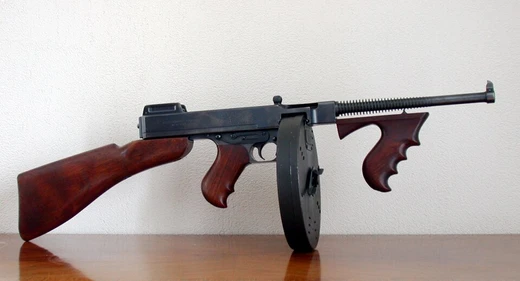
PP-90
A concealable folding submachine gun for Russian special units.

Muzzzmuzzmuzzz · CC0
The PP-90 is a Russian 9 mm folding submachine gun created by the KBP Instrument Design Bureau in Tula for special units of the Russian Ministry of Internal Affairs (MVD). It is intended for close-quarters combat, especially situations where the weapon must be brought into action quickly under unconventional conditions.
The weapon, whose name stands for "Machine Pistol model of 1990," is automatic-only and operates via straight blowback, firing the 9×18mm Makarov cartridge. Its design is conceptually similar to the American Ares FMG submachine gun in 9×19mm. The PP-90 consists of a receiver (containing the barrel, bolt, return mechanism, safety, and fire selector), a pistol grip integrated with the magazine well, and a stock. When folded for carry, the bolt is forward and closed; the pistol grip and magazine tuck under the barrel along the bore axis, covered by the folded stock. The resulting shape is a cuboid measuring 270 × 90 × 32 mm with no protruding parts, allowing easy concealment. To fire, the stock is pivoted out (which also deploys the pistol grip, magazine, trigger, and trigger guard), the safety is disengaged, and the bolt is cocked via a handle at the rear of the receiver, accessed from beneath the stock.
Safety was a priority in design: internal mechanisms prevent firing when folded or when the stock is not fully deployed. A manual safety and fire selector switch are located on the left side of the receiver. The safety toggle has two positions: top "P" for safe, bottom "O" for automatic fire. The safe setting mechanically disables the bolt catch. A drop safety prevents discharge if the weapon is dropped with a loaded chamber. The PP-90 feeds from a detachable 30-round box magazine housed in the hollow pistol grip, with the magazine catch at the grip's heel. Flip-up iron sights (notch and front post) are made of thin sheet metal and fold flat against the receiver top cover. The barrel muzzle is threaded to accept a sound suppressor.
The submachine gun, along with spare magazines and a cleaning brush, is carried in a holster that can be worn on a duty belt or shoulder rig. A sling can also be used.
Variants include the PP-92, chambered in 9×19mm Parabellum; the PP-90M, a selective-fire version; and the PP-93, a non-folding model.
Quick Facts
- Origin
- Soviet Union
- Is Ranged
- yes
- Service
- 1990–present
- Used By
- Russia
- Designer
- KBP Instrument Design Bureau
- Design Date
- 1990s
- Variants
- PP-90M, PP-92
- Weight
- 1.83 kg (empty) / 2.23 kg (loaded)
- Length
- 490 mm (unfolded)
- Part Length
- 200 mm
- Cartridge
- 9×18mm Makarov
- Action
- Blowback
Facts from the source article.
Lore & Background
The PP-90 (short for Pistolet-pulemet obrazets 1990) bears a conceptual resemblance to the 9×19mm FMG submachine gun made by the American company Ares. When carried in the stowed position, the pistol grip and magazine are folded under the barrel in line with the bore axis and covered by the folded stock body, forming a cuboid with no protruding elements for easy concealment. To ready the weapon, the stock is pivoted out, deploying the pistol grip with magazine, trigger, and trigger guard; the safety is disengaged and the bolt cocked via a handle at the rear end of the receiver housing, accessed from beneath the stock.
Emphasis was placed on safety during design: the internal mechanisms prevent discharge when folded or when the stock is not fully deployed. A manual safety and fire selector switch on the left side of the receiver has a top “P” setting for safe and a bottom “O” setting for automatic fire; the safe setting mechanically disables the bolt catch. A drop safety prevents discharge if the weapon is dropped with a loaded chamber. The submachine gun uses flip-up iron sights made from thin sheet metal that fold flush against the receiver top cover, and the muzzle is threaded to accept a sound suppressor.
The PP-90 is fed from a detachable 30-round box magazine housed in the hollowed pistol grip, with the magazine catch in the heel of the grip. The weapon, along with spare magazines and a cleaning brush, is carried in a holster that can be slung from a duty belt or shoulder rig, and it can also be used with a sling.
Reader's Guide
The PP-90 represents a specialized approach to close-quarters combat, prioritizing concealability and rapid deployment for Russian MVD special units. Its folding design, which reduces the weapon to a flat, cuboid shape with no protruding elements, allows it to be carried discreetly and brought into action quickly in unusual circumstances. The emphasis on internal safety mechanisms—preventing discharge when folded or partially deployed, and including a drop safety—reflects the need for safe handling in high-stress environments. The weapon's straight blowback operation and use of the 9×18mm Makarov cartridge align with standard Russian submachine gun practice, while the threaded muzzle for a sound suppressor adds tactical flexibility. Variants such as the PP-92 in 9×19mm Parabellum, the selective-fire PP-90M, and the non-folding PP-93 show the design's adaptability. Though not widely adopted outside its intended user base, the PP-90 remains a notable example of a purpose-built concealable submachine gun, conceptually similar to the earlier American FMG but tailored to Russian operational requirements.
Did You Know?
- The PP-90 was developed by the KBP Instrument Design Bureau in Tula for Russian MVD special units.
- When folded, the weapon measures 270 × 90 × 32 mm and has no protruding elements.
- The PP-90 cannot be fired when folded or when the stock is not fully deployed, due to internal safety mechanisms.
- A version chambered in 9×19mm Parabellum is known as the PP-92.
From European Lessons to American Steel
In 1941, U.S. Army Ordnance officials observed the combat effectiveness of submachine guns in Western Europe—especially the German MP 40 and British Sten—and by October 1942 a formal study to build an American equivalent was underway. Requirements from the Infantry and Cavalry branches called for a shoulder-fired weapon in .45 ACP or .30 Carbine with full and semi-automatic capability. Aberdeen Proving Ground refined the brief: all-sheet-metal construction, minimal machining, a heavy bolt keeping the cyclic rate under 500 rounds per minute, and 90 percent of full-auto shots on a six-by-six-foot target at fifty yards, benchmarked against the M1928A1 Thompson. George Hyde of General Motors' Inland Division handled the design while chief engineer Frederick Sampson organized tooling. The T15 specification was revised to eliminate the semi-automatic mode and permit a 9 mm conversion, producing the T20. Five .45 prototypes and five 9 mm kits were built; the T20 scored 97 out of 100 in accuracy and fired over 5,000 rounds in endurance testing with only two feed failures. Four service boards—Airborne, Amphibious, Infantry, and Armored—conducted independent trials, all noting recurring magazine-follower jams.
Mass Production and the Shadow War
The M3 was formally approved for production at General Motors' Guide Lamp Division in Anderson, Indiana, in December 1942, and 606,694 units were manufactured between 1943 and 1945. Beyond the standard .45 run, Guide Lamp built roughly one thousand 9 mm Parabellum variants, marked 'U.S. 9 mm S.M.G.' on the magazine well, which were delivered to the Office of Strategic Services in 1944. These were distributed to resistance groups in France, Belgium, the Netherlands, Italy, and Norway so partisans could fire captured German ammunition, reducing reliance on .45 ACP resupply drops from the OSS and British SOE. Rock Island Arsenal and Buffalo Arms Corporation produced limited 9 mm conversion kits—new barrels, bolts, recoil springs, and adapters for British Sten 32-round magazines—though the original 25,000-kit request was cut to 500, and only a small number were actually made. The OSS also ordered approximately one thousand .45 M3s fitted with an integral Bell Laboratories sound suppressor. Guide Lamp supplied the specially drilled barrels and barrel nuts; High Standard Firearms Company built the internal components and completed assembly. The suppressor was estimated at only 80 percent the efficiency of the British suppressed STEN Mk IIS.
A Long Twilight in Uniform
The M3A1 variant, introduced by late 1944, carried the Grease Gun through the Korean War and later conflicts. Its planned successor, the M14 rifle adopted in 1959, was intended to replace the M3A1 along with the M1 Garand, M1918 Browning Automatic Rifle, and M1 carbine. The M14's 7.62×51mm NATO cartridge, however, generated recoil too powerful for the submachine gun role, undermining the replacement rationale. The M14 was itself superseded by the M16 in 1964, and the shorter XM-177 firing the intermediate 5.56×45mm NATO round proved a far more natural successor to the M3A1's niche. Officially withdrawn from U.S. frontline service after 1959, the M3A1 nonetheless lingered in a secondary capacity. Armored vehicle crews continued to carry them as backup weapons into the Gulf War of 1990–1991, and several overseas U.S. military bases kept issuing the old .45 guns to certain crews into the mid-to-late 1990s. In those final decades, the Grease Gun had shifted from a frontline volume-of-fire weapon to a compact, dependable fallback tucked into a crewman's kit.
Built to Be Cheap, Built to Be Forgotten
From the start, the M3 was conceived as a minimum-cost small arm. Its stamped, riveted, and welded sheet-metal body was engineered for rapid, inexpensive mass production with minimal machining—a deliberate trade-off that sacrificed the accuracy and finish of the Thompson it replaced. The Army's philosophy was blunt: use the weapon in combat, then discard it once inoperative. In keeping with that disposable mindset, no replacement parts, weapon-specific tools, or sub-assemblies were made available to unit, depot, or ordnance-level commands at the M3's introduction. Even when single-feed magazine malfunctions surfaced during early trials, the magazine design went unchanged. A 1944 production shortage, driven by urgent interim-weapon demand, further strained supply. The gun's working-class character was sealed by its nickname—the 'Grease Gun' or 'the Greaser'—borrowed from the mechanic's grease gun whose shape it closely resembled. For the ordinary soldier in mid-1944, the M3 was not a precision instrument but a rugged, affordable tool for delivering close-range .45 ACP suppressive fire.
Gallery
Frequently Asked Questions
What is the PP-90?
The PP-90 is a Russian folding submachine gun produced by the KBP design bureau in Tula, with its name translating to 'Machine Pistol model of 1990.' It was purpose-built for close-quarters combat situations where a weapon must be drawn and fired almost instantly.
What caliber and magazine does the PP-90 use?
The standard PP-90 feeds a 30-round detachable box magazine and fires the 9×18mm Makarov cartridge. A 9×19mm Parabellum variant exists under the PP-92 designation.
How does the PP-90 operate?
It functions via a straight blowback system and is locked to fully automatic fire in its base form. The PP-90M variant breaks from that by introducing a selective-fire option.
How compact is the PP-90 when folded?
Folded, the weapon shrinks to 270 × 90 × 32 mm, making it extremely concealable for a submachine gun. Its overall compact-folding concept is often compared to the American Ares FMG.
Who is the PP-90 designed for?
The gun was created for special units operating under Russia's Ministry of Internal Affairs (MVD). Its design philosophy centers on rapid deployment in unconventional close-quarters scenarios rather than sustained engagement.
More in Submachine Guns, Part 2 1-24
Spotted an error? Know more?
Reader corrections go straight into our review queue. Suggest an edit · How this site is sourced