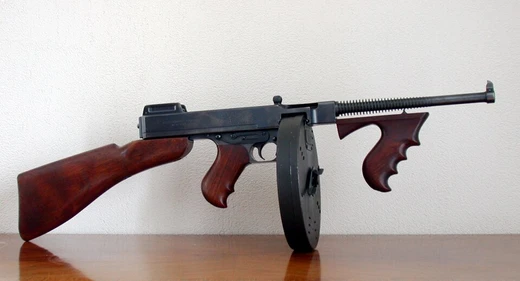
MP 18
German submachine gun introduced in 1918 for trench warfare.

Konrad Krzyżanowski · Public domain
The MP 18, or Maschinen-Pistole 18, was a German submachine gun built by Bergmann Waffenfabrik. It entered service with the German Army in the middle of 1918, during World War I, and was designed for close-quarters trench fighting, giving individual soldiers more firepower than a pistol. Though production stopped after the war, the MP 18 had a major impact on later firearm design, serving as the template for most submachine guns made in the first half of the 20th century.
The concept of the submachine gun emerged in the early 1900s, tied to new tactics of fire and movement and infiltration, especially for clearing enemy trenches where fights happened at very close range. In 1915, the German Rifle Testing Commission in Spandau set out to create a new trench weapon. Attempts to convert existing semi-automatic pistols, like the Luger and C96 Mauser, failed because they were too light and fired too fast—around 1,200 rounds per minute—making accurate automatic fire impossible. The commission decided a completely new design was needed. Hugo Schmeisser, working at Bergmann Waffenfabrik alongside Theodor Bergmann and a few other technicians, helped develop a weapon to meet these requirements. It was called the Maschinenpistole 18/I, with the "I" standing for the number 1. Four versions—models I, II, III, and IV—were tested by the German Army. They shared the same basic design but had different feeding systems. The MP 18/I used the same drum magazine as the artillery Luger. Details on the MP 18/II are unknown, but the MP 18/III and MP 18/IV fed from a straight, 90-degree magazine that took Mauser-style box magazines—the same type used in Mauser’s experimental C06/08 pistol and C17 "Trench Carbine" (possibly a rival to the MP 18/I), and later the SIG Bergmann. Full-scale production began in early 1918.
Whether the MP 18 was the very first submachine gun is debated. Some sources dismiss the earlier Villar Perosa because it was originally used as a mounted light support weapon. In October 1915, Austro-Hungarian Standschützen battalions tested a submachine gun called the Maschinengewehr Hellriegel, chambered in 9x23mm Steyr, used both as a prone support weapon and a hip-fired assault weapon. In late 1916, the Italian Army’s Military Aviation Corps made the first official request for a submachine gun, asking for a single-barreled Villar Perosa with a detachable stock.
Quick Facts
- Origin
- German Empire
- Designer
- Hugo Schmeisser
- Manufacturer
- Bergmann Waffenfabrik / C.G. Haenel (MP 28/II) / Lindelof Konetehdas (Lindelof Submachinegun) / Pieper (Mi 34) / Qingdao Iron Works / SIG (SIG M1920)
- Design Date
- 1917
- Production Date
- 1918–1920s / 1928 – early 1940s (MP 28/II)
- Service
- 1918–1945 (Germany)
- Part Length
- 200 mm
- Cartridge
- 9×19mm Parabellum / 7.63×25mm Mauser (export) / 7.65×21mm Parabellum (export) / 9x23mm Largo (export) (MP 28/II) / 9x25mm Mauser (export) (MP 28/II) / .45 ACP (export) (MP 28/II)
- Action
- Open-bolt blowback
- Rate
- approx. 350–500 rounds/min (MP 18) / 550–600 rounds/min (MP 28/II)
- Velocity
- 380 m/s
- Weight
- 4.18 kg / 4.0 kg (MP 28/II)
Facts from the source article.
Lore & Background
The concept of the submachine gun developed around fire and movement and infiltration tactics for clearing trenches, where engagements were unlikely beyond a few feet. In 1915, the German Rifle Testing Commission at Spandau decided to develop a new weapon for trench warfare. Attempts to modify existing semi-automatic pistols (Luger and C96 Mauser) failed due to their light weight and high rates of fire of 1,200 rounds per minute, making accurate aimed fire in full automatic mode impossible. The commission determined a completely new kind of weapon was needed. Hugo Schmeisser, working for Bergmann Waffenfabrik, was part of a team that designed the Maschinenpistole 18/I. Four versions (I, II, III, IV) were evaluated, sharing the same basic design but differing in feed system. Full-scale production began in early 1918.
The MP 18 is often credited as the very first submachine gun, though some sources discount the Villar Perosa on account that it was originally fielded as a light support weapon on a mount. Whether the MP 18 was actually the first submachine gun is debated. The Austro-Hungarian Maschinengewehr Hellriegel was trialed in October 1915, and the Italian Carabinetta Automatica OVP was adopted in early 1917. The MP 18/I was the first mass-produced submachine gun to see extensive use in an infantry assault role in warfare.
The first recorded unit to receive the MP 18/I was the 237th Infantry Brigade of the 119th Infantry Division, which received 216 guns for field trials in July 1918, after the spring offensive ended. The MP 18/I was used by German troops at the Battle of Amiens. The total number manufactured during the war remains controversial, with estimates ranging from about 35,000 to 50,000, though the number that actually reached the front was probably around 4,000.
Reader's Guide
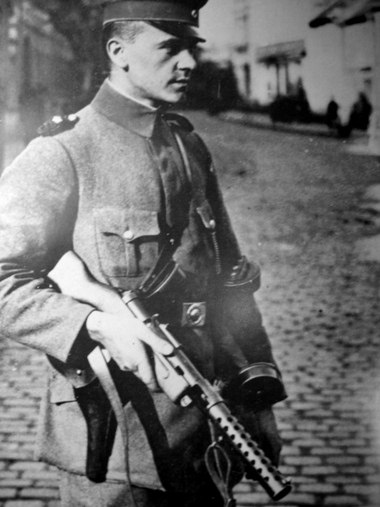
The MP 18 proved to be an excellent weapon, its concept well-proven in trench fighting. The basic design directly influenced later submachine gun designs and showed its superiority over the regular infantry rifle in urban, mobile, and guerrilla warfare. After the armistice, many submachine guns that had not been sent to the front were issued to Freikorps volunteers, who used them to crush the Spartacist uprising. The MP 18/I proved particularly popular among these irregular forces. It was gradually retired from military service and allocated to police forces, particularly the Sicherheitspolizei. The government's implementation of the Treaty of Versailles in 1924 approved distribution of maschinenpistole by the Ordnungspolizei, provided they were not issued at a rate higher than one gun for every twenty men. Many of the approximately 50,000 guns produced fell into the hands of unofficial paramilitaries or criminal elements. In 1922, Foreign Minister Walther Rathenau was assassinated by ultranationalists armed with a stolen MP 18/I. During the failed 1924 Estonian coup d'état attempt, the MP 18 was used to defend the Tallinn barracks from Communist militants, some of whom were armed with Thompson submachine guns, possibly the first engagement where submachine guns were used on both sides. All limited conflicts between 1920 and 1940 saw increasing use of this new class of weapons.
Did You Know?
- The MP 18/I used the same Trommelmagazin drum as the artillery Luger.
- Canadian soldiers of 13th Battalion (Royal Highlanders of Canada) were photographed with a captured MP 18/I on 11 August 1918.
Design Origins in Trench Warfare
The submachine gun as a concept was born from the brutal reality of trench combat, where engagements rarely extended beyond a few feet. In 1915, the German Rifle Testing Commission at Spandau set out to create a dedicated weapon for this close-quarters environment. Their first strategy—modifying existing semi-automatic pistols such as the Luger and the C96 Mauser—proved futile, as these lightweight firearms could not deliver accurate aimed fire at their punishing 1,200 rounds-per-minute rates. The commission concluded that an entirely new category of weapon was required. Hugo Schmeisser, working alongside Theodor Bergmann and a small team of technicians at Bergmann Waffenfabrik, rose to the challenge. Their design, designated the Maschinenpistole 18/I, was one of four variants—models I through IV—evaluated by the German Army. All shared a common underlying architecture but differed in their magazine and feed mechanisms. The /I variant used a drum magazine borrowed from the artillery Luger, while the /III and /IV accepted straight box magazines in the Mauser pattern, the same type later employed in the SIG Bergmann. Full-scale production commenced in early 1918.
The Contested Claim of First
The MP 18 is frequently hailed as the world's first submachine gun, yet this claim remains contested. The Italian Villar Perosa had already been formally requested by the Military Aviation Corps in late 1916 and adopted as the Carabinetta Automatica OVP by early 1917, with 500 units issued to observation crews. Its designer, Colonel Bethel-Abiel Revelli, had articulated the submachine gun concept as early as September 1915, describing a single-barreled shoulder-fired variant of his original weapon. Meanwhile, in October 1915, Austro-Hungarian Standschützen-Battalionen trialed the Maschinengewehr Hellriegel, a 9x23mm Steyr submachine gun tested both as a prone support weapon and a hip-fired assault gun. Some sources dismiss the Villar Perosa from consideration because it was initially deployed as a mounted light support weapon rather than a handheld infantry arm. What the MP 18/I can claim with greater certainty is that it was the first mass-produced submachine gun to see extensive use in an infantry assault role during wartime, distinguishing it from earlier experimental or support-oriented designs.
A Late and Limited Combat Debut
Contrary to widespread assumption, the MP 18 did not feature prominently in the German spring offensive of early 1918, and no solid evidence confirms that stormtroopers employed submachine guns during that campaign. The weapon was primarily fielded in the war's final months. The first documented unit to receive the MP 18/I was the 237th Infantry Brigade of the 119th Infantry Division—comprising the 46th and 58th Infantry Regiments, the 46th Reserve Infantry Regiment, and the 119th Storm Division—which was issued 216 guns for field trials in July 1918, after the spring offensive had concluded. Shortly thereafter, German troops employed the weapon at the Battle of Amiens; Canadian soldiers of the 13th Battalion, Royal Highlanders of Canada, were photographed holding a captured MP 18/I on 11 August. Production figures remain murky: Major-General Ernst von Wrisberg of the Prussian War Ministry cited roughly 17,000 deliveries by October 1918, while a postwar French report claimed 50,000 were manufactured but only 8,000 to 10,000 delivered. Surviving serial numbers extend into the 30,000 range, and one estimate based on extant examples suggests around 35,000 were produced in 1918 and possibly 1919. Most were never accepted into service.
Shaping a Century of Small Arms
Although MP 18 production ceased with the end of the First World War, its influence on firearms design proved profound and enduring. The weapon established the fundamental template for most submachine guns manufactured during the first half of the twentieth century, setting structural and operational precedents that designers would follow for decades. The Treaty of Versailles, in its Tables No. II and No. III, imposed restrictions on German arms including rifles, carbines, heavy and light machine guns, and a common claim holds that the MP 18's demonstrated effectiveness led to its specific prohibition. The vast majority of the roughly 35,000 units produced never reached the front; they sat in factory warehouses until renewed demand emerged in the interwar period. The weapon's provenance also extended beyond Germany: an MP 18/I held in the Sarsılmaz Museum in Düzce, Turkey, is said to trace its origins to the Turkish War of Independence, hinting that some examples were transferred to the Ottoman Empire at the war's close. In every respect, the MP 18's brief wartime service belied its outsized role in defining an entire category of infantry weaponry.
Gallery


Frequently Asked Questions
What is the MP 18?
The MP 18 (Maschinen-Pistole 18) is a German submachine gun manufactured by Bergmann Waffenfabrik that entered military service in mid-1918. It was purpose-built to give individual infantrymen a burst of automatic close-range firepower inside trenches, filling the gap between a pistol and a full rifle.
Who designed the MP 18?
Hugo Schmeisser led the design work at Bergmann Waffenfabrik, collaborating with Theodor Bergmann and a small team of technicians. The project grew out of the early-1900s push to create a compact automatic weapon suited to infiltration and fire-and-movement tactics.
What magazines did the MP 18 use?
The original MP 18/I model fed from a large drum magazine borrowed from the artillery Luger pistol. Later variants, the MP 18/III and MP 18/IV, switched to a 90-degree straight box magazine in the Mauser pattern.
Why is the MP 18 considered important in firearms history?
Although production ceased after World War I, the MP 18 set the basic blueprint—compact, magazine-fed, automatic, pistol-caliber—that nearly every submachine gun of the first half of the twentieth century followed. It is widely regarded as the prototype that defined the entire SMG category.
In what war was the MP 18 first used?
The MP 18 saw its only operational deployment during World War I, entering German Army service in the middle of 1918. It was intended specifically for close-quarters trench fighting, where a soldier could deliver a rapid volume of fire that a standard pistol simply could not match.
More in Submachine Guns, Part 2 1-24
Spotted an error? Know more?
Reader corrections go straight into our review queue. Suggest an edit · How this site is sourced