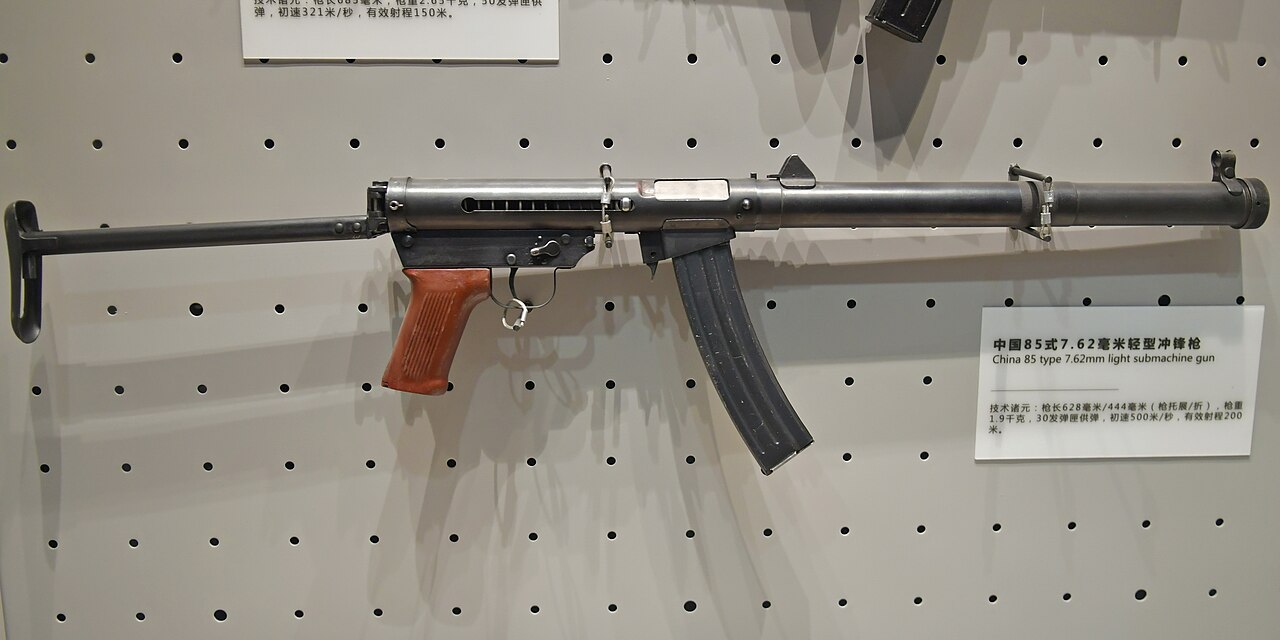
Type 85 submachine gun
Simplistic Chinese open-bolt submachine gun replacing Type 79 and Type 64.

Tyg728 · CC BY-SA 4.0
The Type 85 submachine gun, designated as the 1985 Year Type, was developed in China during the early 1980s. It was intended as a cheaper alternative to the Type 79, and a suppressed variant was also created to take over from the Type 64 in People's Liberation Army service.
Design work began between 1979 and 1983 at the 208th Research Institute of China Ordnance Industry, with the weapon being finalized in 1985. The design was simple and straightforward, prioritizing ease of manufacture. Early prototypes were criticized for their appearance, earning nicknames like "toy gun" and "the master work of plumber" within the Chinese military. The Type 79 had reliability problems, so a replacement plan was started in 1979. Two prototypes were ready for testing by January 1980, and trials in 1981 included combat testing with single and full-auto modes. Initial feedback was positive on handling, but improvements were needed. Multiple state factories competed for the production order in 1983, and the design was finalized around 1984. Early issues included excessive recoil and trigger sensitivity. After these were resolved, the Type 85 was certified by the military in 1985. It gradually replaced the Type 79 and was praised for its reliability and simple maintenance. Like the Type 79, it was later phased out of military service and issued to Chinese police forces. While popular with the military, it was widely disliked by police, mainly because its simple open-bolt design caused poor first-shot accuracy.
The Type 85 is a blowback weapon that fires from an open bolt, with its mechanism partly based on the Type 64. Parts are interchangeable between the standard and suppressed versions, except for the barrels. The safety and fire selector are on the right side of the trigger unit, above the trigger guard, with settings for safe, single shot, and full automatic (marked 0, 1, and 2 on the receiver). It is optimized for special 7.62×25mm Type 64 ammunition with heavy, subsonic bullets, but can also fire standard 7.62mm Type 51 ammunition, though with increased noise. A 5.8mm version was researched but never adopted. It uses the same 30-round box magazines as the Type 64, and has a steel shoulder stock that folds to the right.
Variants include the Type 85 suppressed, which has an integral suppressor and a changed barrel and sleeve.
Quick Facts
- Origin
- China
- Is Ranged
- yes
- Service
- 1985–present
- Design Date
- 1979-1983
- Manufacturer
- China North Industries Corporation
- Weight
- 1.9 kg
- Cartridge
- 7.62×25 mm Tokarev (Type 85)
- Action
- Blowback-operated, open bolt
- Feed
- 30-round box magazine
- Sights
- Rear sight notch
Facts from the source article.
Lore & Background
Design of the Type 85 started between 1979 and 1983, with work done by the 208th Research Institute of China Ordnance Industry. The weapon's design was simplistic and straightforward, emphasizing ease of manufacture. During development, its appearance drew criticism, earning nicknames such as "toy gun" or "the master work of plumber" in the Chinese military. Two prototypes were made for testing in January 1980, and trials in 1981 included combat testing with single and full auto modes. Initial feedback noted good handling but room for improvement; problems included excessive recoil and trigger sensitivity. Multiple state factories competed for the order in 1983, and the design was finalized around 1984. The Type 85 was certified by the military in 1985 and gradually replaced the Type 79 in Chinese military service, receiving positive feedback for high reliability and simplicity in maintenance.
The Type 85 is a simple blowback weapon firing from an open bolt, with its mechanism partially based on the Type 64. Parts for the regular and suppressed versions are interchangeable except for the barrels. The safety and fire mode selector is on the right side of the trigger unit above the trigger guard. It is optimized for special 7.62×25mm Type 64 ammunition with heavy subsonic bullets but can also fire standard 7.62mm Type 51 ammunition. A 5.8mm version was researched but never adopted. The weapon uses the same 30-round box magazines as the Type 64. The suppressed variant features an integral suppressor with a changed barrel and sleeve.
The Type 85 was eventually phased out of military service and issued to Chinese police forces. While popular in the military, it was widely detested in the police force, largely due to its overly simplified open-bolt design, which contributed to poor first-shot accuracy.
Reader's Guide
The Type 85 submachine gun represents a deliberate shift toward simplified, cost-effective production in Chinese small arms development during the early 1980s. Its design was driven by the need to replace the Type 79, which had reliability issues, and the Type 64 silenced submachine gun. The Type 85 achieved its goals of high reliability and easy maintenance, earning positive feedback from the People's Liberation Army. However, its open-bolt blowback action, while simple and robust, introduced a significant drawback in first-shot accuracy, which became a major point of criticism when the weapon was later transferred to police forces. This contrast in reception—popular with soldiers but detested by police—highlights the different operational requirements between military and law enforcement users. The Type 85 also saw use beyond China, including with special forces and armed police in China, and with military forces in Comoros and Tanzania during the 2008 invasion of Anjouan. It was also used by law enforcement in Bangladesh, notably the Rapid Action Battalion, and by non-state actors such as the Liberation Tigers of Tamil Eelam, whose Black Tigers commandos employed suppressed Type 85s during the attack on Anuradhapura Air Force Base. The weapon's legacy is that of a functional, no-frills design that fulfilled its intended military role but struggled to adapt to the precision demands of police work.
Did You Know?
- The suppressed version of the Type 85 was developed to replace the Type 64 submachine gun in PLA service.
- The Type 85's open-bolt design caused poor first-shot accuracy, making it widely detested in Chinese police forces.
- Suppressed Type 85s were used by LTTE Black Tigers commandos during the attack on Anuradhapura Air Force Base.
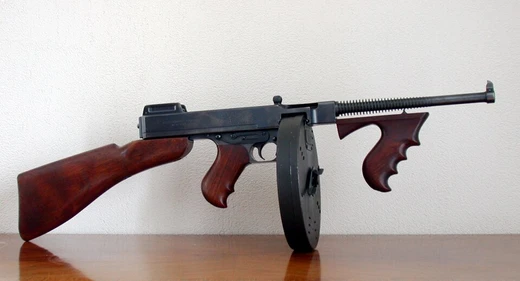
From Trench Broom to Submachine Gun: The Birth of a Concept
Brigadier General John T. Thompson, a career ordnance officer in the U.S. Army, envisioned a hand-held automatic weapon to break the stalemate of World War I trench warfare. His original ambition was broader—a fully automatic rifle to replace bolt-action service guns like the M1903 Springfield. While seeking a workable operating mechanism, he found a 1915 patent by John Bell Blish describing how inclined metal surfaces adhere under pressure. Backed by businessman Thomas F. Ryan, Thompson founded the Auto-Ordnance Company in 1916 and established development in Cleveland, Ohio, where Theodore H. Eickhoff, Oscar V. Payne, and George E. Goll served as principal designers. By late 1917 the Blish lock's limits became clear—it was just extreme static friction—so the team redesigned the action as a friction-delayed blowback system. The .45 ACP proved the only service cartridge compatible with the new lock, and Payne shaped the receiver alongside stick and drum magazine options. The project, called "Annihilator I," had most design problems solved by 1918, but the armistice fell two days before prototypes could ship to Europe. At a 1919 board meeting the weapon was renamed the "Thompson Submachine Gun," making it the first firearm ever marketed under that label.
From West Virginia Coalfields to Irish Barricades
The Thompson's first combat appearance came not on a European front but on a West Virginia mountainside. On June 13, 1921, state troopers opened fire near Lick Creek at striking miners who had been shooting at passing vehicles. By the time the larger Battle of Blair Mountain unfolded, thirty-seven Thompsons sat in state police hands and fifty-six more were held by coal companies and local law enforcement, with additional units trickling into regional hardware stores. The weapon's early international footprint was equally diverse. Agents of the Irish Republican Army, including gunman Harry Boland, purchased some of the first production batches. Tom Barry of the West Cork Brigade conducted the first Irish test firing in the presence of IRA leader Michael Collins. Of the 653 units the IRA acquired, U.S. customs officials in New York seized 495 in June 1921; the remainder reached Ireland via Liverpool and saw action in the final month of the Irish War of Independence. After the British-imposed ceasefire of July 1921, additional Thompsons were imported and employed during the Irish Civil War, though the gun proved only moderately effective, producing serious casualties in roughly a third of the incidents in which it was deployed. In the failed 1924 Estonian coup, communist insurgents armed with Thompsons clashed with defenders wielding German MP 18s—possibly the first engagement in which submachine guns faced each other on opposing sides.
The Tommy Gun and the Age of Prohibition
The Thompson was sold openly to the general public, and its $200 price tag in 1921—roughly equivalent to $3,610 in 2025 dollars—meant early civilian sales were sluggish. Yet the weapon's very visibility made it irresistible to those who could afford it. During the Prohibition era of the 1920s, the Thompson became the signature sidearm of organized crime syndicates across the United States, and its silhouette became a fixture of the era's media coverage. It was a common sight in both criminal and law-enforcement hands, a symbol of the gunfights that defined the decade. Early user complaints centered on the weapon's cumbersome weight, its inaccuracy beyond fifty yards, and the limited penetrating power of the .45 ACP cartridge, but none of these drawbacks diminished its cultural cachet. The Federal Bureau of Investigation, which had previously operated as an entirely unarmed agency, adopted Thompsons in its ranks following the 1933 Kansas City massacre, marking a turning point in federal law-enforcement capability. The U.S. Marine Corps employed the weapon during the Banana Wars, the Postal Inspection Service incorporated it into its operations, and the Republic of China also fielded Thompsons, underscoring how quickly the gun permeated every level of armed conflict and public order in the interwar years.
Millions of Guns and a Lasting Label
When World War II erupted, the Thompson transitioned from a niche interwar weapon to a mass-produced military staple. The U.S. armed forces adopted it in large numbers, and Allied troops across multiple theaters used it extensively. Three principal designations defined the wartime service life: the M1928A1, the M1, and the M1A1. Production during the war exceeded 1.5 million units, a figure that cemented the Thompson's place as one of the most numerous small arms of the conflict. Beyond sheer volume, the Thompson carries a unique distinction in firearms nomenclature: it was the first weapon ever labeled and marketed specifically as a "submachine gun," a term that had not previously been applied to any firearm. The German Bergmann MP 18, which German Sturmtruppen had employed in 1918, was technically the world's first submachine gun in practice, but it was Thompson's 1919 renaming at the Auto-Ordnance board that gave the category its official name. Today, the original selective-fire military variants are no longer manufactured, though Auto-Ordnance continues to produce semi-automatic civilian models that retain the Thompson's recognizable silhouette while incorporating modifications to comply with current U.S. firearm regulations.
Gallery
Frequently Asked Questions
What is the Type 85 submachine gun?
The Type 85 is a Chinese open-bolt submachine gun completed in 1985 by the 208th Research Institute of China Ordnance Industry. It was conceived as a low-cost, easily manufactured weapon meant to supplant both the Type 79 and the Type 64 in PLA service.
What ammunition does the Type 85 submachine gun use?
It chambered 7.62×25mm rounds—the same cartridge as the Type 64—fed from a 30-round box magazine. This shared ammunition pool meant the Type 85 could draw directly on existing Type 64 stockpiles.
How does the Type 85 submachine gun's action work?
The weapon runs on a straightforward blowback mechanism with the bolt resting open at rest. A three-position selector (marked 0, 1, 2) lets the shooter choose between safe, single-shot, and fully automatic fire.
Why was the Type 85 submachine gun developed?
Chinese designers in the early 1980s wanted a cheaper, simpler replacement for the Type 79, and a suppressed variant was also produced to assume the Type 64's role in the People's Liberation Army. The design philosophy deliberately favored manufacturing simplicity over looks, which earned early prototypes mocking nicknames such as "toy gun."
What is the stock design on the Type 85 submachine gun?
It carries a steel shoulder stock that folds to the right side of the receiver. The overall build was intentionally crude and utilitarian, reflecting the 208th Institute's priority of keeping production costs and complexity as low as possible.
More in Submachine Guns, Part 2 1-24
Spotted an error? Know more?
Reader corrections go straight into our review queue. Suggest an edit · How this site is sourced