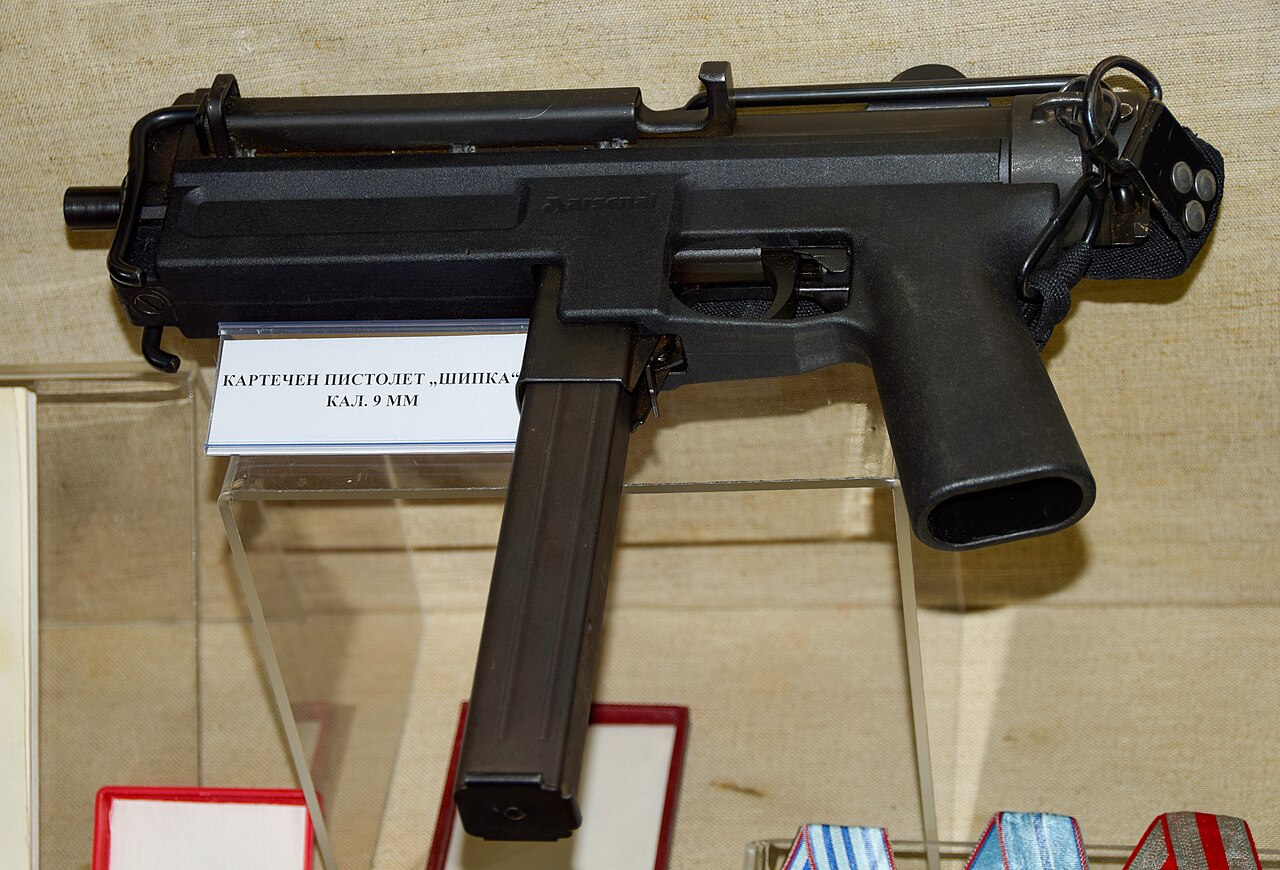
Arsenal Shipka
Bulgarian open-bolt submachine gun for police and military.

Photographer: Mosbatho · CC BY 4.0
The Arsenal Shipka is a Bulgarian submachine gun that entered production in 1996. Chambered in 9mm, it was built by the company Arsenal for use by the country’s police and military. Its name comes from the Shipka Pass, a location near Arsenal’s headquarters in Kazanlak. There, during the Russo-Turkish War of 1877, Bulgarian volunteers and Russian forces defeated the Ottoman Empire, leading to Bulgaria’s liberation.
The weapon was designed to be compact, intended for drivers, pilots, special operations troops, and others who needed more range and a higher rate of fire than a standard handgun could offer. Early prototypes and pre-production models used 9×25mm Mauser ammunition and a 30-round box magazine. Production versions switched to 9×18mm Makarov with a 32-round magazine. After Bulgaria joined NATO, a variant in 9×19mm Parabellum appeared, using a 25-round magazine. The Shipka operates on a simple blowback system and fires from an open bolt. Its lower receiver, pistol grip, and trigger guard are made from polymer, while the upper receiver is steel. The wire buttstock folds to the left side of the gun.
Quick Facts
- Is Ranged
- yes
- Origin
- Bulgaria
- Production Date
- 1996
- Service
- 1999–present
- Caliber
- 9 mm
- Part Length
- 150 mm
- Cartridge
- 9×18mm Makarov / 9×19mm Parabellum
- Feed
- Detachable box magazine: / 32 rounds (9×18mm) / 25 rounds (9×19mm)
- Action
- blowback
- Rate
- 600–650 rpm (9×18mm) · 700 rpm (9×19mm)
- Velocity
- 320 m/s (9×18mm) · 360 m/s (9×19mm)
- Weight
- 2 to 2.2 kg without magazine
Facts from the source article.
Lore & Background
The Shipka is a compact weapon originally intended for use by drivers, pilots, special operations forces, and other military personnel who might benefit from a close-quarter weapon with greater range and fire rate than a typical sidearm. The prototype and pre-production versions were chambered in 9×25mm Mauser and used a 30-round box magazine. Production versions shifted to 9×18mm Makarov with a 32-round magazine. After Bulgaria's entry into NATO, a version chambered in 9×19mm Parabellum with a 25-round magazine was introduced.
The design is a straightforward blowback operation firing from an open bolt. The lower receiver along with the pistol grip and trigger guard is made from polymer, while the upper receiver is made from steel. The simple buttstock is made from steel wire and folds to the left side of the gun.
Reader's Guide
The Shipka represents a specific moment in Bulgarian small arms development, bridging Cold War-era chamberings with NATO standardization. Its production in 1996 by Arsenal, a major Bulgarian arms manufacturer, reflects the country's post-communist military modernization. The weapon's design—blowback, open bolt, polymer lower receiver, steel upper, and folding wire stock—is conventional for submachine guns of its era. The shift from 9×25mm Mauser in prototypes to 9×18mm Makarov in production, and later to 9×19mm Parabellum after NATO entry, illustrates adaptation to changing ammunition standards. The Shipka was developed specifically for Bulgarian police and military, with an emphasis on compactness for vehicle crews, pilots, and special operations forces. Its legacy is tied to its role as a domestically produced submachine gun for Bulgarian forces, rather than widespread international adoption. The name commemorates the Shipka Pass battle of 1877, linking the weapon to Bulgarian national history.
Did You Know?
- The Shipka is named after the Shipka Pass, site of a 1877 battle in the Russo-Turkish War.
- Prototype versions were chambered in 9×25mm Mauser with a 30-round magazine.
- After Bulgaria joined NATO, a 9×19mm Parabellum version with a 25-round magazine was introduced.
From Ruse to Kazanlak: A Century of Relocation and Growth
The story of what is now JSC Arsenal AD begins in 1878, when the Ruse Artillery Arsenal became the first armory established on Bulgarian soil. Strategic vulnerabilities prompted a move to Sofia in 1891, but the decisive relocation came in 1924, after Bulgaria's defeats in the Second Balkan War and World War I. The entire operation—workforce, machinery, and inventory—was transplanted to the central town of Kazanlak, where it was rechristened the Darzhavna voenna fabrika, or State Military Factory. In those early decades, output was limited to artillery components and ammunition. Over successive decades the product line broadened steadily: gas masks appeared in the 1920s, nitroglycerin production followed in the 1930s, machine tools in the 1940s, and by the 1950s the factory was turning out assault rifles, optic sights, and B-10 recoilless rifles. The milestone year was 1958, when a direct copy of the Soviet AK-47 rolled off the line. By the 1960s the enterprise had grown to encompass seven separate factories under a single corporate umbrella, cementing its position as Bulgaria's oldest and most significant arms supplier.
The Friedrich Engels Disguise: Concealment in the Cold War Era
Throughout the communist period, the enterprise operated under a deliberately misleading identity. Until the political upheaval of 1989-1990, it carried the name Mashinostroitelen kombinat Fridrih Engels—the Friedrich Engels Machinery Works—a label chosen specifically to mask the reality that it was, in essence, a military weapons plant. This cover was not merely nominal; the factory genuinely diversified into civilian production to reinforce the disguise. Among the non-military goods it manufactured were automobiles, most notably the Bulgarrenault-8, a model that enjoyed considerable popularity on Bulgarian roads. The strategy of dual-use manufacturing allowed the enterprise to blend into the broader industrial landscape while quietly maintaining and expanding its core arms capabilities. The curtain began to lift in the late 1980s and early 1990s, when the company opened channels of technical cooperation with partners in Japan, Sweden, Ukraine, and Germany. These international collaborations marked the first sustained engagement with Western and non-Soviet manufacturing expertise, setting the stage for the post-communist transformation that would reshape the company's identity and market reach.
A Comprehensive Arsenal: The Modern Weapons Portfolio
Today's production catalogue spans nearly every category of small arms and light weapons. Handguns include the Arsenal Compact and the Makarov pistol, while the Shipka submachine gun is offered in both 9×18 mm Makarov and 9×19 mm Parabellum calibres. The light-machine-gun line provides RPK variants in 7.62×39 mm, 5.45×39 mm, and 5.56×45 mm NATO. General-purpose machine guns comprise a licensed PK in 7.62×54 mmR and a NATO-adapted PK modification in 7.62×51 mm, with tripod options. The grenade-launcher range is especially diverse: the Lavina 40 mm revolver-type launcher, the multi-shot Arsenal MSGL, underbarrel UBGL attachments for AK-series rifles, the M4 carbine, and the M16, plus anti-tank options like the ATGL-L and ATGL-H. Mortars span 60, 81, and 82 mm calibres, and the air-defence line features a ZU-23-2 variant with advanced optics and a computerised fire-control system. Bolt-action BARR hunting rifles, semi-automatic SAR rifles, and HE-FRAG or flash-bang grenades complete the small-arms shelf, while the munitions division produces rounds across every major small-arms, artillery, and anti-tank calibre.
Beyond the Firing Line: Civilian Industry and Global Reach
Since the fall of communism, JSC Arsenal AD has reinvented itself as a private joint-stock company headquartered in Kazanlak, with 10,500 employees making it the largest non-state employer in Bulgaria. While international arms trade remains a core business, the company has aggressively broadened its civilian portfolio. It now exports high-precision metalworking machinery, mobile robot manipulators, and synthetic diamonds—products that bear little resemblance to the gas masks and nitroglycerin of the 1920s and 1930s. The manufacturing division also produces CNC equipment, cemented carbide inserts, tips, and special tools for industrial use. Even the company's legacy in propellants has found a civilian market: hunting powders branded Sokol, Mars, and Magia are sold to sportsmen, while nitrocellulose is supplied for lacquer production and, in a more traditional application, dynamite manufacturing. This dual identity—defence contractor and precision-industry supplier—reflects a deliberate strategy to diversify revenue streams and maintain relevance in a global marketplace that increasingly values both military capability and advanced manufacturing expertise.
Gallery
Frequently Asked Questions
What is the Arsenal Shipka?
The Arsenal Shipka is a compact, open-bolt submachine gun developed in Bulgaria and put into production in 1996. It was manufactured by the state arms company Arsenal to serve both police units and military personnel.
What calibers does the Arsenal Shipka come in?
The standard production model fires the 9×18 mm Makarov round from a 32-round magazine, while a NATO variant accepts 9×19 mm Parabellum with a 25-round magazine. A pre-production prototype chambered in 9×25 mm Mauser with a 30-round magazine also existed.
Why is the gun called 'Shipka'?
The name references the Shipka Pass, a mountain pass located near Arsenal's headquarters in Kazanlak. During the 1877 Russo-Turkish War, Bulgarian volunteers and Russian troops fought a decisive victory against Ottoman forces there, an event tied to Bulgaria's eventual liberation.
Who was the Arsenal Shipka designed for?
It was built as a compact sidearm for personnel who needed more range and a faster cyclic rate than a pistol could offer, such as vehicle drivers, aircraft pilots, and special-operations troops. Its blowback, open-bolt action keeps the design simple and reliable in those roles.
What country and company are behind the Arsenal Shipka?
The weapon is of Bulgarian origin, produced by the arms manufacturer Arsenal. It entered service in 1996 as a domestic solution for the country's police and military forces.
More in Submachine Guns, Part 2 1-24
Spotted an error? Know more?
Reader corrections go straight into our review queue. Suggest an edit · How this site is sourced