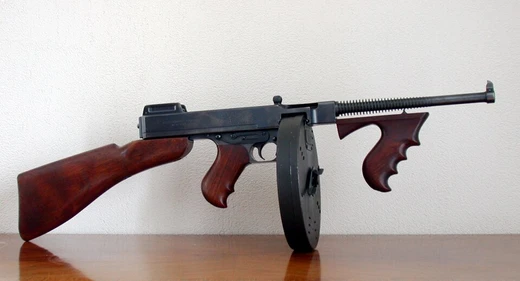
Type 100 submachine gun
Japan's only mass-produced submachine gun of World War II.

War department · Public domain
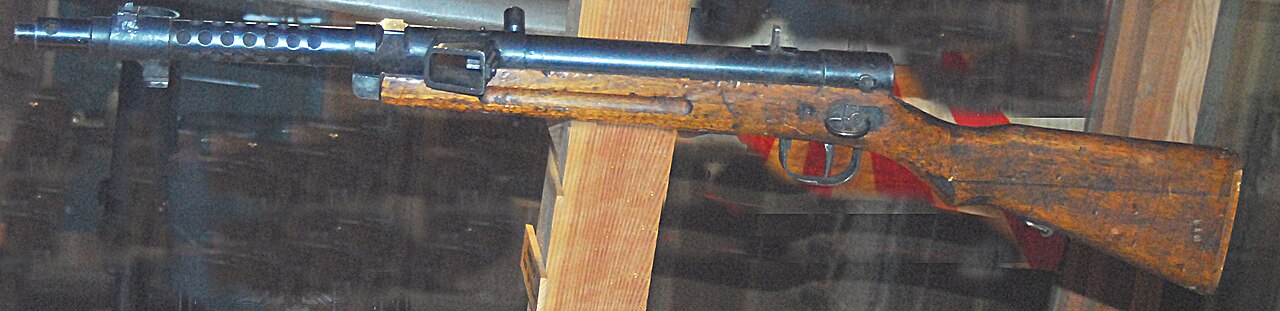
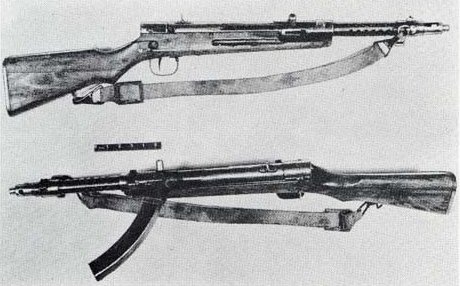
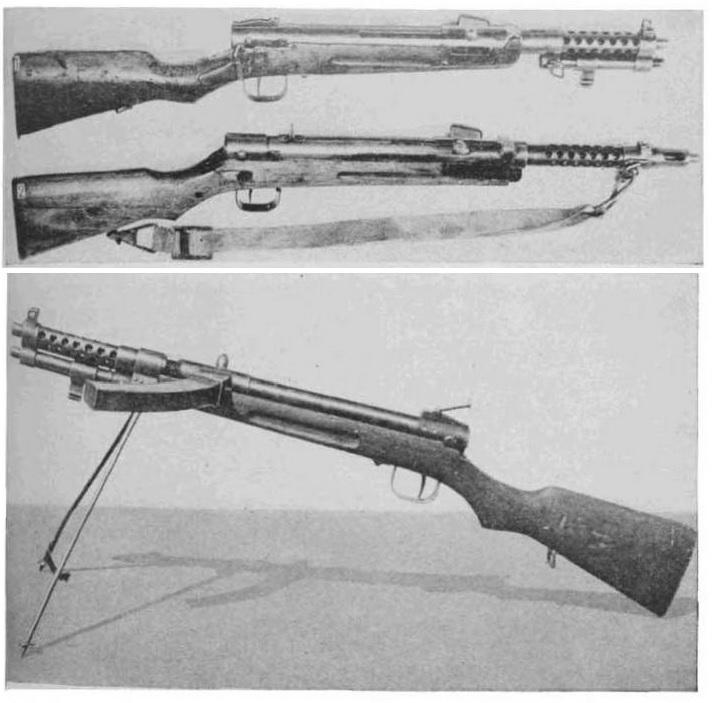
The Type 100 submachine gun, designated 一〇〇式機関短銃 (Hyaku-shiki kikan-tanjū), was Japan’s only mass-produced submachine gun during World War II. It appeared in two main versions, which Allied observers labeled the Type 100/40 and the Type 100/44, with the latter also called the Type 100 (simplified). A small number of early models were modified with a folding stock, sometimes known to the Allies as the Type 100 navy, intended for parachutists.
Japan lagged behind in adopting submachine guns for its military. Though roughly 6,000 SIG Bergmann 1920s (a licensed MP 18) and a few Solothurn S1-100s were bought from Switzerland and Austria in the 1920s and 1930s—and used during the 1937 invasion of China—domestic mass production did not start until 1944. In the meantime, Imperial Japan ordered 350 MAB 38/43 submachine guns from Italy, delivered in 1943.
While these European imports saw use, Japanese development of submachine guns stalled. After earlier prototypes from the Nambu Arms Manufacturing Company—the Experimental Model 1 and Model 2—failed to meet standards, the Army issued new requirements in August 1937. The simpler design that followed drew on the imported “Bergmann type” submachine guns, which Japanese marines had used effectively in both Battles of Shanghai. This led to the Experimental Model 3 in 1938. The first version, Model 3A, was followed by Model 3B in April 1939. Testing results were generally positive, and a batch of 200 weapons was recommended for military trials with infantry, cavalry, and reserve units. Further demands called for better accuracy and a way to mount the standard Type 30 bayonet. Some cavalry units received weapons fitted with a bipod and a sight graduated to 1,500 meters to test them against the bulky Type 11 light machine gun.
In November 1939, the Type 3C appeared, featuring a double-slot muzzle brake. After nearly completing its testing cycle, the Imperial Japanese Army adopted it in summer 1940 as the Type 100 submachine gun (the “Type 100/40” in Western sources). Yet no major order followed, because the Army’s interest had shifted to the new 7.7 mm Type 99 light machine gun. Japanese tactics saw little need for a submachine gun. Under a low-priority contract, the Type 100 began deployment in August 1942, with fewer than 1,000 units produced.
Quick Facts
- Is Ranged
- yes
- Origin
- Empire of Japan
- Designer
- Kijiro Nambu
- Design Date
- 1939
- Manufacturer
- Nagoya Arsenal
- Production Date
- 1942–1945
- Service
- 1942–1954
- Used By
- Imperial Japanese Army / Imperial Japanese Navy
- Wars
- World War II
- Caliber
- 8mm
- Part Length
- 228 mm (1942) / 230 mm (1944)
- Cartridge
- 8×22mm Nambu
Facts from the source article.
Lore & Background
Japan was late in introducing the submachine gun to its armed forces. Although around 6,000 models of the SIG Bergmann 1920 and a few Solothurn S1-100s were purchased from Switzerland and Austria in the 1920s and 1930s, and were used in the invasion of China in 1937, mass production of a native submachine gun did not begin until 1944. In the interim, Imperial Japan ordered 350 MAB 38/43 submachine guns from their Italian allies, delivered in 1943. After earlier prototypes (Experimental Model 1 and Experimental Model 2) proved inadequate, new requirements were formulated in August 1937 by the Army. The new simpler design was based on the imported European 'Bergmann type' submachine guns used effectively in both Battles of Shanghai by Japanese marines. This led to the Experimental Model 3 in 1938, with the Model 3B introduced in April 1939. After further refinements, the Type 3C appeared in November 1939, and the weapon was adopted in the summer of 1940 as the Type 100. However, no major order was made; interest had turned to the Type 99 light machine gun. Under a low-priority contract, the Type 100 began deployment in August 1942, with numbers not exceeding 1,000 units, of which around 200 were converted to folding stock models for paratroopers. The paratrooper version was referred to by the Allies as the 'Type 100 navy'.
Reader's Guide
The Type 100 submachine gun represents Japan's belated and limited entry into submachine gun production during World War II. Its development was slow, hampered by a lack of tactical doctrine for such weapons and a preference for light machine guns. The early Type 100/40 saw only small-scale deployment, with some units sent to the Solomon Islands in late 1942 for trials; many shipments were sunk. The later Type 100/44, produced from May 1944, was a simplified, cost-reduced design with roughly finished stocks and welded metal. Approximately 7,500 late models were made, with total production estimated at about 10,000. These later weapons were used by special units of the Imperial Army, including paratrooper raiding units in the Philippines campaign and the Battle of Okinawa, notably by Giretsu Kuteitai airlifted special forces. After the war, a limited number were supplied by the American administration to arm the Japanese police. The Type 100 remains notable as the only submachine gun Japan produced in any quantity, though its impact on the war was minimal due to late introduction and limited numbers.
Did You Know?
- The Type 100 was the only submachine gun produced by Japan in any quantity during World War II.
- A small number of early Type 100s were converted to a folding-stock paratrooper version, called the 'Type 100 navy' by the Allies.
- The later Type 100/44 model had a simplified muzzle brake consisting of two ports drilled in the barrel.
- Total production of the Type 100 is estimated at about 10,000, with nearly 9,000 being the later 1944 model.
Engineering Origins and the Blish Lock
Brigadier General John T. Thompson, a career ordnance officer, conceived the weapon as a fully automatic rifle meant to supplant the bolt-action M1903 Springfield. While searching for a reliable operating mechanism, he encountered a 1915 patent by John Bell Blish describing the adhesion of inclined metal surfaces under pressure. With backing from businessman Thomas F. Ryan, Thompson founded the Auto-Ordnance Company in 1916 to develop his "auto rifle." Work proceeded in Cleveland, Ohio, led by designers Theodore H. Eickhoff, Oscar V. Payne, and George E. Goll. By late 1917, the team realized the Blish lock was essentially an extreme case of static friction, and the design was reworked into a friction-delayed blowback system. The .45 ACP proved to be the only in-service cartridge compatible with the new mechanism. Payne crafted the receiver along with stick and drum magazine feeds under the internal project title "Annihilator I." Most engineering problems were resolved by 1918, yet the armistice arrived just two days before prototypes could ship to Europe. At a 1919 company meeting, the weapon was officially rechristened the Thompson Submachine Gun, making it the first firearm ever branded and sold under that specific category.
Early Combat and International Service
The Model of 1921 marked the Thompson's first production run, though its $200 price tag—roughly $3,610 in 2025 dollars—kept civilian sales sluggish. Early users cited the weapon's cumbersome weight, poor accuracy beyond fifty yards, and the limited penetrating power of the .45 ACP round. The gun's first recorded combat use came on 13 June 1921, when West Virginia state troopers fired on a mountainside near Lick Creek where striking miners were shooting at passing vehicles. By the Battle of Blair Mountain, thirty-seven Thompsons were in state police hands and fifty-six with coal companies and local law enforcement. Simultaneously, IRA agents including gunman Harry Boland purchased some of the earliest batches. Unit commander Tom Barry conducted the first Irish test-fire before IRA leader Michael Collins. The group acquired 653 units, but US customs seized 495 in New York that June; the remainder reached the IRA via Liverpool and saw action in the final month of the Irish War of Independence. After the July 1921 ceasefire, more guns were imported for the Irish Civil War, though the Thompson proved only moderately effective, causing serious casualties in 32 percent of engagements. In the 1924 Estonian coup, Communists deployed Thompsons against defenders armed with MP 18s—possibly the first battle featuring submachine guns on both sides.
Prohibition Era and Criminal Notoriety
Because the Thompson was available to the general public, it quickly became entangled with the criminal underworld of 1920s America. During the Prohibition era, the weapon became the signature arm of organized crime syndicates across the United States, and its distinctive silhouette was a common sight in the media of the period. The Thompson was wielded by both law enforcement officers and criminals, making it a defining symbol of the violent clash between order and outlawry that characterized the decade. The United States Marine Corps employed Thompsons during the Banana Wars, and the US Postal Inspection Service also adopted the weapon for its operations. Perhaps most significantly, the FBI—previously an entirely unarmed agency—decided to arm its agents following the 1933 Kansas City massacre, a violent confrontation that highlighted the gap between the firepower criminals could bring and the tools available to those who pursued them. The Thompson's dual identity as both a tool of state authority and a favorite of gangsters cemented its place in American cultural memory as the defining weapon of the Prohibition and Great Depression years.
WWII Mass Production and Lasting Legacy
The Thompson's true coming-of-age arrived during World War II, when it was widely adopted by the United States armed forces and used extensively by other Allied troops. Three principal variants served during the conflict: the M1928A1, the M1, and the M1A1. Production scaled to an extraordinary degree, with more than 1.5 million Thompson submachine guns manufactured over the course of the war. After the conflict, the original selective-fire Thompson variants ceased production. However, the weapon's lineage endures through Auto-Ordnance, the very company Thompson founded in 1916, which continues to manufacture semi-automatic civilian versions. These modern models retain the recognizable silhouette of their wartime predecessors while incorporating various modifications to comply with current US firearm regulations. The Thompson's legacy is further cemented by its unique distinction: it was the first weapon in history to be labeled and marketed specifically as a "submachine gun," a category designation it was the first to claim for the firearms industry.
Gallery
Frequently Asked Questions
What is the Type 100 submachine gun?
It is Japan's sole mass-produced submachine gun of World War II, formally designated the Hyaku-shiki kikan-tanjū. The weapon fires 8 mm ammunition and was developed to close a gap that had left Japanese forces largely without a dedicated close-quarters firearm.
What variants of the Type 100 submachine gun exist?
Allied observers distinguished two main models: the Type 100/40 (early) and the Type 100/44 (late, also called the 'simplified' version). A small batch of early guns received a folding stock for paratrooper use and was informally labeled the Type 100 navy.
How many Type 100 submachine guns were produced?
Roughly 10,000 units were manufactured in total, with nearly 9,000 of those being the later Type 100/44 model. The late variant rolled off Nagoya Arsenal's Toriimatsu Factory lines at about 1,000 per month from May 1944 through the war's end.
Why is the Type 100 submachine gun historically significant?
It represents the only instance in which Japan fielded a domestically produced submachine gun in meaningful numbers during the war. Its late adoption and limited output underscore how far behind Western nations the Japanese military was in embracing the SMG concept.
Who manufactured the Type 100 submachine gun?
The early Type 100/40 was built in small quantities by Chuo Kogyo Company, while the much larger run of Type 100/44 models came from the Toriimatsu Factory at Nagoya Arsenal. Japan was the sole recorded user of the weapon.
More in Submachine Guns, Part 2 1-24
Spotted an error? Know more?
Reader corrections go straight into our review queue. Suggest an edit · How this site is sourced