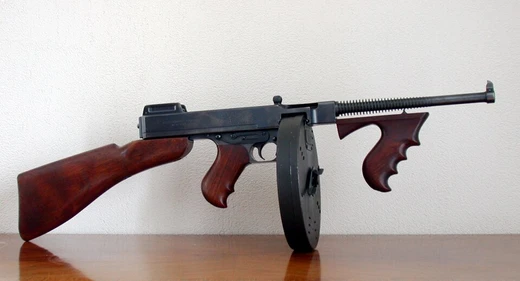
SIG MKMO
A Swiss delayed-blowback SMG with folding magazine well.

The SIG MKMO is a submachine gun produced by Schweizerische Industrie Gesellschaft (SIG) in Neuhausen from 1933 to 1937. Designed for military use, it featured a larger-capacity magazine and a longer barrel to increase firepower. Only 1,228 of these guns were produced, and it saw limited adoption by Swiss police departments and the Swiss Guard at the Vatican.
Quick Facts
- Is Ranged
- yes
- Origin
- Switzerland
- Design Date
- 1930
- Designer
- Gotthard End
- Manufacturer
- Schweizerische Industrie-Gesellschaft (SIG)
- Production Date
- 1933–1941
- Used By
- Switzerland / Finland / Pontifical Swiss Guard / Mengjiang
- Wars
- World War II
- Spec Label
- SIG MKMO
- Part Length
- 500 mm / 300 mm (MKPS)
- Cartridge
- 9×25mm Mauser, 7.63×25mm Mauser, 7.65×21mm Parabellum, 9×19mm Parabellum
- Feed
- 40-round detachable box magazine / 30-round detachable (MKPS)
Facts from the source article.
Lore & Background
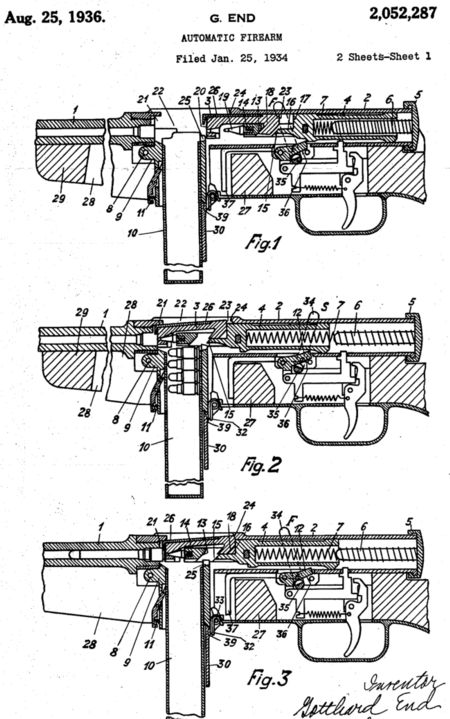
The SIG MKMO used a hesitation-locked operating system adapted by Gotthard End from a John Pedersen design first used in the Remington Model 51 pistol. This system kept the cartridge within the chamber long enough for barrel pressure to drop to a safe level. The locked-breech blowback system mirrored that of the Remington Model 51, with a locking recess above the bolt. When fired, the breech block and bolt carrier moved rearward together; the breech block stopped at a locking shoulder, locking the breech while the bolt carrier continued rearward, allowing chamber pressure to drop. The continuing motion of the bolt carrier then camed the breech block from its locking recess to complete the cycle.
The MKMO was the first personal weapon to have a folding magazine well, allowing the magazine and well to pivot horizontally and store within the wooden fore-stock for easier transport. A simple catch system released the magazine for quick deployment. There was no fire selector switch; single or automatic fire was gauged by trigger pull force: a short pull for single shot, a long pull for automatic. It also had an integral dust cover on the magazine housing. Sights were fully manually adjustable from 100m to an optimistic 1000m, which caused confusion and accuracy issues for young soldiers.
Two variants existed: the MKPO with a shortened 300 mm barrel for police use, still using the hesitation-locked action. In 1937, SIG introduced the simplified MKMS and MKPS (side ejection) versions that operated on straight blowback from an open bolt. All models were priced high and sales slow; production stopped in 1941.
Reader's Guide
The SIG MKMO represents an early attempt to combine delayed-blowback operation with a compact, portable submachine gun. Its hesitation-locked system, derived from John Pedersen's pistol design, was innovative for a personal weapon of the era, aiming to reduce recoil and improve safety by delaying breech opening until chamber pressure dropped. The folding magazine well was a notable ergonomic feature, simplifying carry and storage. However, the MKMO's high cost and limited production—only 1,228 units—restricted its adoption. It saw use primarily by Swiss police and the Pontifical Swiss Guard, with a small number of MKMS variants sold to Finland for home guard, supply, and coastal defense during the Continuation War. The confusing adjustable sights and lack of a fire selector (relying on trigger pull depth) were practical drawbacks. The MKMO's legacy lies in its technical curiosity: a rare, well-made Swiss SMG that influenced later SIG designs but never achieved widespread military service.
Did You Know?
- The MKMO was the first personal weapon with a folding magazine well that stored horizontally in the fore-stock.
- Only 1,228 MKMO guns were produced between 1933 and 1937.
- The MKMO had no fire selector; single or automatic fire was determined by trigger pull depth.
- Finland purchased 282 MKMS variants, which arrived too late for the Winter War but were used in the Continuation War.
Design & Mechanical Innovation
The SIG MKMO's operating system was its defining engineering feature. Based on a hesitation-lock concept originally developed by John Pedersen for the Remington Model 51 pistol, Gotthard End adapted this principle for a submachine gun. The system worked by allowing the breech block and bolt carrier to move rearward together initially, then the breech block would strike a locking shoulder and stop while the bolt carrier continued its rearward travel. This brief delay gave chamber pressure time to drop to safe levels before the breech unlocked. The MKMO was also the first personal weapon to feature a folding magazine well, allowing the magazine and its housing to pivot horizontally and tuck into the wooden fore-stock for easier transport. A simple catch released the magazine for quick deployment. Notably, there was no fire selector switch; instead, the trigger used a force-based system where a short pull produced a single shot and a longer pull engaged automatic fire. The magazine housing also included an integral dust cover, another early innovation.
Operational History & International Users
Despite its innovative design, the MKMO family saw surprisingly limited military adoption. Swiss police departments were the primary domestic users, and the Pontifical Swiss Guard at the Vatican also fielded the weapon. In 1940, sixty MKPS units bearing serial numbers 3321 through 3380, chambered in 7.65mm Parabellum, were delivered to the Swiss Army. Finland purchased 282 MKMS variants in both 9x19 and 7.65 Parabellum during the Winter War, but the weapons arrived too late for that conflict. Instead, they saw service with Finnish home guard units, supply troops, and coastal defense forces during the Continuation War. The weapon also appeared in Mengjiang, and at least one or a few MKMS units were likely sent to the Kingdom of Hungary around 1938 for trials. Perhaps most strikingly, photographs from the 1948 Costa Rican civil war and its aftermath show MKPS submachine guns in use, a remarkable geographic distance from the Swiss workshop where they were built.
Variants, Production & the End of the Line
The MKMO name itself was an acronym: Maschinen (machine), Karabiner (carbine), Militär (military), and Oben (top ejection). SIG produced the weapon in Neuhausen from 1933 to 1937, with only 1,228 units manufactured across all variants. The original MKMO featured a longer barrel and larger-capacity magazine to boost firepower for military use. The MKPO, with a shortened 300 mm barrel, was the police variant that retained the two-part hesitation-locked action. In 1937, SIG introduced the MKMS and MKPS (the S standing for Seitlich, meaning side ejection), which abandoned the Pedersen hesitation lock entirely in favor of a simpler straight blowback system firing from an open bolt. Despite these refinements, all four models remained expensive and sales were slow. Production ultimately ceased in 1941. The sights on both the MKMO and MKPO were fully manually adjustable, calibrated from 100 meters to an optimistic 1,000 meters, a range that often proved confusing for younger soldiers who struggled to operate them properly.
Legacy & Place in Firearms History
The SIG MKMO occupies a niche but fascinating position in the history of delayed-blowback firearms. Its operating cycle was essentially a mirror image of Pedersen's Remington Model 51, with the locking recess positioned above the bolt rather than below it. This mechanical lineage connects it to a broader family of delayed-blowback designs that includes the 701 rifle and the Remington R51. Within SIG's own product line, the MKMO preceded the MP41 and MP-48, and its design philosophy influenced later Swiss submachine gun development. The weapon's brief production run and modest numbers mean it is often overlooked in mainstream firearms histories, yet its innovations—the folding magazine well, the trigger-pull fire selector, the integral dust cover—were genuinely ahead of their time for a submachine gun. In 2022, the YouTube channel Forgotten Weapons featured the MKPS in a video titled "Possibly the Most Beautiful SMG Ever Made," a testament to the design's enduring aesthetic and mechanical appeal nearly a century after it left the Neuhausen factory floor.
Gallery
Frequently Asked Questions
What is the SIG MKMO?
It is a Swiss submachine gun built by SIG in Neuhausen between 1933 and 1937, featuring a longer barrel and a higher-capacity magazine to give the shooter more sustained firepower than earlier SIG models.
What operating system does the SIG MKMO use?
It relies on a hesitation-locked blowback mechanism derived from John Pedersen's earlier design, which briefly delays the bolt's rearward travel to soften felt recoil.
How many SIG MKMOs were ever produced?
Only 1,228 units rolled off the line during its four-year production window, making it a comparatively rare sidearm even among Swiss small arms.
Who actually fielded the SIG MKMO?
Rather than seeing wide military adoption, it was taken up in limited numbers by Swiss police departments and the Swiss Guard at the Vatican.
What variants of the SIG MKMO exist?
The family spans the MKMO, MKPO, MKMS, and MKPS designations, with the MKPS variant chambered in 7.65 mm Parabellum.
More in Submachine Guns, Part 2 1-24
Spotted an error? Know more?
Reader corrections go straight into our review queue. Suggest an edit · How this site is sourced