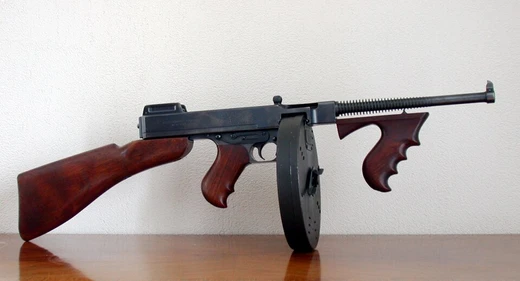
MP 34
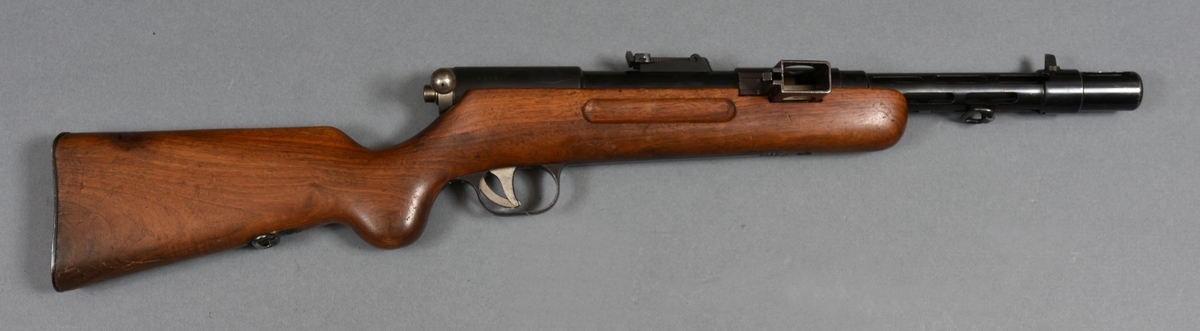
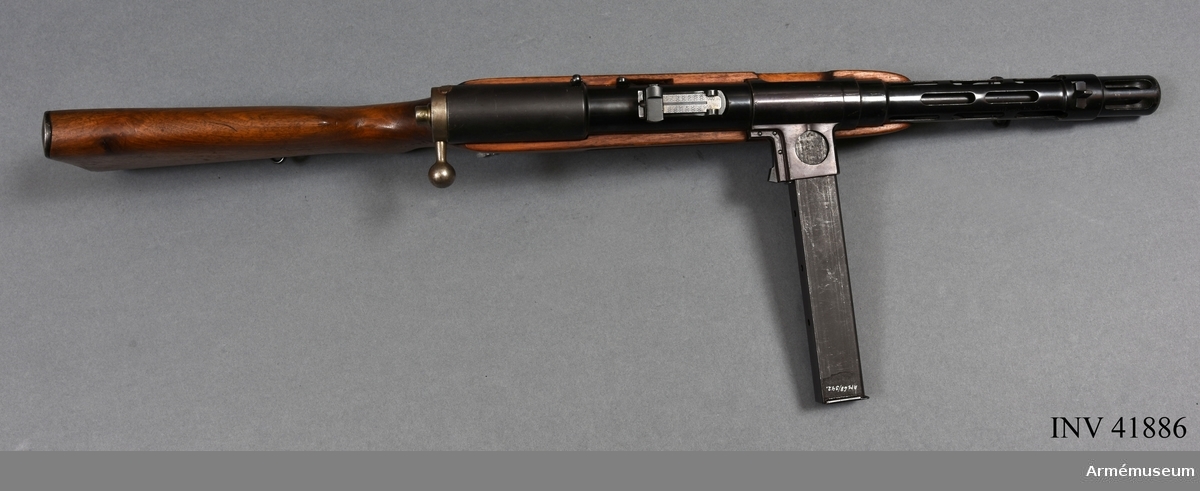
A well-made submachine gun used by Austrian and German forces.

Konrad Krzyżanowski · Public domain
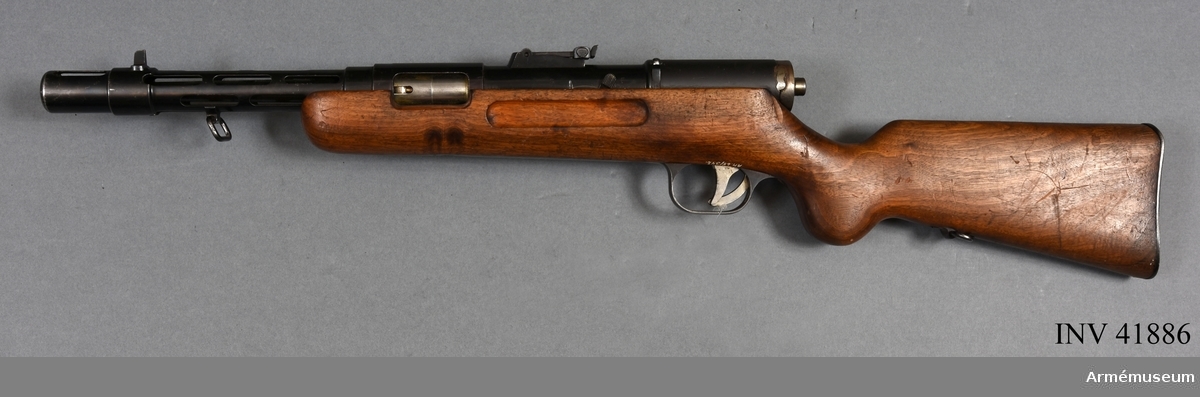
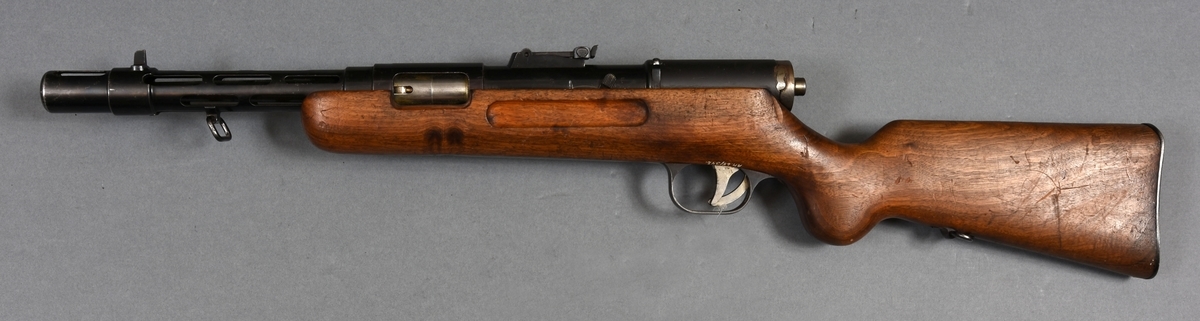
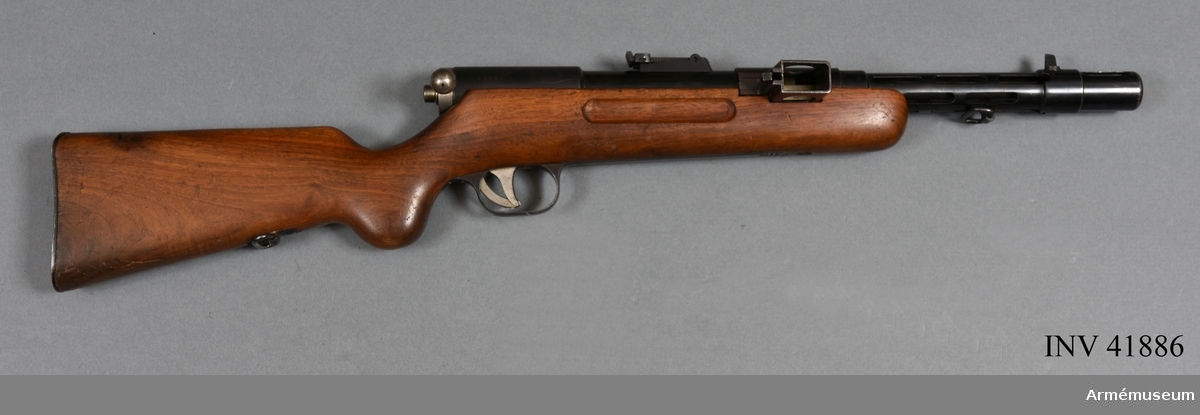
The MP34 (Maschinenpistole 34) is a submachine gun originally manufactured by Waffenfabrik Steyr as the Steyr-Solothurn S1-100. It was used by the Austrian Army and Austrian Gendarmerie, and later by units of the German Army and the Waffen-SS during World War II. Exceptionally well-made, it remained in service with some forces into the 1970s.
Quick Facts
- Origin
- Austria
- Is Ranged
- yes
- Service
- 1930–1970s
- Wars
- Chaco War / Spanish Civil War / World War II / Ecuadorian–Peruvian War / Bolivian National Revolution / Vietnam War / Portuguese Colonial War
- Designer
- Louis Stange
- Manufacturer
- Waffenfabrik Steyr
- Design Date
- 1929
- Production Date
- 1929–1940
- Variants
- S1-100, MP30
- Weight
- Loaded 4.48 kg / Unloaded 4.25 kg
- Length
- 850 mm
- Part Length
- 200 mm / <!--
Facts from the source article.
Lore & Background
The MP34 was based on a design for the MP19 by Rheinmetall of Düsseldorf, similar to the MP18 Bergmann from World War I. To circumvent the Treaty of Versailles, Rheinmetall acquired Swiss firm Waffenfabrik Solothurn in 1929 and began secret prototype production under the designation S1-100. Later, Rheinmetall took a controlling interest in Waffenfabrik Steyr in Austria, and weapons were sold through the Zürich-based trade company Steyr-Solothurn Waffen AG. The MP34 was manufactured from the best materials and finished to a high standard, earning the nickname 'Rolls-Royce of submachine guns', but its high production costs led to its replacement by the MP40.
The weapon is blowback-operated, open-bolt, and selective-fire. The return spring is housed in the wooden stock, linked to the bolt via a long push rod. A hinged top cover provides easy access for cleaning. The fire selector is a sliding switch on the left side of the stock, marked T and S. Early models had a Schmeisser-style bolt-locking safety; later models added a manual safety on the top cover. Box magazines of 32 or 20 rounds feed from the left, with the housing angled forward to improve feeding. The magazine housing also allows refilling via stripper clips. The barrel is enclosed in a perforated cooling jacket with a bayonet lug. Some versions could be fitted with a detachable tripod for use as a machine gun.
In 1930, the Austrian police adopted the S1-100 as the Steyr MP30 in 9×23mm Steyr. The Austrian Army adopted it as the Steyr MP34 in 9×25mm Mauser. After the 1938 Anschluss, the German Army acquired most MP30s and MP34s, re-barrelling some to 9×19mm as the MP34(ö). Production ceased in mid-1940 as lines shifted to the MP40. The MP34 saw limited combat with Waffen-SS units in Poland and France, then was allocated to security and reserve units. It was used by Greek police, Yugoslav partisans and Chetniks, and by Portugal in several calibers, remaining in Portuguese service into the 1970s. Japan imported small numbers for testing, and the PAVN used it in the Vietnam War.
Reader's Guide
The MP34's significance lies in its exceptional build quality and its role as a transitional weapon between World War I designs and the mass-produced submachine guns of World War II. Nicknamed the 'Rolls-Royce of submachine guns', it was made from the best materials and finished to a high standard, but its high cost prevented widespread adoption. It served as a substitute standard arm for German forces early in the war before being replaced by the cheaper MP40. The weapon's longevity is notable: it remained in service with Portuguese paramilitary and security forces in Africa into the 1970s, and saw use in the Vietnam War. Its design influenced later weapons, and its use by multiple nations—Austria, Germany, Portugal, Greece, Yugoslavia, Japan, and Vietnam—demonstrates its adaptability across different calibers and roles. The MP34 is a testament to the craftsmanship of pre-war European arms manufacturing, even as the demands of industrial warfare rendered such quality unsustainable.
Did You Know?
- The MP34 was nicknamed the 'Rolls-Royce of submachine guns' due to its high-quality materials and finish.
- The magazine housing allowed refilling from stripper clips without removing the magazine.
- Portugal used the MP34 in its African colonies into the 1970s during the Portuguese Colonial Wars.
Design & Development
The idea of a purpose-built close-quarters automatic weapon grew directly out of trench warfare, where fights rarely stretched beyond a few feet and the emerging fire-and-movement doctrine called for something far more lethal than a pistol. In 1915 the German Rifle Testing Commission at Spandau set out to develop exactly that. Their initial plan—adapting semi-automatic pistols such as the Luger or the Mauser C96—collapsed because the light frames and 1,200-rounds-per-minute rates made controlled full-auto aimed fire unworkable. The commission therefore demanded an entirely new class of firearm. Hugo Schmeisser, part of a small team at Bergmann Waffenfabrik that included Theodor Bergmann and other technicians, answered the call. The product was designated Maschinenpistole 18/I, the Roman numeral simply meaning "one." The German Army evaluated four variants, I through IV, all sharing the same core architecture but differing in feed mechanism. Model I used the drum magazine familiar from the artillery Luger; models III and IV switched to a straight, right-angle box magazine of the Mauser pattern, the same type later employed in the C06/08 pistol, the C17 Trench Carbine, and the SIG Bergmann. Full production began in early 1918.
Combat Debut in 1918
Contrary to a persistent popular narrative, there is no solid evidence that the MP 18 reached the front lines during the German spring offensive of early 1918 or that stormtroopers carried it into those assaults. In reality the weapon was fielded mainly in the latter half of 1918, as the war was already winding down. The first documented unit to receive the gun was the 237th Infantry Brigade, part of the 119th Infantry Division, which encompassed the 46th and 58th Infantry Regiments, the 46th Reserve Infantry Regiment, and the 119th Storm Division. In July 1918—after the spring offensive had concluded—that brigade was issued 216 MP 18/I examples for field trials. Shortly thereafter, German troops employed the weapon at the Battle of Amiens. On 11 August, soldiers of the Canadian 13th Battalion (Royal Highlanders of Canada) were photographed holding a captured MP 18/I, providing one of the earliest visual records of the gun in Allied hands. A separate thread of provenance links an MP 18/I now housed in the Sarsılmaz Museum in Düzce, Turkey, to the Turkish War of Independence, hinting that a small number of the weapons may have been transferred to Ottoman forces at the war's end.
Production Figures and the Numbers Debate
Pinning down exactly how many MP 18s were built, and how many actually entered service, remains one of the weapon's most persistent puzzles. Major-General Ernst von Wrisberg, director of the Prussian War Ministry, stated shortly after the armistice that roughly 17,000 guns had been delivered by October 1918, a figure corroborated by military acceptance stamps that reach the 17,000 serial mark. Yet surviving examples carry serial numbers well into the 30,000 range, and one estimate drawn from the serials of guns still in existence puts total output at around 35,000 across 1918 and possibly into 1919. A French post-war report went further, claiming 50,000 were produced in 1918 alone while only 8,000 to 10,000 were actually delivered. The most telling indicator of front-line use is the serial range of the handful of MP 18s captured by Allied forces in the second half of 1918: every one bore a low number, typically in the hundreds. From that evidence, a reasonable estimate is that perhaps 4,000 guns ever saw combat, with the vast majority of production sitting in factory warehouses until new demand emerged in the interwar period.
The 'First Submachine Gun' Question and Lasting Influence
The MP 18 is frequently billed as the world's first submachine gun, but that claim is far from settled. In October 1915 the Austro-Hungarian Standschützen-Battalionen tested the Maschinengewehr Hellriegel, a 9×23 mm Steyr weapon tried both as a mounted support gun and a hip-fired assault rifle. In late 1916 the Italian Military Aviation Corps issued what is considered the first formal request for a submachine gun, asking for a single-barreled Villar Perosa with a detachable stock; that design was built in early 1917, adopted as the Carabinetta Automatica OVP, and 500 copies went to observation crews. The Villar Perosa's designer, Colonel Bethel-Abiel Revelli, had outlined the concept of a shoulder-fired automatic weapon as early as September 1915, though whether he actually built one matching that description remains debated. What can be stated with confidence is that the MP 18/I was one of several parallel submachine-gun projects of the era and cannot be called the first with certainty. What it was, however, was the first mass-produced submachine gun to see extensive use in an infantry assault role—and after production ended with the war, its design principles went on to underpin the majority of submachine guns built through the first half of the twentieth century.
Gallery

Frequently Asked Questions
What is the MP 34?
The MP 34 is a submachine gun originally produced by Waffenfabrik Steyr under the designation Steyr-Solothurn S1-100. It served as a compact, selective-fire sidearm for Austrian and later German military and police units during World War II.
What calibers can the MP 34 chamber?
It was offered in a notably wide spread of cartridges, including 9×19mm, 9×25mm Mauser, 9×23mm Steyr, 7.63×25mm Mauser, 7.65×21mm Luger, and .45 ACP. That versatility let different units adopt the platform without changing their existing ammunition supply.
How does the MP 34 operate mechanically?
It runs on a blowback, open-bolt system with a selective-fire trigger for both semi-automatic and full-automatic modes. A 32- or 20-round box magazine feeds from the left side, and the rear sight is graduated from 100 to 500 meters.
Which forces actually fielded the MP 34?
Austrian Army and Gendarmerie units were the primary early users, and the weapon was subsequently adopted by German Army and Waffen-SS formations during the Second World War. Some armed forces kept it in active service well into the 1970s.
Why do enthusiasts regard the MP 34 as special?
It is widely praised for its exceptionally high build quality and finish, setting it apart from many contemporaneous submachine guns. Its remarkably long service life, stretching from the 1930s into the 1970s, underscores just how durable and well-engineered the design was.
More in Submachine Guns, Part 2 1-24
Spotted an error? Know more?
Reader corrections go straight into our review queue. Suggest an edit · How this site is sourced