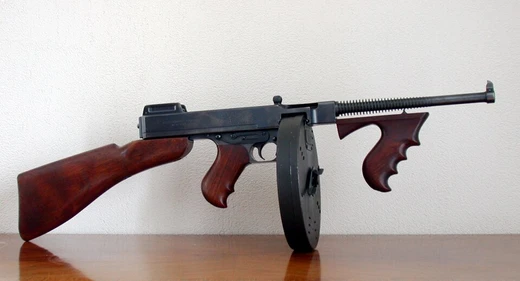
Erma EMP
A German submachine gun based on Vollmer's telescoping spring design.

The Erma EMP (Erma Maschinenpistole), also known as the MPE (Maschinenpistole Erma), is a German submachine gun produced by the Erma factory from 1931 to 1938. Based on designs acquired from Heinrich Vollmer, it was exported to several countries and used domestically by the SS, as well as being produced under license in Spain.
Quick Facts
- Origin
- Germany
- Is Ranged
- YES
- Service
- 1931–1958
- Wars
- Chaco War · Spanish Civil War · Second Sino-Japanese War · World War II · Ifni War
- Design Date
- 1930
- Manufacturer
- Erma Werke
- Production Date
- 1931–1938
- Number
- Approx.10,000
- Weight
- 4 kg
- Length
- 95 cm
- Part Length
- 32 cm
- Caliber
- 9 mm
Facts from the source article.
Lore & Background
Heinrich Vollmer began developing submachine guns in the early 1920s, with early models similar to the MP18. His VMP1925 was secretly tested by the Reichswehr, and subsequent development led to the VMP1928, which introduced a 32-round box magazine on the left side. The VMP1930 introduced a telescoping main spring assembly, for which Vollmer received a patent in 1933. After the Reichswehr stopped financial support in late 1930, Vollmer sold the rights to his designs to Erma Werke.
The Erma EMP, introduced in 1932, was essentially the VMP1930 with a restored cooling jacket. Three main variants were produced: one with a 30 cm barrel, tangent rear sight and bayonet lug; a second with a 25 cm barrel and no bayonet lug; and a third with an MP18-style stock with finger grooves. The weapon was adopted by the SS and German Police, and exported to Mexico, Yugoslavia, and Spain. During the Spanish Civil War, it was used by both sides.
After the Spanish Civil War, over 3,000 EMPs from defeated Spanish Republicans ended up in a French warehouse. The French tested and adopted the weapon, issuing a provisional manual in 1939–1940. They distributed EMPs to frontline units, but were hampered by a shortage of magazines. After the German conquest of France, some EMPs armed the Legion of French Volunteers Against Bolshevism, later part of the SS Charlemagne division. The Yugoslav-purchased EMPs were used by both Partisans and Chetniks.
Reader's Guide
The Erma EMP is significant as a transitional design that directly influenced the later MP38 and MP40. Its telescoping main spring assembly, patented by Vollmer, was retained essentially unchanged in the EMP 36 and subsequently in the Maschinenpistole 38. The EMP 36, an intermediate model between the EMP and MP38, replaced the solid wood stock with a wood frame and folding metal butt, and made the magazine housing nearly vertical.
The EMP saw widespread use across multiple continents and conflicts, from the Chaco War to the Spanish Civil War and World War II. Its adoption by the French in 1939–1940, despite magazine shortages, and subsequent use by German forces after the fall of France, illustrates the weapon's adaptability and the complex logistics of wartime. In Spain, unlicensed production continued under Franco's regime until the mid-1950s as the Model 1941/44, known as the Naranjero, though it performed poorly during the Ifni War. The EMP's legacy is thus one of a robust, widely exported design that bridged early submachine gun concepts and the iconic German MP series.
Did You Know?
- The EMP's telescoping main spring assembly was patented by Heinrich Vollmer in 1933 as DRP# 580620.
- Over 3,000 EMPs from defeated Spanish Republicans were stored in a French warehouse at Clermont-Ferrand after the Spanish Civil War.
- The EMP was produced under license in Spain as the Model 1941/44, commonly known as the Naranjero.
- The EMP's telescopic cylinder return spring guide was retained for the Maschinenpistole 38.
More in Submachine Guns, Part 2 1-24
Spotted an error? Know more?
Reader corrections go straight into our review queue. Suggest an edit · How this site is sourced