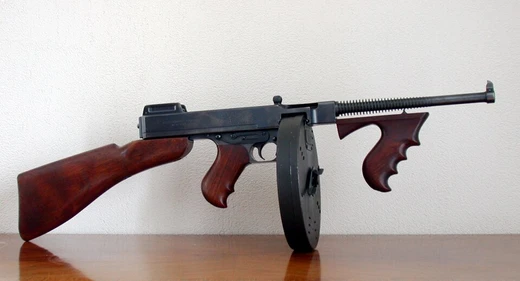
Danuvia 43M submachine gun
The most produced variant of the Hungarian Danuvia submachine gun.

The Danuvia 43M submachine gun is a variant of the Hungarian Danuvia/Király series, designed by Pál Király and produced by the Danuvia company. It was developed in 1943 as an improved version of earlier models, featuring a forward-folding metal stock, a wood fore stock, and a pistol grip. The 43M was the most produced variant of the Danuvia line and saw service during World War II and into the early 1950s.
Quick Facts
- Is Ranged
- yes
- Origin
- Hungary
- Designer
- Pál Király
- Design Date
- 1930s
- Manufacturer
- Danuvia
- Production Date
- 1939–1944
- Service
- 1939 to 1950s
- Used By
- Hungary / Soviet Union (limited use by partisans) / Nazi Germany
- Wars
- World War II / Hungarian Revolution of 1956
- Cartridge
- 9×25mm Mauser 39M and 43M / 9x19mm Parabellum 44M / 7.62 Tokarev 50M
- Feed
- 40 round detachable box magazine
- Action
- Lever-delayed blowback
Facts from the source article.
Lore & Background
The Danuvia 43M was introduced in 1943 as a further development of the earlier 39M and 39/AM models. It incorporated a forward-folding metal stock, a wood fore stock, and a pistol grip, making it more compact than its predecessors. The barrel was shortened, and the magazine was angled forward, holding 40 rounds of the powerful 9×25mm Mauser cartridge. The 43M retained the patented two-part lever-delayed blowback bolt to manage the high-energy round, and its fire selector was a circular cap on the rear of the receiver with settings for semiautomatic, full automatic, and safety.
The 43M was used by Hungarian army troops, military police, and police forces. It was well-liked for its reliable function in sub-zero and muddy conditions on the Eastern Front, though the availability of 9×25mm Mauser ammunition was a difficulty. The gun remained in service until the early 1950s, when it was gradually replaced by the PPSh-41 and the Kucher K1. After the war, some 43Ms were later repurposed as the 50M variant, rechambered to 7.62 Tokarev and used by guard personnel and police, with some likely seeing combat in the 1956 revolution in Hungary.
Reader's Guide
The Danuvia 43M represents the peak production of the Danuvia submachine gun series, with more units made than any other variant. Its design addressed the need for a more compact weapon compared to the full-stocked 39M, particularly for paratroopers and other troops requiring a shorter firearm. The forward-folding metal stock and shortened barrel made it more portable while retaining the robust lever-delayed blowback action that allowed the use of the high-velocity 9×25mm Mauser round. This cartridge gave the 43M greater power and range than many contemporary submachine guns, though it also created logistical challenges due to limited ammunition availability.
The 43M's legacy extends beyond its wartime service; after World War II, it was modified into the 50M variant for police and guard use, and its design influenced the later Kucher K1. The 43M is notable as a well-regarded weapon among its users, functioning reliably in harsh conditions, and as a key example of Hungarian small arms development during the mid-20th century.
Did You Know?
- The Danuvia 43M was the most produced version of the Danuvia submachine gun series.
- It used a forward-folding metal stock, wood fore stock, and a pistol grip.
- The 43M was chambered for the powerful 9×25mm Mauser cartridge.
- Some 43Ms were later converted into the 50M variant, rechambered to 7.62 Tokarev.
More in Submachine Guns, Part 2 1-24
Spotted an error? Know more?
Reader corrections go straight into our review queue. Suggest an edit · How this site is sourced