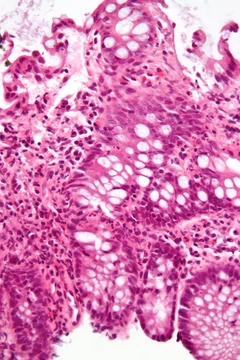
Collagenous colitis
A microscopic colitis subtype marked by colonic collagen deposits.
Collagenous colitis is an inflammatory condition of the colon and a subtype of microscopic colitis, characterized by collagen deposits between colonic glands. It typically causes chronic watery diarrhea without rectal bleeding and is often diagnosed in late middle-aged or elderly individuals, with a higher incidence in women.
Quick Facts
- Field
- Gastroenterology
Facts from the source article.
Did You Know?
- Up to 40% of patients with collagenous colitis have an autoimmune disease.
- Use of NSAIDs, proton pump inhibitors, and beta blockers appears to increase the risk of collagenous colitis.
- On colonoscopy, the colonic mucosa typically looks normal despite microscopic collagen deposition.
Signs and symptoms
Microscopic colitis generally causes chronic watery diarrhea and increased stool frequency. Some patients experience nocturnal diarrhea, abdominal pain, bowel urgency, fecal incontinence, fatigue, and weight loss; severe cases may involve dehydration and electrolyte imbalances. In a retrospective study of collagenous colitis patients, all had chronic diarrhea, 42% had weight loss, 41% had abdominal pain, 27% had nocturnal diarrhea, 14% had fatigue, and 8% had meteorism, with a median of 6 stools per day and a median weight loss of 6 kg among those affected.
Treatment
First-line treatment for collagenous colitis is budesonide, a locally acting steroid with high first-pass clearance. Other options include bismuth agents, 5-aminosalicylic acid, immunosuppressants such as azathioprine, and infliximab. Pilot studies suggest possible benefit from Boswellia serrata extract and specific probiotic strains, though larger studies are needed.
Epidemiology
Reported incidence rates of collagenous colitis have varied, from 0.6 per 100,000 person-years in French data (1987–1992) to 5.2 per 100,000 in an Icelandic study (1995–1999). A study in Olmsted County, Minnesota (1985–2001) found an overall rate of 3.1 per 100,000, but a higher rate of 7.1 per 100,000 for 1998–2001, exceeding rates of Crohn's disease and ulcerative colitis. The Icelandic study also showed an increase from 2.2 in 1995 to 8.3 in 1999. An updated Olmsted County study (2011–2019) reported an incidence of 9.9 per 100,000, a prevalence of 100.1 per 100,000, and a female–male ratio of 4.7, with stable rates over that period. In Denmark (2001–2016), the overall incidence was 12.2 per 100,000, prevalence 116.7 per 100,000, and female–male ratio 3.1; incidence rose sharply from 2.3 in 2001 to 24.3 per 100,000 for microscopic colitis overall, but collagenous colitis rates peaked at 19.6 in 2011 and stabilized through 2016. The average age at diagnosis was 67, with highest incidence in those over 80.
More in Steroid-responsive Inflammatory Conditions
Spotted an error? Know more?
Reader corrections go straight into our review queue. Suggest an edit · How this site is sourced