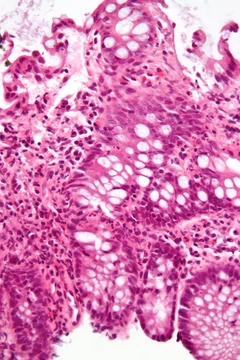
Eosinophilic esophagitis
An allergic esophageal inflammation driven by eosinophil infiltration.
Eosinophilic esophagitis is an allergic inflammatory condition of the esophagus characterized by an accumulation of eosinophils, a type of white blood cell not normally found in the esophagus. It was first described in children but also occurs in adults, and its cause is poorly understood, though food allergy may play a significant role. The condition is notable for causing symptoms such as swallowing difficulty and food impaction, and treatment may involve dietary changes, medication, or endoscopic procedures.
Quick Facts
- Field
- Immunology, Gastroenterology
Facts from the source article.
Did You Know?
- Long-standing, untreated disease may result in esophageal remodeling, leading to strictures, Schatzki ring, and eventually achalasia.
- The risk of esophageal strictures increases by 9% each year that eosinophilic esophagitis goes untreated.
- A study comparing active EoE children to non-EoE children found an altered microbiome with a positive correlation between a relatively high abundance of Haemophilus and disease activity.
Signs and symptoms
EoE often presents with difficulty swallowing, food impaction, stomach pains, regurgitation or vomiting, and decreased appetite. Symptoms vary by age: young children may show feeding difficulties and poor weight gain, while school-aged children and adolescents commonly experience difficulty swallowing, food impaction, and choking with coarse-textured foods, along with abdominal or chest pain. In adults, the predominant symptom is difficulty swallowing, but intractable heartburn and food avoidance may occur, and adults tend to have more episodes of esophageal food impaction and abnormalities such as Schatzki ring, esophageal webs, or achalasia. Many symptoms overlap with GERD, but most patients respond poorly to acid-suppression therapy. EoE is frequently associated with other autoimmune and allergic diseases like asthma and celiac disease, as well as mast cell disorders.
Pathophysiology
The pathophysiology of eosinophilic esophagitis is incompletely understood but is thought to involve antigen exposure in genetically susceptible individuals, triggering a hyperactive immune response. Antigen exposure stimulates esophageal epithelial cells to release IL-33 and thymic stromal lymphopoietin, which attract and activate Th2 helper T-cells. These T-cells release IL-13, IL-4, and IL-5, causing inflammation, basal cell hyperplasia, and dilated intracellular spaces. IL-5 and eotaxin-3 act as chemotaxins, attracting basophils, mast cells, and eosinophils to the esophagus. Eosinophils release chemical signals that inflame surrounding tissue, leading to pain, visible redness on endoscopy, and potential stricturing. The migration of eosinophils to the esophagus is not fully understood but may involve genetic, environmental, and host immune factors. At the tissue level, EoE is characterized by a dense eosinophil infiltrate in the epithelial lining, considered an allergic reaction to ingested food, with eosinophils recruited in response to eotaxin-3 produced by IL-13-stimulated epithelial cells.
Diagnosis
Diagnosis of EoE is based on symptoms and diagnostic testing, after ruling out conditions such as GERD, esophageal cancer, achalasia, hypereosinophilic syndrome, infection, Crohn's disease, and drug allergies. Previously, EoE could only be diagnosed if gastroesophageal reflux did not respond to a six-week trial of twice-daily high-dose proton-pump inhibitors or if a negative ambulatory pH study ruled out GERD. On barium swallow, the term "ringed esophagus" may be seen. Endoscopically, ridges, furrows, rings, or white exudates may appear; multiple rings can create a "corrugated esophagus" appearance. Biopsy requires at least 15 eosinophils per high-power field in the superficial epithelium, and profoundly degranulated eosinophils, microabscesses, and basal layer expansion may be present. Endoscopic findings alone are not diagnostic without clinical symptoms.
Treatment
Treatment aims to control symptoms by reducing esophageal eosinophil numbers and inflammation, using dietary, pharmacological, and endoscopic approaches. Dietary treatment includes the six-food elimination diet (excluding cow's milk, wheat, egg, soy, nuts, and fish/seafood), or less restrictive four-group or two-group exclusion diets, each typically followed for six weeks. The elemental diet, an amino acid-based liquid formula for 4-6 weeks, shows high response rates (nearly 90% in children, 70% in adults) and is followed by histological evaluation and slow food reintroduction. A trial of proton-pump inhibitors (e.g., esomeprazole 20-40 mg daily or twice daily) is a reasonable first-line therapy; if symptoms and eosinophils persist after PPI treatment, the diagnosis is immune-mediated EoE. In severe cases, endoscopic procedures may be used to enlarge the esophagus.
More in Steroid-responsive Inflammatory Conditions
Spotted an error? Know more?
Reader corrections go straight into our review queue. Suggest an edit · How this site is sourced