IgG4-related disease
A chronic inflammatory condition with fibrosis and IgG4 plasma cell infiltration.
IgG4-related disease (IgG4-RD) is a chronic inflammatory condition marked by tissue infiltration with lymphocytes and IgG4-secreting plasma cells, fibrosis, and a typically prompt response to oral steroids. It follows a relapsing-remitting course and tends to form mass-like, tissue-destructive lesions in multiple sites, which can lead to organ dysfunction or failure if untreated. Early detection is important to prevent serious complications, and treatment is recommended for all symptomatic cases as well as asymptomatic cases involving certain anatomical sites.
Quick Facts
- Field
- Immunology/Rheumatology
Facts from the source article.
Did You Know?
- Approximately 1/3 of cases exhibit increases in blood eosinophil counts, either eosinophilia or hypereosinophilia.
- An article from 1977 identified four distinct stages of the fibroinflammatory process in Küttner's tumor.
Signs and symptoms
IgG4-related disease is often described as an indolent condition, with symptoms, if any, commonly reported as mild despite possible considerable underlying organ destruction. People are frequently generally well at diagnosis, though some report weight loss. Pain is not a typical feature of inflammation but may arise secondarily from obstruction or compression. Diagnosis often follows the discovery of painless swellings or mass lesions, or complications such as jaundice from pancreatic, biliary, or liver involvement. Symptoms are frequently attributed to other conditions, and alternative diagnoses may have been made years earlier. Lesions may be found incidentally on imaging but can be mistaken for malignancies. The disease can involve one or multiple sites, either synchronously or metachronously. Several historically recognized diseases are now considered manifestations of IgG4-RD, including type 1 autoimmune pancreatitis, interstitial nephritis, Riedel's thyroiditis, Mikulicz's disease, Küttner's tumor, inflammatory pseudotumors, mediastinal fibrosis, and some cases of retroperitoneal fibrosis. Other confirmed sites include the heart, hard palate, esophagus, stomach, small intestine, rectum, adrenal gland, ovary, uterus, ureter, bladder, urachus, and synovium. Radiologic evidence suggests possible involvement of the superior vena cava and seminal vesicle.
Histology
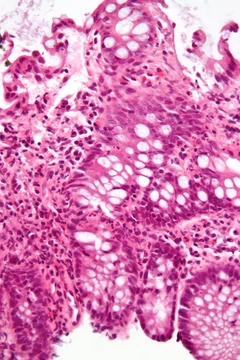
The hallmark histopathological features of IgG4-RD, regardless of the site, are a dense lymphoplasmacytic infiltrate rich in IgG4-positive plasma cells, fibrosis arranged at least focally in a storiform pattern, and obliterative phlebitis. IgG4 immunostaining must be specifically requested to detect these plasma cells. Storiform refers to a cartwheel or woven mat appearance. Obliterative phlebitis involves venous channels being obliterated by a dense lymphoplasmacytic infiltrate within both the walls and lumen. Additional features include non-obliterative phlebitis and increased tissue eosinophils. Research into Küttner's tumor identified four stages of the fibroinflammatory process: focal periductal lymphocytic infiltration; diffuse lymphocytic infiltration with severe periductal fibrosis; prominent lymphocytic infiltration with parenchymal atrophy and periductal sclerosis; and marked parenchymal loss and sclerosis, resembling cirrhosis.
Treatment
Treatment aims to induce and maintain remission to prevent progression of fibrosis and organ destruction. An international expert panel recommends treatment for all symptomatic active IgG4-RD and for some asymptomatic cases, as certain organs may not cause symptoms until late stages. Urgent treatment is advised for manifestations such as aortitis, retroperitoneal fibrosis, proximal biliary strictures, tubulointerstitial nephritis, pachymeningitis, pancreatic enlargement, and pericarditis. In untreated active disease, glucocorticoids are the recommended first-line induction agent, typically producing rapid and often dramatic clinical and radiographic improvement. However, advanced fibrotic lesions may respond poorly. A common induction regimen is prednisolone 30–40 mg per day for 2–4 weeks, tapered over 3–6 months, though recurrences during or after tapering are frequent. Steroid-sparing immunosuppressive agents such as rituximab, azathioprine, methotrexate, and cyclophosphamide may be used in combination with glucocorticoids to reduce side effects, though trials are needed. Maintenance therapy, such as low-dose prednisolone or a steroid-sparing agent, may be given in cases with high relapse risk or organ-threatening manifestations.
Nomenclature
Before 2011, IgG4-RD was referred to under various names in the medical literature. Historical reports of disease associations, such as autoimmune hepatitis with febrile panniculitis that responded to prednisolone, are now considered likely manifestations of IgG4-RD. At the International Symposium on IgG4-Related Diseases, the consensus name IgG4-related disease was endorsed, having already been agreed upon by Japanese investigators. The term 'systemic' was deliberately omitted to avoid misdiagnosing malignant tumors in other organs as manifestations of the condition. Some experts expressed reservations about naming the disease after IgG4, citing its questionable role in pathogenesis and the unreliability of serum IgG4 as a biomarker. The expanded term 'Immunoglobulin G4-related disease' has sometimes been used but was not referenced in the 2012 nomenclature recommendations and appears erroneous.
More in Steroid-responsive Inflammatory Conditions
Spotted an error? Know more?
Reader corrections go straight into our review queue. Suggest an edit · How this site is sourced