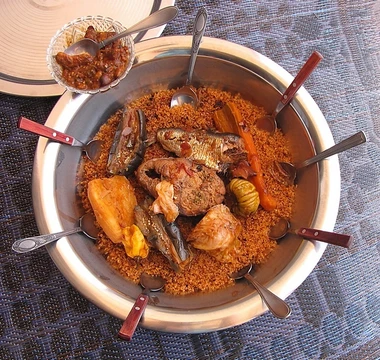
Thiere
Millet-based couscous staple of Senegal, The Gambia, and Mauritania.

Thiere, also written as thiéré, chere, or saadj, is a couscous made from millet that serves as a key staple across Senegal, The Gambia, and Mauritania. It can be eaten in several ways: as a breakfast cereal with fermented milk, cream, and sugar, or more like a standard couscous with sauces, meat, fish, or vegetables. Though it works for breakfast or lunch, it is most often eaten in the evening.
The name thiéré comes from the Wolof word *cere*; in The Gambia it may be spelled chere, chereh, or cherreh. In Serer it is called saadj, sadj, or sat, with dialect variants like saac (among the Serer Niominka) or saay (among the Serer-Saafi and other Serer Cangin groups). Other names include lacciri in Fula, futo in Soninke, futu in Mandinka, basi in Bambara, ngemu or kuskus in Hassaniya Arabic, and oufti in Zenaga.
A dish similar to thiere may have been eaten by the Tichitt culture around 700–400 BCE, where millet was grown and possibly turned into couscous. By at least the 1400s, when Europeans first arrived and wrote about it, thiere was already a major staple in the Senegambian region. It was consumed throughout the Senegal river valley, from Waalo up to Gajaaga and Bambouk. Only in the 1800s did it begin to lose ground to thieboudienne, now Senegal’s national dish.
Historically, the Serer made saadj/thiere in the pre-colonial kingdoms of Sine, Baol, Saloum, and Tekrur as part of their regular meals. It was also prepared for religious ceremonies like the Gamo, Raan, and Xooy festivals, as well as for weddings and naming ceremonies. Among the Serer’s ancestors, the dish could be eaten in the morning with fermented milk and honey, or at other times with vegetables, meat, or fish, depending on what was available. With trade and globalization, ingredients became more accessible, and recipes grew richer and more varied regardless of the time of day.
Among the Wolof and Fula, thiere is customarily eaten in the evening, at weddings, or on Islamic occasions such as Tamkharit (Ashura, the Muslim new year). Serer and Fula women from Futa Jallon are the main sellers of thiere in street markets.
Preparation was historically labor-intensive: women pounded millet by hand with a large pestle and mortar, adding baobab leaf (laalo) for a smooth texture and better taste. Today it is often served with sauces like bassi salté, bassi guerte, or mboum, which may include
- type
- Food dish
- region
- Senegal, The Gambia, Mauritania
- main_ingredient
- Millet
- also_known_as
- Chere, saadj, lacciri, futo, futu, basi, ngemu, oufti
- historical_significance
- Staple of the Senegambian region since at least the 15th century
Quick Facts
- Place Of Origin
- Senegambia
Facts from the source article.
Lore & Background
A dish resembling thiere may have been consumed by the Tichitt culture (700–400 BCE), where millet was grown and perhaps made into a couscous. By at least the 15th century, thiere was a main staple in the Senegambian region, eaten throughout the Senegal river valley from Waalo to Gajaaga and Bambouk. Only in the 19th century did it begin to lose ground to thieboudienne, now Senegal's national dish.
Historically, saadj/thiere was produced by the Serer in the pre-colonial Serer Kingdoms of Sine, Baol, Saloum, and Tekrur. It was prepared on religious ceremonial occasions such as the Gamo, Raan, and Xooy festivals, as well as during weddings and naming ceremonies. Among the Serers' ancestors, the dish could be eaten at any time of day depending on available ingredients.
Among the Wolof and Fula, it is customary to consume thiere in the evenings, at weddings, or on special Islamic occasions such as Tamkharit (the Muslim new year, Ashura). Serer and Fula women from Futa Jallon are the main thiere sellers in street markets.
Reader's Guide
Thiere represents a deep culinary tradition in the Senegambian region, with roots possibly extending to the Tichitt culture around 700–400 BCE. It was a central staple by the 15th century, documented by early European arrivals, and remained dominant until the 19th century when thieboudienne rose to prominence. The dish is culturally significant among the Serer, Wolof, and Fula peoples, used in both everyday meals and ceremonial occasions such as the Serer Gamo, Raan, and Xooy festivals, and the Islamic Tamkharit. Its preparation historically involved labor-intensive hand-pounding of millet with baobab leaf (laalo) to achieve a smooth texture. Today, thiere is sold by Serer and Fula women in street markets, and its recipes have diversified with global trade. The dish's many names—thiéré, chere, saadj, lacciri, futo, futu, basi, ngemu, oufti—reflect its widespread adoption across ethnic groups and languages in the region.
Did You Know?
- Thiere is also spelled chere, chereh, or cherreh in The Gambia.
- Historically, women prepared thiere by pounding millet by hand using a large pestle and mortar, adding baobab leaf (laalo) for smooth texture and taste.
- A dish resembling thiere may have been consumed by the Tichitt culture, dated to 700–400 BCE.
- Serer and Fula women from Futa Jallon are the main thiere sellers in street markets.
Frequently Asked Questions
What is Thiéré?
Thiéré is a millet-based couscous that functions as a core staple food across Senegal, The Gambia, and Mauritania. It is one of the most widely consumed traditional dishes in the Senegambian region.
What is Thiéré made from?
The primary ingredient is millet, processed into a grain similar to couscous. It can then be served as a porridge-style cereal or as a grain base topped with sauces, meats, fish, or vegetables.
How is Thiéré typically eaten?
It can be enjoyed as a breakfast cereal mixed with fermented milk, cream, and sugar, or served as a hearty meal alongside sauces and proteins. Despite working at any meal, it is most commonly consumed in the evening.
What other names does Thiéré go by?
Depending on the language and region, it appears as chere or cherreh in The Gambia, and as saadj, sadj, or sat in Serer. Other regional names include lacciri, futo, basi, ngemu, and oufti.
How old is the tradition of Thiéré?
This millet couscous has been a dietary staple in the Senegambian region since at least the 15th century, making it one of the oldest continuously prepared dishes in West Africa.
More in Senegalese cuisine 1-21
Spotted an error? Know more?
This is a living reference — every entry is fact-audited, and reader corrections feed straight into our audit queue. Suggest an edit · See this site's audit record