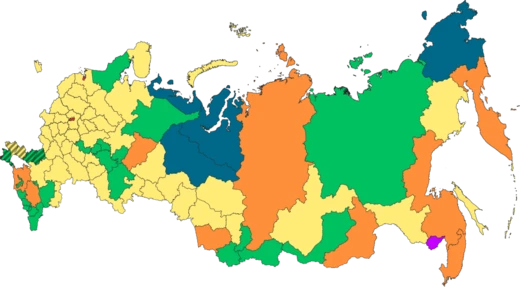
Vladimir Oblast
A central Russian region of ancient cathedrals, mixed forests, and the Klyazma River.

Vladimir Oblast is a federal subject of Russia (an oblast). Its administrative center is the city of Vladimir, which is located 190 km east of Moscow. As of the 2010 Census, the oblast's population was 1,443,693. The UNESCO World Heritage List includes the 12th-century cathedrals of Vladimir, Suzdal, Bogolyubovo, and Kideksha.
- Administrative center
- Vladimir
- Population (2010 Census)
- 1,443,693
- Area
- Part of the East European Plain
- Major rivers
- Klyazma and Oka
- UNESCO sites
- 12th-century cathedrals in Vladimir, Suzdal, Bogolyubovo, and Kideksha
- Established as separate oblast
- 14 August 1944
Lore & Background
The territory of modern Vladimir Oblast has been populated since ancient times. The oldest known traces of human settlement date to the Upper Paleolithic. A settlement of Homo Sapiens dating back to between 32,050 BC and 28,550 BC was discovered in the area of Sungir, located around 200 km east of Moscow. The region of Vladimir were inhabited by different people like Slavs, Tatars, Finno-Ugrics and Balts. The East Slavic tribe of the Buzhans originated in the Vladimir region. Archaeological excavations of Volga Finn settlements document also the Finno-Ugric roots of this land. Merya, Muromian, and Meshchera are inhabited territory of the region during this period. Since the 10th century AD, Slavic colonization of the area began in Murom and Suzdal. The current territory of Vladimir Oblast became part of Kievan Rus. After the breakdown of the authority of Kievan Rus, the region became part of the Rostov-Suzdal principality in the 11th century and then the Vladimir-Suzdal principality in the 12th century. Vladimir region rapidly developed in the mid-12th century during the rule of Yuri Dolgorukiy and Andrey Bogolyubsky. New townships arose—Yuriev-Polsky, Yaropolch-Zalessky, Gorokhovets, Starodub-on-the-Klyazma, Mstislavl—along with princely residences in Kideksha and Bogolyubovo. The Vladimir Highway, a pre-modern civilian road that has been in use since at least the 14th century, traverses the region, bringing people between Moscow and Nizhny Novgorod. Most, if not all, of modern Vladimir, during the Soviet period, seems to have been part of Ivanovo Oblast until it became a separate Federal Subject on 14 August 1944.
Reader's Guide
Vladimir Oblast borders Moscow, Yaroslavl, Ivanovo, Ryazan, and Nizhny Novgorod Oblasts. The oblast is situated in the center of the East European Plain. The Klyazma and the Oka are the most important rivers. There are approximately three hundred lakes in the oblast. The oblast is situated in a zone of mixed forests. The region's geology is characterized by a variety of sedimentary and igneous rocks, including sandstone, shale, limestone, granite, and diabase. There are also several mineral deposits in the oblast, including iron ore, apatite, and phosphate. Some notable natural landmarks in the oblast include the Klyazma Reservoir and the Suzdal Kremlin, which is a UNESCO World Heritage site. Additionally, there are several nature reserves and parks in the oblast, such as the Meshchyora National Park and the Ugra National Park. The oblast's fauna currently includes more than fifty species of mammals (some examples including elk, brown bear, wild boar, roe deer, red and sika deer, lynx, wolf, squirrel, rabbit, marten, fox, weasel, badger and other fur-bearing animals), five species of reptiles, and ten species of amphibians. The semiaquatic Russian desman is listed in the Russian Red Book of endangered species. The region is inhabited by 216 species of birds, among which are the capercaillie, black grouse, grouse, partridge, woodcock, goose, duck, etc. The lesser white-fronted goose is listed in the Red Book. Hunting season runs from October to February with the following license and permit restrictions: Elk, wild boar, red deer, and sika deer from mid-November through mid-January; Hare from October through January; Grouse, black grouse, woodcock, duck and goose for 10 days in April. Bodies of water in the region are rich in numerous species (about 40) of fresh-water fish (e.g. eel, roach, pike, perch, bream, rudd, and sturgeon in the Klyazma River), which support ice fishing in winter. Additionally, the oblast has several hunting farms. The total expanse of the oblast's surface waters is 32.9 hectares. The region has hundreds of rivers with a total length of more than 8,600 kilometers—there are 560 rivers and streams throughout the oblast. The Klyazma River flows into the Oka River on the south-eastern edge of the oblast's border with the Nizhny Novgorod Region. The Klyazma River's major tributaries in the Vladimir Region are the Sherna (with the Molokcha fl
Did You Know?
- The UNESCO World Heritage List includes the 12th-century cathedrals of Vladimir, Suzdal, Bogolyubovo, and Kideksha.
- The oblast has approximately three hundred lakes.
- The semiaquatic Russian desman is listed in the Russian Red Book of endangered species.
- The Vladimir Highway has been in use since at least the 14th century.
More in Russian Regions 1-24
Spotted an error? Know more?
This is a living reference — every entry is fact-audited, and reader corrections feed straight into our audit queue. Suggest an edit · See this site's audit record