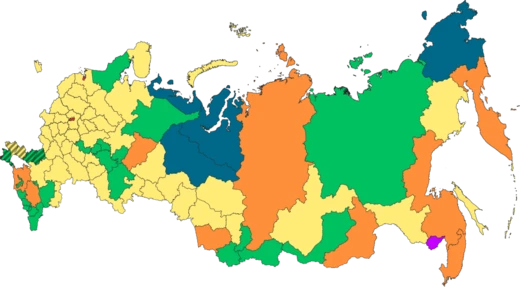
Smolensk Oblast
Smolensk Oblast: Land of the Dnieper, history, and space pioneers.

Smolensk Oblast, informally also called Smolenshchina, is a federal subject of Russia (an oblast). Its administrative centre is the city of Smolensk. As of the 2021 Census, its population was 888,421.
- Founded
- 27 September 1937
- Population (2021 Census)
- 888,421
- Administrative Centre
- Smolensk
- Area Divisions
- 25 districts, 2 cities, 15 towns, 12 urban-type settlements, 302 rural okrugs
- Climate
- Humid continental, with average January temperatures from -9°C to -8°C and July temperatures from 17°C to 18°C
Lore & Background
The oblast was founded on 27 September 1937. It borders Pskov Oblast in the north, Tver Oblast in the northeast, Moscow Oblast in the east, Kaluga Oblast in south, Bryansk Oblast in the southwest, and Mogilev and Vitebsk Oblasts of Belarus, in the west and northwest, as part of the Belarus–Russia border. From July 1941-September 1943 part of region fell to Germany.
Reader's Guide
Smolensk Oblast is divided into 25 districts (raions) and two cities of oblast significance, which are further divided into 15 towns, 12 urban-type settlements, and 302 rural okrugs. The main river is the Dnieper and its tributaries. The climate is humid continental. The highest executive body is the Oblast Government, and the highest official is the Governor.
Did You Know?
- Yuri Gagarin, the first man in space, was born in Klushino, Smolensk Oblast.
- Isaac Asimov, the American writer and biochemist, was born in Petrovichi, Smolensk Oblast.
- The oblast's top export in 2021 was fertilizers, at 19.2% of total exports.
The Chabad-Lubavitch Dynasty
The village of Lyubavichi occupies a singular place in Jewish religious history as the namesake and spiritual home of the Chabad-Lubavitch branch of Hasidic Judaism. Beginning in 1813, when the second Rebbe, Dovber Schneuri, relocated his court from Lyady, the settlement became the seat of four successive generations of Chabad leadership spanning more than a century. The third Rebbe, Menachem Mendel Schneersohn, and the fourth, Shmuel Schneersohn, both died and were buried in the village. In the summer of 1897, the fifth Rebbe, Sholom Dovber Schneersohn, founded the Yeshivah Tomchei Temimim Lubavitch, a central institution for Chabad learning. The outbreak of World War I forced the Rebbe to evacuate his court to Rostov in the autumn of 1915, and the yeshivah was disbanded in 1917, scattering its students into exile before the Rebbe reestablished the institution in Rostov. In 2008, the Chabad movement opened an information center called Hatzer Raboteinu Nesieinu Belubavitch in the village's former Jewish area, close to the Rebbes' graves. In August 2016, the European Conference of Shluchim brought five hundred Chabad rabbis to the village to visit the graves and tour the settlement.
The Jewish Community and Its Tragedy
Lyubavichi sustained a substantial Jewish community for centuries, with records documenting 1,164 Jewish residents in 1847 and 1,660 by 1897. Around 1880, the village contained two synagogues alongside two Russian Orthodox churches, and Jews made up the majority of the roughly 1,516 total inhabitants. The community's fortunes shifted dramatically after the 1917 Russian Revolution, as the local economy declined and religious Jews faced persecution under the Yevsektsiya. By 1926, the Jewish population had fallen to 967, though it still represented half of all residents in the village. The most devastating chapter arrived during the German invasion of 1941. In August of that year, German military forces entered Lyubavichi and established a ghetto. On November 4, 1941, the 483 Jews who remained were massacred, effectively annihilating the community that had thrived in the settlement for generations. The village's Yiddish name, Lyubavitsh, and the Chabad-Lubavitch tradition that traces its founding to a Jew named Meir, serve as enduring reminders of the deep Jewish roots that once defined this small locality in what is now Smolensk Oblast.
Economic Life and Demographic Shifts
From at least 1654, when it existed within the Polish-Lithuanian Commonwealth, Lyubavichi grew from a modest settlement into a recognized small town by 1784, at which point it was held by the Polish princely Lubomirski family. After the partitions dissolved the Commonwealth, the village was annexed by the Russian Empire, where it was administered as part of Orshansky Uyezd in Mogilev Governorate. Its population fluctuated considerably: a mid-nineteenth-century record noted 2,500 inhabitants in 1857, while a later source from around 1880 counted 1,516 people living in 313 houses. The village's commercial significance was remarkable for its size. In the late nineteenth and early twentieth centuries, Lyubavichi served as the largest market in the entire Mogilev Governorate, generating annual sales exceeding 1.5 million rubles. The Napoleonic invasion of 1812 briefly disrupted local life when French troops occupied the village for two weeks, but the settlement recovered and continued to function as a center of economic activity well into the twentieth century, before the upheavals of revolution and war reshaped its character.
Geographic Setting and Administrative Identity
Lyubavichi is a rural village situated in Rudnyansky District of Smolensk Oblast, Russia. The settlement carries names in three languages—Russian (Lyubavichi), Belarusian (Lyubavichy), and Yiddish (Lyubavitsh)—reflecting the layered cultural history of the region. According to Chabad-Lubavitch tradition, the village was originally founded by a Jew named Meir, a detail that underscores the deep Jewish roots embedded in the local identity. The village experiences a warm-summer humid continental climate, classified as Dfb under the Köppen system. Administratively, Lyubavichi has undergone significant shifts over the centuries: from a possession of Polish nobility within the Commonwealth, to a village in the Russian Empire's Mogilev Governorate, to its current status as a rural locality within the modern Russian oblast. A 2004 Smolensk Oblast law formally established Rudnyansky District's municipal boundaries and granted status to the constituent municipal formations, while a 2008 regional resolution updated the registry of administrative and territorial units, cementing Lyubavichi's place in the contemporary territorial framework of the oblast.
Frequently Asked Questions
Who is Smolensk Oblast?
Smolensk Oblast, affectionately nicknamed Smolenshchina, is a federal subject of Russia governed from the city of Smolensk. It was carved out as an independent administrative unit on 27 September 1937 and sits along the country's western edge, sharing a border with Belarus.
What are Smolensk Oblast's powers and role?
As a full oblast, it exercises regional authority over 25 districts, 2 cities, and 15 towns, handling local governance within the framework of the Russian Federation. Its government coordinates infrastructure, education, and public services across the entire territory.
How does Smolensk Oblast's story end?
Because Smolensk Oblast is a living, ongoing administrative region rather than a scripted narrative, it has no fixed ending. As of the 2021 Census, roughly 888,000 people still call it home, and its story continues to unfold.
Why is Smolensk Oblast important?
It is widely celebrated as the birthplace of Yuri Gagarin, the first human to journey into outer space, giving the region a legendary place in world history. Its geographic position, flanked by Belarus and several neighboring oblasts, has also made it a strategic crossroads for centuries.
What is the climate like in Smolensk Oblast?
The region sits under a humid continental climate, so January temperatures typically dip to around -9 °C to -8 °C while July peaks near 17 °C to 18 °C. In practice this means long, cold winters and short, mild summers rather than scorching heat.
More in Russian Regions 1-24
Spotted an error? Know more?
This is a living reference — every entry is fact-audited, and reader corrections feed straight into our audit queue. Suggest an edit · See this site's audit record