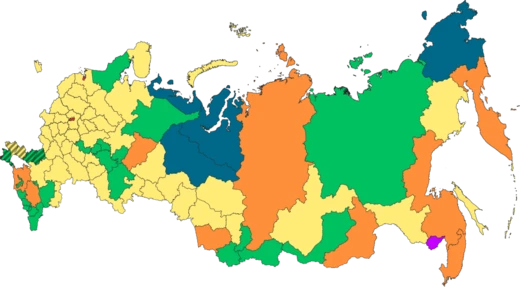
Novosibirsk Oblast
The third-largest city in Russia, Novosibirsk, is the administrative center of this southwestern Siberian oblast.

Novosibirsk Oblast is a federal subject of Russia (an oblast) located in southwestern Siberia. Its administrative and economic center is the city of Novosibirsk, the third-largest city in the country. As of the 2021 Census, Novosibirsk Oblast had a population of 2,797,176 with the majority, 1.63 million, living in Novosibirsk.
- established
- September 28, 1937
- population
- 2,797,176 (2021 Census)
- capital
- Novosibirsk
- area
- over 600 km west to east, over 400 km north to south
- climate
- continental, average January temperature -19°C, July +19°C
- major_rivers
- Ob and Irtysh
Lore & Background
During the Middle Ages the region was populated by Siberian Tatar tribes (Baraba and Chat). Being constantly raided by Oirat nomads throughout the first centuries of the exploration of Siberia, future Novosibirsk Oblast did not attract many Russian colonists, who preferred to settle around more northerly Tomsk. The first Russian village Maslyanino was founded in 1644. In 1716, officer Ivan Butkeyev built the Berd fortress that later became the city of Berdsk, the main center of future colonization and development of the region. Like many other parts of Siberia, the Berd lands became a safe haven for political dissidents, fugitive serfs and religious sects from all across Russia. For most parts of its history, the Novosibirsk Oblast belonged to the Tomsk administration, initially as a part of the Tomsk uyezd of the Tobolsk Governorate and later, starting with 1804, the separate Tomsk Governorate. The turning point in history of the region was the construction of the Trans-Siberian and the Turkestan–Siberian railways. Founded in 1893, Novosibirsk, then Novonikolayevsk, became a transport hub of sub-regional importance and surpassed other major Siberian cities like Omsk and Tomsk in mere decades. In 1920, the capital of the Tomsk Governorate was moved to Novonikolayevsk, in 1921 the Novonikolayevsk Governorate was established. In 1925, most of the Siberian governorates were united as the Siberian Krai with Novosibirsk as the capital. In 1930, it was split into West Siberian (Novosibirsk) and East Siberian (Irkutsk) krais, the former existed until 1937. The Novosibirsk Oblast was finally established on September 28, 1937. Kemerovo and Tomsk became separate from it only in 1943–1944.
Reader's Guide
Novosibirsk Oblast is located in the south of the West Siberian Plain, at the foothills of low Salair ridge, between the Ob and Irtysh Rivers. The oblast borders Omsk Oblast in the west, Kazakhstan (Pavlodar Province) in the southwest, Tomsk Oblast in the north, Kemerovo Oblast in the east, and Altai Krai in the south. The territory of the oblast extends for more than 600 km from west to east, and for over 400 km from north to south. The oblast is mainly plain; in the south the steppes prevail; in the north enormous tracts of woodland with great number of marshes prevail. There are many lakes, the largest ones located at the south. The majority of the rivers belong to the Ob basin. Among the main lakes are Chany, Sartlan, Tandovo and Ubinskoye. As of 2007, the oil reserves of the region amounted to 204 million tons. In addition, Novosibirsk Oblast had free gas reserves of 600 million cubic meters, solute gas reserves of 5.2 billion cubic meters, and gas condensate reserves of 121,000 tons. Most of the oil and gas reserves are located in the Severny and Kyshtovsky districts. The following metals can be found in the region: zirconium dioxide (0.7 million tons), titanium dioxide (2.9 million tons), bauxite (2,068,000 tons), and tin (588,000 tons). In addition, there are twenty-three fields of alluvial placer gold in the region (nineteen of which were being developed and prospected in 2006) and seven residual soil gold fields suitable for open-cut mining in the southeast. Novosibirsk Oblast has 5.527 million tons of high-quality anthracite, as well as 2.720 million tons of long-flame and coking coal. Most of these are located in the Iskitim and Toguchin districts. The north part of the region also has peat fields with estimated reserves of 7.6 billion tons. Prospected mineral water reserves in the region amount to 6,948 cubic meters per day. The popular Karachinskaya mineral water originates from the region. The oblast has 4,531,800 hectares or 45,318 square kilometres of forests, with 509.88 million cubic meters of timber reserves. Most of the region's forests consist of softwood. Softwood forests cover an area of 3,481,300 hectares or 34,813 square kilometres, while softwood timber is spread out over 387.96 million cubic meters. Coniferous forests - located mostly near the Ob River and the Salair Ridge - cover an area of 1,011,900 hectares or 10,119 square kil
Did You Know?
- The first Russian village in the region, Maslyanino, was founded in 1644.
- The Berd fortress, built in 1716, later became the city of Berdsk.
- Novosibirsk, founded in 1893, surpassed Omsk and Tomsk in mere decades due to the Trans-Siberian and Turkestan–Siberian railways.
- The Novosibirsk Oblast was established on September 28, 1937.
- The region has 5.527 million tons of high-quality anthracite and 2.720 million tons of long-flame and coking coal.
Geographic Character and Mineral Wealth
Novosibirsk Oblast stretches across more than six hundred kilometers from west to east and over four hundred from north to south, sitting in the southern reaches of the West Siberian Plain at the base of the low Salair Ridge. Bordered by Omsk Oblast, Kazakhstan's Pavlodar Province, Tomsk Oblast, Kemerovo Oblast, and Altai Krai, the territory is framed by the Ob and Irtysh rivers. The southern half is dominated by open steppe, while the north gives way to vast woodlands interspersed with marshes. Numerous lakes dot the landscape, with Chany, Sartlan, Tandovo, and Ubinskoye among the largest, concentrated toward the south. Beneath this terrain lies considerable mineral wealth. As of 2007, the region held roughly 204 million tons of oil, alongside free and solute gas reserves and gas condensate deposits, most concentrated in the Severny and Kyshtovsky districts. Metal deposits include zirconium dioxide, titanium dioxide, bauxite, and tin. Twenty-three alluvial placer gold fields and seven residual soil gold fields add to the extractive potential, while Iskitim and Toguchin districts hold millions of tons of anthracite and coking coal. The north also conceals peat reserves estimated at 7.6 billion tons.
From Tatar Steppes to Siberian Capital
During the medieval period, the lands that would become Novosibirsk Oblast were home to the Baraba and Chat Siberian Tatar tribes. Persistent raids by Oirat nomads made the area unattractive to early Russian settlers, who instead gravitated toward the more northerly city of Tomsk. The first Russian settlement, Maslyanino, appeared only in 1644, and it was not until 1716 that officer Ivan Butkeyev raised the Berd fortress, which grew into the town of Berdsk and became the region's principal colonial center. Berd's lands subsequently served as refuge for political dissidents, escaped serfs, and religious sectarians fleeing other parts of Russia. For centuries the territory remained under Tomsk's administrative umbrella. Everything changed with the arrival of the Trans-Siberian and Turkestan-Siberian railways. The town of Novonikolayevsk, founded in 1893, rapidly outgrew rivals such as Omsk and Tomsk, becoming a sub-regional transport nexus. By 1920 it had absorbed the role of regional capital, and through a series of administrative reorganizations—governorate, Siberian Krai, West Siberian Krai—the modern Novosibirsk Oblast was formally created on 28 September 1937.
Political Architecture and the Post-Soviet Transition
Under Soviet rule, authority in the oblast was deliberately distributed among three figures: the first secretary of the Novosibirsk Communist Party committee, who in practice wielded the most influence; the chairman of the oblast Soviet, representing legislative power; and the chairman of the oblast Executive Committee, overseeing executive functions. This tripartite arrangement persisted until 1991, when the Communist Party's collapse reshaped the entire governance landscape. In the post-Soviet era, the head of the oblast administration—and later the elected governor—emerged as the chief executive, working alongside a directly elected regional parliament. The Charter of Novosibirsk Oblast serves as the region's foundational legal document. The Legislative Assembly, composed of seventy-six deputies, holds the power to enact laws, issue resolutions, and supervise their implementation. The most recent elections for this body took place on 13 September 2020. The Oblast Government functions as the highest executive organ, encompassing district administrations, specialized committees, and commissions that manage day-to-day affairs. The governor, as the region's top official, acts as guarantor of the Charter's observance in accordance with the Constitution of the Russian Federation.
Climate, Forests, and the Northern Woodland
Novosibirsk Oblast experiences a sharply continental climate, with January averages at minus nineteen degrees Celsius and July at plus nineteen. Annual precipitation stays modest, between three hundred and five hundred millimeters, reinforcing the dry steppe character of the south and the marshy woodlands of the north. The region's forests span roughly 4.53 million hectares and hold about 510 million cubic meters of timber. Softwood is the dominant type, covering approximately 3.48 million hectares with nearly 388 million cubic meters of standing wood. Coniferous stands, found primarily near the Ob River and the Salair Ridge, add another 1.01 million hectares and 121 million cubic meters. A key practical constraint is that most of these forests sit in the northern part of the oblast, where difficult terrain and remoteness limit commercial exploitation. The oblast's waterways largely feed the Ob basin, and many rivers terminate in dead-end lakes. The southern steppe zone shelters the region's largest lakes. Together, the extreme seasonal temperature range, low rainfall, and vast softwood tracts give Novosibirsk Oblast a distinctly Siberian ecological character.
Frequently Asked Questions
Who is Novosibirsk Oblast?
Novosibirsk Oblast is a federal subject of the Russian Federation situated in southwestern Siberia, with the city of Novosibirsk—Russia's third-largest urban center—serving as its administrative and economic heart.
What are Novosibirsk Oblast's powers and role?
As an oblast, it acts as a regional government unit handling local administration, public services, and economic planning across its territory. Its population and economic activity are heavily concentrated in Novosibirsk, which holds roughly 1.63 million of the oblast's 2.8 million residents.
Where is Novosibirsk Oblast located?
It occupies the southern stretch of the West Siberian Plain at the base of the low Salair ridge, framed by the Ob and Irtysh Rivers. The region extends over 600 km west-to-east and more than 400 km north-to-south, sharing borders with Omsk, Tomsk, and Kemerovo oblasts, Altai Krai, and Kazakhstan's Pavlodar Province.
When was Novosibirsk Oblast established?
The oblast was formally created on September 28, 1937, as part of the Soviet administrative reorganization of Siberia. It has continued as a recognized federal subject of Russia well into the post-Soviet era.
Why is Novosibirsk Oblast important?
It anchors Siberia's largest population cluster through Novosibirsk, the country's third-biggest city, giving it outsized economic and cultural weight for the region. Its sharply continental climate—averaging around -19°C in January and +19°C in July—shapes the daily rhythms and infrastructure needs of its nearly 2.8 million inhabitants.
More in Russian Regions 1-24
Spotted an error? Know more?
This is a living reference — every entry is fact-audited, and reader corrections feed straight into our audit queue. Suggest an edit · See this site's audit record