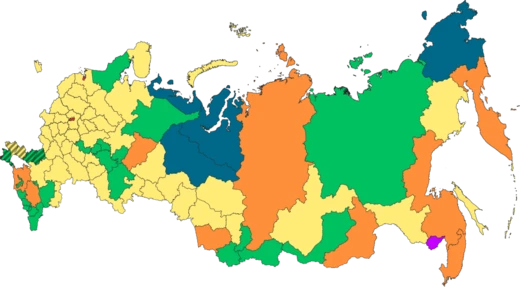
Mordovia
A republic of Russia in Eastern Europe, home to the Mordvin people and the city of Saransk.

Mordovia, officially the Republic of Mordovia, is a republic of Russia, situated in Eastern Europe. Its capital is the city of Saransk. As of the 2010 Census, the population of the republic was 834,755. Ethnic Russians (53.1%) and Mordvins (39.8%) account for the majority of the population.
- Capital
- Saransk
- Area
- 26,200 sq km
- Population (2010 Census)
- 834,755
- Ethnic groups
- Russians 53.1%, Mordvins 39.8%
- Official languages
- Russian, Erzya, Moksha
- Highest point
- 324 m
Lore & Background
The earliest archaeological signs of modern humans in the area of Mordovia are from the Neolithic era. Mordvins are mentioned in written sources from the 6th century. Later, Mordvins were under the influence of both Volga Bulgaria and the Kievan Rus. Mordovia was briefly united under the Principality of Purgaz, led by Erzya prince Purgaz. The Mordvin tribes were plunged into a civil war between Purgaz and Puresh. The Principality of Purgaz survived the war with Vladimir-Suzdal, which ended in 1232, and was later subjugated to the Golden Horde as the Mukhsha Ulus. After the Golden Horde disintegrated in the 1430s, some Mordvins became subjects of the Khanate of Kazan, others were incorporated into Muscovy. After Ivan IV annexed the Khanate of Kazan in 1552, the Mordvin lands were subjugated by the Russian monarchy. In 1925, the Soviet government founded autonomous districts and village councils in the area of the Mordvins. The Mordovian Okrug was founded on 16 July 1928, and it was elevated to an autonomous oblast on 10 January 1930. The autonomous oblast was transformed into the Mordovian Autonomous Soviet Socialist Republic on 20 December 1934. When the Soviet Union disintegrated, the Mordovian ASSR proclaimed itself the Mordovian Soviet Socialist Republic in 1990 and remained a part of the Russian Federation. Mordovia was one of only two republics that did not proclaim sovereignty. On 25 January 1994, it was renamed the Republic of Mordovia.
Reader's Guide
The republic is located in the eastern part of the East European Plain of Russia. Area: 26200 km2. Borders: Nizhny Novgorod Oblast (N), Chuvashia (NE/E), Ulyanovsk Oblast (E/SE), Penza Oblast (S/SW), Ryazan Oblast (W/NW). Highest point: 324 m. There are 114 rivers in the republic. Major rivers include Alatyr, Issa, Moksha, Satis, Sivin, Sura, Vad. There are approximately five hundred lakes. Natural resources include peat, mineral waters, and others. Climate is moderately continental. Average January temperature: −11 C, July: +19 C, annual precipitation: ~500 mm. Mordovia is divided into 22 districts. The city of Saransk is administrated separately as an urban okrug. The head of the government is the Head of the Republic, currently Artyom Zdunov (acting from 18 November 2020). The State Assembly is the legislature. The most developed industries are machine construction, chemicals, woodworking, and food industries. Largest companies include Unimilk, Ruzayevsky Chemical Machine-Building Plant, Mordovcement, Saranskkabel. The Mordvin people are a Volga Finnic group speaking Moksha and Erzya. According to the 2010 Census, Russians make up 53.4%, ethnic Erzya and Moksha 39.8%, Tatars 5.2%, Ukrainians 0.6%. According to a 2012 survey, 68.6% adhere to the Russian Orthodox Church, 5% are unaffiliated Christians, 2% Muslims, 1% Old Believers, 10% spiritual but not religious, 7% atheist, 6.4% follow Buddhism only in Saransk. Some Mordvins adhere to the Mordvin native religion. Important higher education facilities include Mordovian State University and Mordovian State Pedagogical Institute in Saransk.
Did You Know?
- Mordovia was one of only two republics that did not proclaim sovereignty when the Soviet Union disintegrated.
- The Mordvin people are a Volga Finnic group speaking two related languages, Moksha and Erzya.
- The highest point in Mordovia is 324 m, at the crossing of the road from Bolshoy Maresev with the roads to Mokshaley, Pyaigiley, and Picheury.
- During the Soviet era, two written languages were developed, one based on the Erzya dialect in 1922 and one on the Moksha dialect in 1923, both using Cyrillic script.
A Dual Identity — Ethnic Composition and Cultural Life
Mordovia is home to a population of roughly 835,000 (2010 Census), split between two dominant groups: ethnic Russians at 53.1% and Mordvins at 39.8%. This dual character has shaped the republic's cultural landscape for centuries. The Mordvin people appear in written records as early as the 6th century, and their traditions persisted even as the Russian Empire gradually absorbed the region. In the mid-18th century, conversion to Orthodox Christianity began, yet shamanist elements lingered in rural life long after the population became nominally Christian. The Mordvin elite quickly adopted Russian language and customs, while rural communities preserved their own cultural practices. Two written Mordvinic languages were developed during the Soviet era—one based on the Erzya dialect in 1922 and another on the Moksha dialect in 1923, both in Cyrillic script. Earlier, the Latin alphabet had been used in the 18th century, and religious texts such as the 1821 Erzya New Testament served as key vehicles for literary expression in the Mordvinic languages.
From Purgaz to the Republic — A Political Journey
The political story of Mordovia stretches back to the 12th century, when Erzya prince Purgaz united Mordvin tribes under the Principality of Purgaz and resisted colonisation by Vladimir-Suzdal. A civil war between Purgaz, backed by Volga Bulgaria, and Moksha prince Puresh, supported by Vladimir-Suzdal, ended in 1232, after which the region fell under the Golden Horde as the Mukhsha Ulus. The Horde's collapse in the 1430s split Mordvin lands between the Khanate of Kazan and Muscovy. Ivan IV's annexation of Kazan in 1552 brought the Mordvin territories fully under Russian royal control. Under the Soviet system, the region gained increasing autonomy: an okrug in 1928, an autonomous oblast in 1930, and an ASSR in 1934. When the USSR dissolved, Mordovia became one of only two Russian republics that did not proclaim sovereignty, renaming itself the Republic of Mordovia in 1994.
Landscape and Natural Wealth
Mordovia sits in the eastern portion of the East European Plain, spanning 26,200 square kilometers. Its western stretches lie on the Oka–Don Plain, while the central and eastern areas rise into the Volga Upland, reaching a maximum elevation of 324 meters at a road crossing near Bolshoy Maresev. The republic is bordered by five neighboring regions: Nizhny Novgorod Oblast to the north, Chuvashia to the northeast and east, Ulyanovsk Oblast to the east and southeast, Penza Oblast to the south and southwest, and Ryazan Oblast to the west and northwest. Waterways are abundant—114 rivers thread through the territory, including the Sura, Moksha, Sivin, Issa, Satis, Vad, and Alatyr rivers. Approximately five hundred lakes dot the landscape. The climate is moderately continental, with January averaging −11 °C and July around +19 °C, and annual precipitation near 500 millimeters. Natural resources include peat deposits and mineral waters.
Governance and the Experiment with Presidency
Mordovia's political structure has undergone notable shifts since the Soviet era. The republic is divided into 22 raions, with the capital Saransk administered separately as an urban okrug. The supreme law is the Constitution of the Republic of Mordovia, and the legislature is the State Assembly. In 1991, during the broader Parade of Sovereignties, Mordovia established a presidency. Vasily Guslyannikov, a physicist and former senior researcher at the Institute of Power Electronics who led the local branch of Democratic Russia, won the general election that year. However, in 1993 the Supreme Council abolished the presidency, removing Guslyannikov from office. His appeal to the Russian Constitutional Court was rejected. The head of government is now titled Head of the Republic, a post held by Artyom Zdunov since becoming acting head in November 2020, succeeding Vladimir Volkov who served from 2012. Major parties maintain regional offices, though only United Russia and the Communist Party hold seats in the State Assembly.
Frequently Asked Questions
Who is Mordovia?
Mordovia is a constituent republic of the Russian Federation located in Eastern Europe, serving as the ancestral homeland of the Mordvin ethnic group. It has been continuously inhabited by the Erzya and Moksha peoples since roughly the 6th century.
What is Mordovia's capital and how large is the region?
The administrative center is the city of Saransk, and the republic spans approximately 26,200 square kilometers. Its terrain is relatively low, with the highest point reaching just 324 meters above sea level.
What languages are officially recognized in Mordovia?
The republic grants official status to three languages: Russian, Erzya, and Moksha. This trilingual arrangement reflects the region's blend of Russian and indigenous Volga Finnic cultural heritage.
What is Mordovia's population and ethnic composition?
The 2010 census recorded roughly 834,755 residents in the republic. The population is divided between a Russian majority at about 53% and a substantial Mordvin community accounting for approximately 40%.
Why is Mordovia historically significant?
The region's past moves through tribal principalities, subjugation by the Golden Horde and the Khanate of Kazan, absorption into the Russian Empire, and eventual status as a Soviet-era republic. This layered sequence of cultural and political transitions gives Mordovia a uniquely complex identity within the Russian Federation.
More in Russian Regions 1-24
Spotted an error? Know more?
This is a living reference — every entry is fact-audited, and reader corrections feed straight into our audit queue. Suggest an edit · See this site's audit record