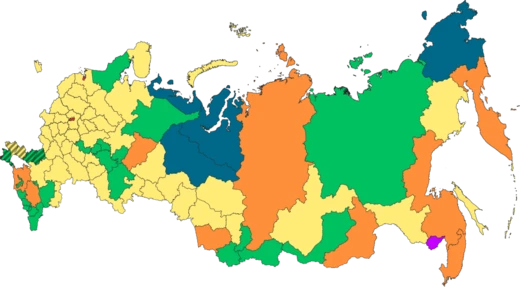
Ulyanovsk Oblast
A Volga region with deep history, from ancient settlements to Soviet industrial development.

Ulyanovsk Oblast is a federal subject of Russia (an oblast). It is located in the Volga Federal District. Its administrative center is the city of Ulyanovsk. It has a population of 1,292,799 (2010 Census). The area of Ulyanovsk Oblast corresponds to the former Simbirsk Governorate which formerly existed as an administrative-territorial unit (guberniya) of the Russian Empire, replacing the Simbirsk Viceroyalty from 1796 and later, Bolshevik Russia. The governorate was renamed to Ulyanovsk Governorate, in honor of Vladimir Lenin (born Ulyanov) who was born in Simbirsk, after his death in 1924. In 1928, Ulyanovsk became an okrug and the present day Ulyanovsk Oblast was formed in 1943 merging some parts of Kuybyshev and Penza Oblasts.
- Founded
- 1943
- Administrative Center
- Ulyanovsk
- Population (2010 Census)
- 1,292,799
- Area
- Corresponds to former Simbirsk Governorate
- Federal District
- Volga Federal District
- Climate
- Warm-summer humid continental (Köppen dfb)
Lore & Background
The first settlements of Middle Volga people were established in this area more than 100,000 years ago. In the 8th and 9th centuries, the Ulyanovsk Volga region became part of early Volga Bulgaria. In the late 14th and early 15th century, Tamerlane desolated Volga Ulyanovsk. In the late 1430s, the region became part of the Kazan Khanate. After the pacification, Simbirsk was gradually settled by Russians who mingled with local Tatars. In the late 1640s, construction of the Karsunsky-Simbirsk defense line began. Twenty-two years after its founding, Simbirsk withstood a siege by Cossacks led by Stepan Razin. In the 18th century, Simbirsk lost its strategic military importance but remained the provincial center. The Bolsheviks took power in Simbirsk on December 10, 1917. In 1918, Simbirsk was captured by Komuch army troops led by General Vladimir Kappel, but on September 12 the Bolsheviks recaptured the city. In 1924, Simbirsk was renamed Ulyanovsk. On May 14, 1928, the Ulyanovsk Governorate was abolished and became part of the newly formed Middle Volga region. During the Great Patriotic War, Ulyanovsk served as a rear area for evacuated enterprises and people. On January 19, 1943, Ulyanovsk Oblast was formed from several districts of Kuybyshev and Penza Oblasts. In the 1950s and 1960s, new enterprises and infrastructure were built. In 1970, Leonid Brezhnev inaugurated the memorial museum of Lenin. After 1991, Ulyanovsk Oblast became part of the Russian Federation. On 30 October 1997, it signed a power-sharing agreement with the government of Russia, which was abolished on 31 December 2001.
Reader's Guide
Ulyanovsk Oblast borders Chuvashia (N), Tatarstan (NE), Samara Oblast (E), Saratov Oblast (S), Penza Oblast (W), and Mordovia (NW). It is located on the northern edge of the Central Steppes. A quarter of its territory is covered with deciduous forests; the rest is steppes and meadows. The oblast is divided by the Volga River. Hilly areas to the west are the Volga Upland (elevations up to 358 m). The eastern part is mostly flat. The water table occupies about 6% of territory. The climate is warm-summer humid continental (Köppen Dfb). Mean temperature is 5 °C, ranging from -13.33 °C to 25.6 °C. The hottest month is July (average 19.5 °C), the coldest is January (average -10.6 °C). Annual precipitation averages 23.13 inches; the wettest month is March (average 3.43 inches). Average wind speed is 16 MPH; the windiest month is April (average 18 MPH). Average humidity is 71%, average dew point 32 °F, average pressure 30.03 HG, average visibility 17 miles. Soils are predominantly chernozem. Forests occupy 1/4 of the territory. In the northwest are large oak forests with linden and maple; in the Transvolga region are meadow steppes and separate pine borons. The area is inhabited by moose, marten, squirrel, hare, and numerous planktonic and marshy-coastal birds. The Kuybyshev Reservoir is home to bream, pike-perch, carp, and others. Protected areas include the national park Sengiley Mountains, the guarding zone of the state preserved 'Volga wooded plain', the monuments of nature Undory mineral source, and relict forests.
Did You Know?
- The oblast was formed in 1943 by merging parts of Kuybyshev and Penza Oblasts.
- The administrative center, Ulyanovsk, was originally named Simbirsk and was renamed in 1924 after Vladimir Lenin, who was born there.
- The Volga River divides the oblast into hilly western and flat eastern parts.
- The region was part of Volga Bulgaria and later the Kazan Khanate before Russian settlement.
More in Russian Regions 1-24
Spotted an error? Know more?
This is a living reference — every entry is fact-audited, and reader corrections feed straight into our audit queue. Suggest an edit · See this site's audit record