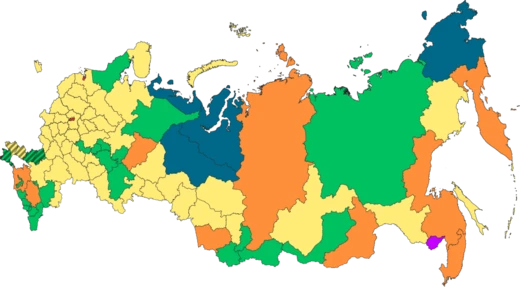
Tyumen Oblast
Russia's oil and gas heartland in Western Siberia.

Tyumen Oblast is a federal subject (an oblast) of Russia. It is located in Western Siberia, and is administratively part of the Ural Federal District. The oblast has administrative jurisdiction over two autonomous okrugs: the Khanty-Mansi and Yamalo-Nenets Autonomous Okrug. The oblast, including its autonomous okrugs, is the third-largest federal subject by area, and has a population of 3,395,755 (2010). Tyumen is the largest city and the administrative center of the oblast, and the first Russian city in Siberia. Tyumen Oblast is the largest producer of oil and natural gas in the country, and has experienced an oil boom since the early 2000s. The rapid growth of the fuel industry has made the oblast by far the richest federal subject of Russia, with an average GDP per capita several times the national average since 2006.
- established
- August 14, 1944
- area
- 160,100 km²
- population
- 3,395,755 (2010 census)
- administrative_center
- Tyumen
- time_zone
- Yekaterinburg time zone (UTC+5; MSK+2)
- GDP_nominal_2016
- ₽5.9 trillion ($104 billion)
- GDP_per_capita_2016
- $28,000
Lore & Background
During the Soviet period, the high authority in the oblast was shared between three persons: The first secretary of the Tyumen CPSU Committee, the chairman of the oblast Soviet, and the Chairman of the oblast Executive Committee. Since 1991, CPSU lost all the power, and the head of the Oblast administration, and eventually the governor was appointed/elected alongside elected regional parliament. The politics in the oblast is governed by the Charter of Tyumen Oblast. The laws within the authority of the oblast are passed by the Legislative Assembly of Tymen Oblast. The highest executive body is the Tyumen Oblast Administration.
Reader's Guide
The territory covers 160,100 km². The Tyumen Oblast was founded on August 14, 1944. It includes two autonomous okrugs of the Khanty-Mansi Autonomous Okrug and Yamalo-Nenets Autonomous Okrug. The territory is located in the basin of the river. The biggest rivers are the Tura, Tobol, Pyshma, Iset, Tavda, Ishim, Agan, Irtysh, Tanama, and Noska. The climate is arctic, subarctic and humid continental in the north, center and south, respectively. The average January temperature ranges from −17 °C in Tyumen Oblast to −27 °C in the north. The region contains more than 70,000 watercourses. The largest navigable rivers are the Ob and Irtysh. There are about 70 thousand lakes. The Red Book of Tyumen Oblast listed 711 rare and endangered species. Tyumen Oblast is in the Yekaterinburg time zone (UTC+5; MSK+2). Transport is presented by the motor, railway, aviation and river communication system. The river port is also a cargo center. Roshchino International Airport is undergoing construction as of 2017.
Did You Know?
- The oblast, including its autonomous okrugs, is the third-largest federal subject by area in Russia.
- Tyumen Oblast is the largest producer of oil and natural gas in the country.
- The region contains more than 70,000 watercourses and about 70 thousand lakes.
- The Red Book of Tyumen Oblast listed 711 rare and endangered species.
- The oblast has a population of 3,395,755 according to the 2010 census.
More in Russian Regions 1-24
Spotted an error? Know more?
This is a living reference — every entry is fact-audited, and reader corrections feed straight into our audit queue. Suggest an edit · See this site's audit record