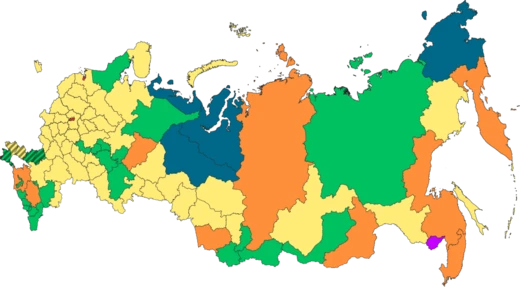
Tomsk Oblast
Siberian taiga, ancient swamps, and a legacy of learning.

Tomsk Oblast is a federal subject of Russia (an oblast) in the southeastern West Siberian Plain, southwest of the Siberian Federal District. Its administrative center is the city of Tomsk. Population: 1,047,394 (2010 Census).
- Established
- August 13, 1944
- Area
- 316,900 square kilometers (122,400 sq mi)
- Population (2010 Census)
- 1,047,394
- Administrative Center
- Tomsk
- Major Natural Resources
- Oil, natural gas, ferrous and non-ferrous metals, peat, forests
- Average Annual Temperature
- 1.75 °C
Lore & Background
The development of the territory began in the early 17th century. Tomsk was founded in 1604. The oblast contains Vasyugan Swamp, the biggest swamp in the northern hemisphere. It borders Krasnoyarsk Krai and Tyumen, Omsk, Novosibirsk, and Kemerovo Oblasts. The oblast is directly divided into four cities and sixteen districts. The four administrative cities are Tomsk, Kedrovy, Strezhevoy, and the closed city of Seversk. Tomsk Oblast is almost entirely taiga; approximately 85% is forested. Major rivers include the Ob, Tom, Chulym, Chaya, Ket, Parabel, Vasyugan, and Tym. The average annual temperature is 1.75 °C, with July average 19.4 °C and January average approximately -19-21 °C. The frost-free season lasts 100–105 days. Mean annual precipitation is 435 millimeters. The oldest settlement is Narym, founded in 1596. Tomsk was founded in 1604 by decree of Tsar Boris Godunov. Tomsk Oblast was re-established on August 13, 1944. The oblast's charter was adopted on July 26, 1995. The current Governor is Vladimir Mazur. The Legislative Duma consists of 42 deputies; the current chairman is Oksana Kozlovskaya. The oblast is rich in natural resources such as oil, natural gas, ferrous and non-ferrous metals, peat, and various waters. Industry makes up about half of regional GDP, agriculture 19%, construction 13%. Major export items are oil (62.1%), methanol (30.2%), and machines and equipment (4.8%). The oblast's main aviation center is Tomsk Airport. 6 railway routes total 346 kilometers. There are 4,204 kilometers of hard-surface road. Major ethnic groups: Russians (92.1%), Tatars (1.7%), Ukrainian-Belarusian (1.4%), Volga Germans (0.9%). Vital statistics for 2024: births 7,586 (7.3 per 1,000), deaths 12,773 (12.3 per 1,000). Total fertility rate (2024): 1.16 children per woman. Life expectancy (2021): total 69.70 years (male 65.03, female 74.36). According to a 2012 survey, 33.3% adhere to Russian Orthodox Church, 4% unaffiliated generic Christians, 2% other Eastern Orthodox, 1% Slavic native faith or indigenous Siberian folk religions, 1% Islam, 0.62% Tibetan Buddhism, 0.4% Catholic; 29% spiritual but not religious, 15% atheist, 13.68% other or no answer. The oblast has six state higher education institutions and 47 research institutes. Tomsk State University was founded in 1888, Tomsk Polytechnic University in 1900, Tomsk State Pedagogical University in 1902. More t
Reader's Guide
The oblast is directly divided into four cities and sixteen districts. The four administrative cities are Tomsk, Kedrovy, Strezhevoy, and the closed city of Seversk. Air transport: Tomsk Airport, remodeled in April 2013 for international flights. Rail transport: 6 routes totaling 346 kilometers, with direct routes from Adler to Vladivostok. Road transport: 4,204 kilometers of hard-surface road as of 2015; a plan to link disconnected road systems by 2030.
Did You Know?
- Tomsk Oblast contains Vasyugan Swamp, the biggest swamp in the northern hemisphere.
- The first university in Asian Russia, Tomsk State University, was founded in 1888.
- Tomsk is often dubbed the 'Siberian Athens' for its unique spirit.
- The oblast's major export item is oil, accounting for 62.1% of exports.
More in Russian Regions 1-24
Spotted an error? Know more?
This is a living reference — every entry is fact-audited, and reader corrections feed straight into our audit queue. Suggest an edit · See this site's audit record