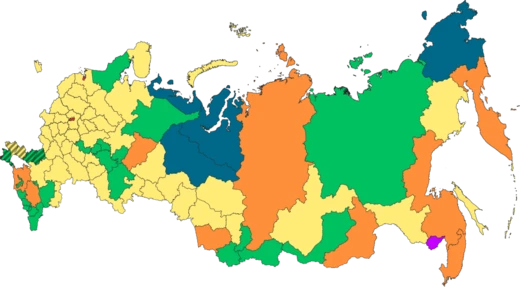
Tatarstan
Republic of Tatarstan: A Volga Federal District republic with a rich history, oil wealth, and cultural ties to Bashkortostan.

Tatarstan, officially the Republic of Tatarstan, sometimes also called Tataria, is a republic of Russia located in Eastern Europe. It is a part of the Volga Federal District; and its capital and largest city is Kazan, an important cultural centre in Russia. The region's main source of wealth is oil with a strong petrochemical industry. The republic borders the oblasts of Kirov, Ulyanovsk, Samara, and Orenburg, as well as the republics of Mari El, Udmurtia, Chuvashia, and Bashkortostan. Tatarstan has strong cultural, linguistic and ethnic ties with its eastern neighbour, Bashkortostan, which is also a republic of Russia. The area of Tatarstan is 68000 km2, occupying 0.4% of the total surface of the country. As of the 2021 census, the population of Tatarstan was 4,004,809.
- Capital
- Kazan
- Area
- 68,000 square kilometres (26,000 mi²)
- Population (2021 census)
- 4,004,809
- Official languages
- Tatar and Russian
- Head of republic
- Rustam Minnihanov
- Major natural resource
- Oil, natural gas, gypsum
Lore & Background
The earliest known organised state within the boundaries of Tatarstan was Volga Bulgaria, which adopted Islam in 922. This is celebrated yearly in the city of Bolgar. Other historical predecessors of Tatarstan include the Golden Horde and the Khanate of Kazan, before ultimately being conquered by Russia. In 1920, the modern Tatar state, known as the Tatar ASSR, was founded as an autonomous republic of the Russian SFSR. It was renamed the Republic of Tatarstan in 1992 and became a federal subject of Russia.
Reader's Guide
The official languages of the republic are Tatar and Russian. The head of Tatarstan is Rustam Minnihanov. Religious leaders include the mufti Kamil Samigullin and the metropolitan bishop Cyril Nakonechny. The republic is located in the centre of the East European Plain, approximately 800 km east of Moscow. It lies between the Volga River and the Kama River (a tributary of the Volga), and extends east to the Ural Mountains. Major rivers include the Volga, Kama, Vyatka, Belaya, Ik, Kazanka, Zay, and Azevka. Major reservoirs include Kuybyshev Reservoir, Lower Kama Reservoir, and Zainsk Reservoir. The biggest lake is Kaban. The biggest swamp is Kulyagash. Hills include Bugulma-Belebey Upland, Volga Upland, and Vyatskiye Uvaly. Natural resources include oil, natural gas, and gypsum. Climate: average January temperature -15°C, average July temperature +18°C, average annual temperature +4°C, average annual precipitation up to 500 to 550 mm.
Did You Know?
- The earliest known organised state within the boundaries of Tatarstan was Volga Bulgaria, which adopted Islam in 922.
- Tatarstan's area is 68000 km2, occupying 0.4% of the total surface of the country.
- The republic's main source of wealth is oil with a strong petrochemical industry.
- The Volga-Kama Nature Reserve is situated in Tatarstan.
More in Russian Regions 1-24
Spotted an error? Know more?
This is a living reference — every entry is fact-audited, and reader corrections feed straight into our audit queue. Suggest an edit · See this site's audit record