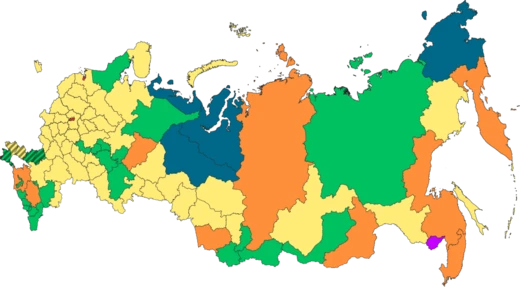
Tambov Oblast
Tambov Oblast: a forest-steppe region with a rich history and strong Orthodox traditions.

Tambov Oblast is a federal subject of Russia (an oblast). Its administrative center is the city of Tambov. As of the 2010 Census, its population was 1,091,994.
- Population (2010 Census)
- 1,091,994
- Population (2021 Census)
- 982,991
- Administrative Center
- Tambov
- Established
- September 27, 1937
- Area (historical governorate)
- 66.5 thousand km²
- Ethnic Majority (2010)
- Russians 97%
- Religious Majority (2012 survey)
- Russian Orthodox 78.4%
Quick Facts
- En Name
- Tambov Oblast
- Flag Size
- 125px
- Anthem
- "Farewell of Slavianka"
- Political Status
- Oblast
- Political Status Link
- Oblasts of Russia
- Federal District
- Central
- Economic Region
- Central Black Earth
- Adm Ctr Type
- Administrative center
- Adm Ctr Name
- Tambov
- Pop 2021Census
- 982991
- Pop 2021Census Rank
- 52nd
- Urban Pop 2010Census
- 58.7%
Facts from the source article.
Lore & Background
The oldest known population of the Tambov region, the Mordovians-Moksha, formed as a nation of local ethnic groups from the 6th century BC. The first Russian settlers arrived in the pre-Mongol period, but the final settlement occurred in the 17th century. To protect the southern borders of Russia from the raids of the Tatars, and to further develop the Black Soil region, the Russian government built the walled cities of Kozlov (1635) and Tambov (1636). The cities protected the main path of nomad raids on Russian land and paved the way for a quick settlement of the region. Kozlovsky Uyezd originally existed in the Tambov area. In the course of the administrative reforms of Peter the Great in 1708 and 1719, it became part of Azov Governorate. New administrative divisions established the Tambov Viceroyalty in 1779 and from 1796 Tambov Governorate, with an area of 66.5 thousand km2 divided into 12 uyezds. With almost no change to its boundaries, the Governorate remained in existence until 1928. An attempt to establish Soviet control over the Tambov area led to the defeat and execution of "Red Sonya" (Sofia Nukhimovna Gel'berg) in the spring of 1918. During the Russian Civil War, an anti-Bolshevik uprising, the Tambov Rebellion, broke out in Tambov Governorate in 1920–1921. Tambov Oblast was finally created from the Voronezh and Samara Oblasts on September 27, 1937. The oblast attained its present form after the separation of Penza Oblast (formerly part of Kuybyshev before joining Tambov) on February 4, 1939.
Reader's Guide
Tambov Oblast is situated in a forest steppe. It borders the Ryazan, Penza, Saratov, Voronezh and Lipetsk oblasts. The acting head of the administration of the Tambov Oblast since 4 October 2021 and Head of the Tambov Oblast since 20 September 2022 is Maxim Yegorov. Elections to the Regional Duma were held from 17 to 19 September 2021. 25 seats were distributed by party lists and 25 by single-member constituencies. The seats at the end of the elections were distributed as follows: United Russia — 42, Rodina — 3, Communist Party of the Russian Federation — 3, Liberal Democratic Party of Russia — 1, A Just Russia — 1. Southeastern Railway passes through Michurinsk and connects the central regions with the southern regions. Breeding cattle, sheep, pig, and chicken is a product of animal husbandry.
Did You Know?
- According to a 2012 survey, 78.4% of the population of Tambov Oblast adheres to the Russian Orthodox Church, making it the federal subject with the highest percentage of this religion in the whole country.
- As of the 2010 Census, the ethnic composition was 97% Russian, 0.7% Ukrainian, 0.4% Armenian, 0.4% Romani, and 1.5% others.
- Vital statistics for 2024: births 5,854 (6.2 per 1,000), deaths 15,095 (15.9 per 1,000), total fertility rate 1.16 children per woman.
Frequently Asked Questions
Who is Tambov Oblast?
Tambov Oblast is a federal subject of the Russian Federation headquartered in the city of Tambov. It was officially created on September 27, 1937, and occupies a stretch of the central-Russian forest-steppe zone.
What are Tambov Oblast's powers and role?
As a first-level administrative unit, it governs a territory of roughly 66,500 square kilometers and coordinates regional policy within Russia's federal structure. It shares its borders with five neighboring oblasts: Ryazan, Penza, Saratov, Voronezh, and Lipetsk.
How does Tambov Oblast's story end?
Its most recent arc is defined by steady population decline, falling from about 1.09 million in 2010 to under 983,000 by 2021. The oblast itself remains an active federal subject, so the narrative is still unfolding rather than concluded.
Why is Tambov Oblast important?
The region is best known as the birthplace of the 1920–1921 Tambov Rebellion, one of the largest peasant uprisings in early Soviet history. It also functions as a key agricultural zone within the Russian forest-steppe belt.
What is Tambov Oblast's demographic profile?
Per the 2010 Census, ethnic Russians comprised approximately 97% of the roughly 1,091,994 residents. By the 2021 count, that figure had slipped below one million, reflecting the broader depopulation trend across central Russia.
More in Russian Regions 1-24
Spotted an error? Know more?
This is a living reference — every entry is fact-audited, and reader corrections feed straight into our audit queue. Suggest an edit · See this site's audit record