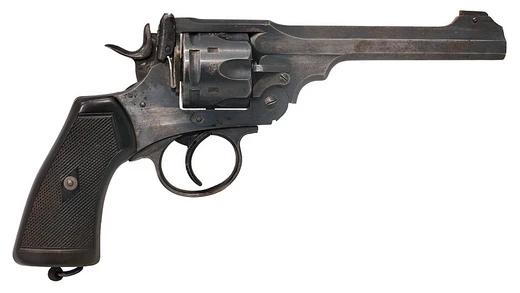
Webley RIC
Early British breechloading revolver adopted by the Royal Irish Constabulary.

The Webley Royal Irish Constabulary revolver, a British double-action centerfire revolver, first appeared in 1867. It was among the earliest British breechloading revolvers and became the first product from Philip Webley and Son of Birmingham to achieve widespread fame, establishing the firm's reputation.
The revolver was originally designed for the .442 centerfire cartridge. Its solid frame featured a round barrel screwed into the frame and a one-piece wooden grip secured by two vertical screws. The foresight was slotted in, typically semi-round, while the backsight was a long, V-shaped groove on the top strap above the cylinder. A loading gate, hinged at the bottom and held by a flat spring, opened sideways. Early models had a plain six-chambered cylinder; later versions were fluted to reduce weight. The ejector rod, mounted on a swivel yoke under the barrel, was mostly housed in the hollow cylinder arbor, allowing it to be pulled out and swung to the right. Drawing the arbor forward permitted removal of the cylinder. The double-action lock included a half-cock position for loading.
In 1868, the newly formed Royal Irish Constabulary, a paramilitary force, adopted the revolver as its first service weapon, giving the model its name. The revolvers were produced in a variety of calibers, none smaller than .410 inch (10.4 mm), and were widely used throughout the British Empire, with copies appearing in several European countries. A pocket model with a 2.5-inch barrel, chambered in .442, was introduced in 1872 and served as the precursor to the famous British Bulldog revolvers.
A slightly smaller and lighter variant, the No. 2 model, entered production in 1872. It measured 8.25 inches overall with a 3.5-inch barrel and weighed 0.76 kg, retaining the same general characteristics. Calibers ranged from .320 and .380 to .450. While service revolvers held six shots, smaller five-shot commercial versions also proved popular.
Beyond the Royal Irish Constabulary, the Webley RIC saw extensive use by United Kingdom and colonial forces. It quickly became a favorite among British Army officers, who were required to purchase their own sidearms, due to its robustness, compactness, and reliability. Officers, cavalry soldiers, and irregulars carried it during the Anglo-Zulu War of 1879, where combat experience showed it was most effective within 25 yards.
Quick Facts
- Origin
- United Kingdom
- Is Ranged
- yes
- Service
- 1867–1918
- Wars
- Fenian Raid / Anglo-Zulu War / Second Afghan War
- Design Date
- 1867
- Manufacturer
- Webley & Scott, Birmingham
- Production Date
- 1867-1898
- Variants
- No 1 & No 2 Model
- Weight
- 30 oz (0.85 kg), unloaded
- Length
- 9.25 in. (235 mm)
- Part Length
- 4.5 in. (114 mm)
- Cartridge
- .442 Webley cartridge
Facts from the source article.
Lore & Background
British armsmaker Philip Webley and Son of Birmingham produced their first caplock revolvers in 1853 with limited success. Taking lead in the new centerfire metal cartridge technology, they produced their first breechloading, centerfire cartridge revolvers in 1867. These were the first popular Webley product that made the firm famous. In 1868, the Royal Irish Constabulary was formed as a paramilitary force armed with carbines and revolvers. As the Webley revolver was adopted as their first service weapon, it became known as the Royal Irish Constabulary revolver.
The revolver has a solid frame with a round barrel screwed into the frame, and a one-piece wooden grip held by two vertical screws. The foresight is slotted in, mostly semi-round, while the backsight is a long, V-shaped groove on the top strap above the cylinder. It has a loading gate hinged at the bottom that opens sideways, held by a flat spring. The ejector rod is mounted on a yoke under the barrel and mostly housed in the hollow cylinder arbor, so it can be pulled out and swung to the right when needed. These revolvers were made in a variety of calibers, but no less than .410 in. They were widely used all over the British Empire and copied in various European countries. In 1872, a pocket model with a 2.5 in barrel was produced, which was the precursor of the famous British Bulldog revolvers.
A slightly smaller model (No. 2) was produced from 1872, with an 8.25 in length, 3.5 in barrel, and weight of 0.76 kg, with the same overall characteristics. They were made in calibers from .320 and .380 to .450. Service revolvers were six-shot, but smaller commercial 5-shot variants were also very popular.
Reader's Guide
The Webley RIC was one of the earliest British breechloading revolvers and one of the most popular British revolvers of the 19th century. Due to their quality, they remained in production for more than 30 years. Aside from the Royal Irish Constabulary, they were used extensively by United Kingdom and colonial forces. They immediately became popular with British Army officers, who at the time were expected to purchase their own personal weapons on their own expense, as very robust, compact and reliable weapons. British officers, cavalry soldiers and irregulars carried the Webley RIC in the Anglo-Zulu War of 1879. Actual combat usage showed that the revolver was at its most effective within 25 yards. The revolver's legacy is tied to its role as a standard sidearm for British forces and its influence on later designs, notably the British Bulldog revolvers.
Did You Know?
- The Webley RIC was designed in 1867 for the .442 centerfire cartridge.
- It was adopted as the first service weapon of the Royal Irish Constabulary, formed in 1868.
- The No. 2 model weighed 0.76 kg and had a 3.5 in barrel.
More in Revolvers, Part 2 1-24
Spotted an error? Know more?
Reader corrections go straight into our review queue. Suggest an edit · How this site is sourced