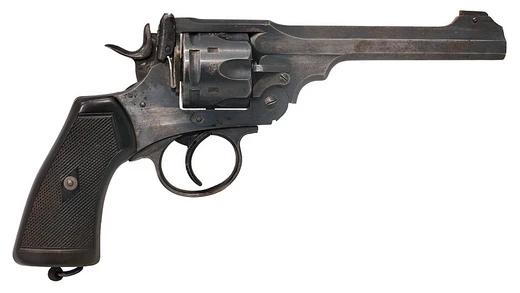
Colt Dragoon Revolver
A .44 caliber percussion revolver developed from the Colt Walker.

The Colt Dragoon Revolver, a .44 caliber percussion handgun, was Samuel Colt’s answer to the flaws of the earlier Colt Walker. Designed for the U.S. Army’s Mounted Rifles and issued to its Dragoon regiments, it fixed the Walker’s four-and-a-half-pound weight, its tendency for cylinders to explode from overloading, and a habit of the loading lever dropping during recoil, which jammed the action. Though it arrived after the Mexican–American War, it caught on with civilians in the 1850s and 1860s and was used in the American Civil War.
Production ran from 1847 to 1860, when the Colt Model 1860 took over. Improvements made to Colt revolvers in general also applied to the Dragoons and smaller models. Total production, including 1,100 Walkers, came to 19,800, plus 750 Dragoons in a separate run for the British market. Collectors recognize three main types plus one transition model.
The Whitneyville Hartford Dragoon, or Transitional Dragoon, was built at the Eli Whitney factory between late 1847 and 1848. About 240 were made, with a 7.5-inch barrel and a 2.1875-inch cylinder—shorter than the Walker’s and still using oval cutouts for the bolt. They looked much like later Dragoons. Serial numbers ran from about 1100 (the last civilian Walker) to roughly 1340 (the first First Model). Two frame variations exist: an earlier one with a cut-out for rounded grips, and a straight-backed version. These had very slender “Slim Jim” grips. Gaps in serial numbers and details of the Second Government Contract later led to the mistaken idea of a “fluck Dragoon.”
The First Model began production in 1848 under Colt’s Second Government Contract. It had rectangular cylinder stops, a V-shaped mainspring, no wheel on the rear of the hammer, and a square-back trigger guard. Colt made about 7,000 between 1848 and 1850.
The Second Model also used rectangular cylinder notches. Up to serial number 10,000, the V-shaped mainspring was standard; after that, a flat leaf mainspring and a wheel on the hammer at its bearing on the mainspring replaced it. All Second Models kept the square-back trigger guard. About 2,550 were made in 1850 and 1851.
The Third Model ran from 1851 through 1860, with numbers reaching ten thousand. It had more variations than earlier models: some had frame cuts for detachable shoulder stocks, horizontal loading lever latches, and folding leaf sights.
Quick Facts
- Origin
- United States
- Is Ranged
- yes
- Service
- 1848–1865
- Wars
- American Indian Wars, American Civil War
- Designer
- Samuel Colt
- Design Date
- 1848–1850
- Manufacturer
- Colt Firearms
- Production Date
- 1848–1860
- Number
- About 18,500 in U.S.A.
- Variants
- Walker Transitions, First and Second Models
- Weight
- 4 lb
- Length
- 14.75 in
Facts from the source article.
Lore & Background
The Colt Dragoon Revolver was produced in several variations between 1847 and 1860, when the Colt Model 1860 revolver replaced it. The Whitneyville Hartford Dragoon, or Transitional Dragoon, was produced at the Eli Whitney factory between late 1847 and 1848, with a barrel length of 7.5 inches and a cylinder diameter of 2.1875 inches. These had 'Slim Jim' grips and two frame variations. The First Model, stemming from Colt's Second Government Contract, began production in 1848 and featured rectangular cylinder stops, a V-type mainspring, and a square back trigger guard; about 7,000 were made through 1850. The Second Model, produced in 1850 and 1851, had rectangular cylinder notches and a square back trigger guard, with about 2,550 made. The Third Model, numbering ten thousand from 1851 to 1860, had a round trigger guard and variations including frame cuts for shoulder stocks, horizontal loading lever latches, and folding leaf sights. Government records showed an order for 8,390 Dragoons.
Reader's Guide
The Colt Dragoon Revolver addressed the Walker's shortcomings: its 4.5-pound weight made it suitable only as a saddle-mounted revolver; its cylinders sometimes exploded due to overloading; and its loading lever could drop during recoil, locking the action. The Dragoon had a shorter cylinder (preventing overloading) and a loading lever latch to keep the lever in place, reducing weight to 4 pounds and lowering explosion risk. It was carried in pommel holsters on saddles. The Dragoon gained popularity among civilians in the Southwest, many of whom had served in the Mexican–American War. Famous users included Joaquin Murietta, Charley Parkhurst, James Douglas Byrd, Tiburcio Vasquez, Union general George B. McClellan, and fictional Augustus McCrae in Lonesome Dove. Clint Eastwood carried a Third Model Dragoon in The Outlaw Josey Wales. The Dragoon is now a collectible arm. Non-firing replicas were made by Denix in Spain; after a 2005 fire destroyed the mold, Denix reintroduced a nickel model. Quality replicas are produced by Aldo Uberti in Italy and distributed by Taylors, Inc. and Cimarron Firearms. Velocities with .451–.457 inch round balls of about 141 grains over 50 grains of powder range from 1000 to 1100 ft/s.
Did You Know?
- The Colt Dragoon Revolver was developed to solve problems with the Colt Walker, including cylinder explosions and loading lever drop.
- The Whitneyville Hartford Dragoon, or Transitional Dragoon, had 'Slim Jim' grips and was produced at the Eli Whitney factory.
- The Third Model Dragoon had a round trigger guard and could accept detachable shoulder stocks.
- Fictional character Mattie Ross used a Colt Dragoon in the 2010 film True Grit, as in the original novel.
Frequently Asked Questions
What is the Colt Dragoon Revolver?
It is a .44 caliber percussion handgun that Samuel Colt developed as a practical successor to the Colt Walker. The U.S. Army issued it to its Mounted Rifles and Dragoon regiments, and it later became a popular civilian sidearm through the 1850s and 1860s, seeing combat in the Civil War.
How does the Colt Dragoon improve on the Colt Walker?
The Dragoon cut the Walker's roughly four-and-a-half-pound weight down to about four pounds and strengthened the cylinder so it no longer risked exploding from overcharging. Colt also reworked the loading lever mechanism so the part stopped dropping out of position during recoil, which had been a common jamming issue on the Walker.
What are the Colt Dragoon Revolver's key specifications?
It fires .44 caliber percussion rounds from a 7.5-inch barrel (extended to 8 inches on later production models), accepts up to 50 grains of black powder, and tips the scales at approximately four pounds.
When was the Colt Dragoon in production and how many were made?
Colt manufactured the model from 1847 until 1860, when the Model 1860 superseded it. Total output reached roughly 19,800 units for the American market (a figure that includes about 1,100 earlier Walkers) plus an additional 750 produced for British buyers.
Why is the Colt Dragoon Revolver significant in firearms history?
It proved that the Walker's ambitious early design could be refined into a dependable, field-ready sidearm, bridging the gap between Colt's experimental prototypes and the battle-tested revolvers that followed. Its engineering lessons fed directly into the Model 1860, which became one of the most recognizable handguns of the Civil War era.
More in Revolvers, Part 2 1-24
Spotted an error? Know more?
Reader corrections go straight into our review queue. Suggest an edit · How this site is sourced