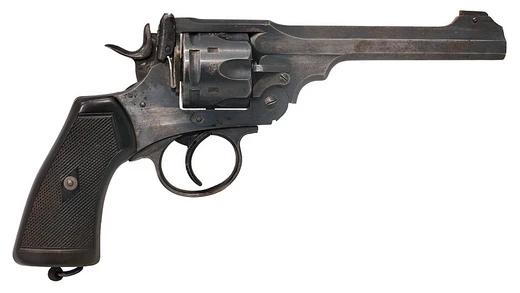
Colt M1861 Navy
A .36-caliber percussion revolver produced from 1861 to 1873.

The Colt Model 1861 Navy is a six-shot, single-action percussion revolver that fires .36-caliber balls. Colt’s Manufacturing Company built it from 1861 to 1873. It uses the same creeping or ratchet loading lever and round barrel found on the .44-caliber Colt Army Model 1860, but its barrel is half an inch shorter, measuring 7.5 inches. Only 38,000 of these revolvers were made.
Like its predecessor, the Colt 1851 Navy, the 1861 Navy saw heavy use during the American Civil War and on the Western frontier, though far fewer were produced. It shares the same general specifications as the earlier model, but features a rounded barrel and a slightly different rammer. While similar in design to the Colt Army Model 1860, some cavalry soldiers preferred the 1861 Navy because its .36-caliber round produced lighter recoil.
During the Civil War, its main competitor in England was the Adams self-cocking revolver, which fired a .49-caliber bullet and did not require the shooter to manually pull back the hammer. Colt’s revolver proved more popular because Colt mass-produced its weapons, whereas Adams’ products were handmade by skilled artisans. In the United States, Colt’s primary rival was the Remington Model 1858.
The Model 1861 Navy had few variations. About 100 of the earliest guns had fluted cylinders without the standard cylinder scene. Another 100, falling between serial numbers 11,000 and 14,000, were cut to accept a shoulder stock—the lower part of the recoil shield was milled away, and a fourth screw for the stock was added to the frame. With the exception of the first fifty or so, all guns had a capping groove. A silver-plated brass trigger guard and back strap were standard. The cylinders of both the 1851 and 1861 Navy revolvers are engraved with a scene depicting the victory of the Second Texas Navy at the Battle of Campeche on May 16, 1843, an engraving provided by Waterman Ormsby.
The Colt 1861 Navy was typically used with paper cartridges—a nitrated paper tube containing a pre-measured black powder charge and either a lead round ball or a lead conical bullet. The nitrated paper burned completely on firing, allowing faster reloading. Alternatively, it could be loaded with separate measured powder charges and lead round balls.
Quick Facts
- Origin
- United States
- Is Ranged
- yes
- Service
- 1861–1873
- Used By
- United States · Confederate States · Native Americans · United Kingdom · Australia · Canada · Empire of Japan
- Wars
- American Civil War · American Indian Wars · Boshin War · Satsuma Rebellion · Fenian Raid · Fenian Rising · Red River Rebellion
- Designer
- Samuel Colt
- Manufacturer
- Colt's Manufacturing Company
- Production Date
- 1861-1873
- Number
- 38,000
- Variants
- 100 revolvers produced with full fluted cylinders
- Weight
- 42 oz
- Length
- 13 in
Facts from the source article.
Lore & Background
The Colt Model 1861 Navy saw widespread use in the American Civil War and on the American Western frontier, though far fewer were produced than its forerunner, the Colt 1851 Navy Revolver. It has the same general specification as the earlier model but with a rounded barrel and somewhat different rammer. While similar in design to the Colt Army Model 1860, the lighter recoil of the .36 caliber was preferred by some cavalry soldiers.
During the Civil War its main competitor in England was the Adams self-cocking revolver, which fired a .49 caliber bullet and did not require the shooter to pull the hammer back. Colt's revolver was more popular because Colt mass-produced his weapons while Adams' products were handmade by skilled artisans. In the United States, Colt's main rival was the Remington Model 1858 revolver.
There were few variations of the Model 1861 Navy. Approximately 100 of the first guns had fluted cylinders with no cylinder scene. Another 100, made between serial ranges 11,000 and 14,000, were cut for a shoulder stock. With the exception of the first fifty or so, all guns had a capping groove. A brass trigger guard and back strap, silver-plated, were standard. The cylinders are engraved with a scene of the victory of the Second Texas Navy at the Battle of Campeche on May 16, 1843, provided by Waterman Ormsby. The revolver typically was used with paper cartridges, which enabled faster reloading, or could be loaded with measured powder charges and lead round balls.
Reader's Guide
After the expiration of the Rollin White Patent on April 3, 1869, a number of Navy 1861 revolvers and their forerunner, the Colt 1851 Navy Revolver, were converted or newly made to fire .38 rimfire or centerfire cartridges, known as the Colt Model 1861 Richards-Mason Conversion by the Colt factory. The Model 1861 Navy represents a transitional design between the earlier percussion revolvers and the cartridge-firing handguns that followed. Its production run of 38,000 units, while modest compared to the 1851 Navy, ensured its presence in both Civil War and frontier contexts. The revolver's use of paper cartridges and its compatibility with later cartridge conversions illustrate the technological shift in firearms during the latter half of the 19th century. The engraved cylinder scene, depicting a naval battle, ties the revolver to Texas history and the artistry of Waterman Ormsby.
Did You Know?
- The Colt 1861 Navy has a barrel 7.5 inches long, half an inch shorter than the Colt Army Model 1860.
- After 1869, many were converted to fire .38 rimfire or centerfire cartridges as the Richards-Mason Conversion.
Frequently Asked Questions
What is the Colt M1861 Navy?
It is a six-shot, single-action percussion revolver chambered in .36 caliber that Colt's Manufacturing Company built from 1861 to 1873. The gun features a 7.5-inch round barrel and a creeping loading lever for cycling the cylinders.
What are the Colt M1861 Navy's key specs?
The revolver fires .36-caliber balls, holds six rounds, and operates on a single-action percussion system with a 7.5-inch barrel. Production ran for twelve years, ending in 1873.
How many Colt M1861 Navy revolvers were actually made?
Only 38,000 units left the factory during its production window. That makes it considerably rarer than the .44-caliber Colt Army Model 1860, which shared the same basic frame and loading-lever mechanism.
What was the Colt M1861 Navy used for in real history?
It served heavily on both sides of the American Civil War and continued into everyday use on the Western frontier. It essentially filled the same compact-sidearm niche as the earlier Colt 1851 Navy, just in a slightly larger frame.
How does the Colt M1861 Navy compare to the Colt 1860 Army?
Both revolvers share the creeping loading lever and round-barrel layout, but the 1861 Navy is chambered in .36 caliber with a barrel half an inch shorter at 7.5 inches. The 1860 Army, by contrast, is a .44-caliber weapon with a slightly longer barrel.
More in Revolvers, Part 2 1-24
Spotted an error? Know more?
Reader corrections go straight into our review queue. Suggest an edit · How this site is sourced