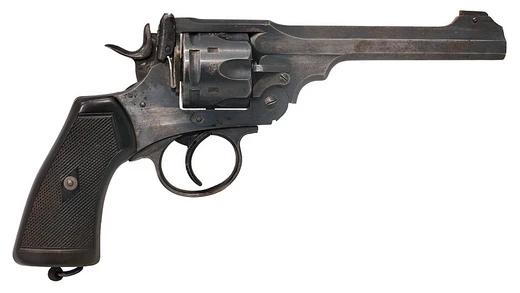
Bodeo Model 1889
Italian service revolver used from 1891 through World War II.

The Bodeo Model 1889 is an Italian solid-framed, six-shot revolver named after Carlo Bodeo, head of the Italian firearm commission that recommended its adoption. It served as the principal handgun of the Royal Italian Army from 1891, seeing use in World War I, interwar colonial campaigns, and World War II, and remained a reserve weapon until the end of the latter conflict.
Quick Facts
- Origin
- Kingdom of Italy
- Is Ranged
- YES
- Used By
- Royal Italian Army
- Wars
- Italo-Turkish War / Boxer Rebellion / World War I / Second Italo-Abyssinian War / Spanish Civil War / World War II
- Production Date
- 1889 to c. 1931
- Weight
- 950 g
- Length
- 232 mm
- Part Length
- 115 mm
- Cartridge
- 10.35mm Ordinanza Italiana · it · 10,35 × 20 mm
- Action
- Single-action
- Velocity
- 256 m/s
- Feed
- 6 round cylinder
Facts from the source article.
Lore & Background
The Bodeo Model 1889 was produced by a wide variety of Italian and Spanish manufacturers between 1889 and 1931. Italian makers included Societa Siderurgica Glisenti, Castelli of Brescia, Metallurgica Bresciana, and Vincenzo Bernardelli. During World War I, Spanish firms Errasti and Arrostegui of Eibar also produced the revolver for the Italian government. The revolver was nicknamed coscia d’agnello ('leg of lamb') by Italian troops.
The design featured a solid frame with a barrel, cylinder, trigger components, loading gate, ejection rod, springs, and screws made of steel, while the frame, backplate, and ejection rod collar were iron. An external hammer block drop safety was retrofitted to many revolvers in 1894, later replaced by an internal safety during an arsenal refinishing program in 1915. Early infantry models were produced 'in the white' (unfinished), but many were later blued.
Two main versions existed: the Tipo A for enlisted soldiers, with an octagonal barrel and a folding trigger; and the Tipo B for officers, with a trigger guard. Both had octagonal barrels, though a later lightweight Alleggerito model introduced a round barrel for civilian and police use. The folding-trigger Tipo A was produced in greater numbers.
Reader's Guide
The Bodeo Model 1889 was the standard Italian service revolver for over five decades, from its adoption in 1891 until increasingly supplanted by the Glisenti Model 1910. It was never declared obsolete and remained in reserve through World War II. The revolver saw action in World War I, interwar Italian colonial wars, and World War II, and was designated Revolver 680(i) by the Wehrmacht when used as an alternative firearm.
Its production spanned numerous manufacturers in Italy and Spain, leading to considerable variation in quality. Early models from the Brescia Arsenal and Glisenti Brescia (1889–1906) exhibited higher workmanship than wartime examples. The revolver was considered simple and robust, with a hammer block safety that prevented firing unless the trigger was fully cocked. The Tipo B was also adopted by local police forces and Italian customs officers. The Alleggerito variant, designed in the 1920s to reduce weight, saw limited military service but was sold to civilians and some police agencies.
Did You Know?
- The Wehrmacht designated the Bodeo as Revolver 680(i) during World War II.
- Early Tipo A revolvers were produced 'in the white' (unfinished) and later arsenal-refinished with bluing and an internal hammer block safety in 1915.
- The round barrel appeared only on the lightweight Alleggerito model, not on the standard Tipo B.
Frequently Asked Questions
What is the Bodeo Model 1889?
It is an Italian solid-framed, six-shot revolver that served as the Royal Italian Army's principal sidearm from 1891 through the end of World War II.
Who was Carlo Bodeo?
Carlo Bodeo led the Italian firearm commission that recommended adopting the revolver for military service, and the weapon took its name from him.
What variants of the Bodeo Model 1889 were produced?
Three main versions were made: Tipo A issued to enlisted soldiers, Tipo B for officers, and the Alleggerito as a reduced-weight option.
Who manufactured the Bodeo Model 1889?
Production spanned 1889 to 1931 and involved several Italian and Spanish workshops, including Societa Siderurgica Glisenti, Castelli of Brescia, Metallurgica Bresciana, Vincenzo Bernardelli, and Errasti and Arrostegui of Eibar.
In which wars did the Bodeo Model 1889 see combat?
The revolver was carried in World War I, Italy's interwar colonial operations, and World War II, where it persisted as a reserve sidearm until the war's conclusion.
More in Revolvers, Part 2 1-24
Spotted an error? Know more?
Reader corrections go straight into our review queue. Suggest an edit · How this site is sourced