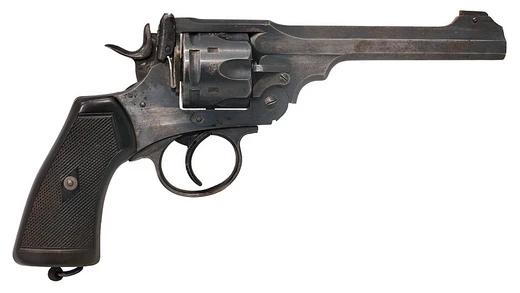
Colt Army Model 1860
The most widely used revolver of the American Civil War.

The Colt Army Model 1860 is a cap-and-ball, .44-caliber, single-action revolver manufactured by Colt's Manufacturing Company. It served as a sidearm for cavalry, infantry, artillery, and naval forces during the American Civil War, becoming the conflict’s most commonly used revolver.
The 1860 Army shares its frame size with the .36-caliber 1851 Navy revolver. To accommodate a .44-caliber chamber, the frame is relieved for a rebated cylinder—the rear portion of the cylinder is turned to a smaller diameter than the front. The barrel’s forcing cone is noticeably shorter than that of the 1851 Navy, allowing for a longer cylinder. A “creeping” loading lever, first seen on the Colt 1855 Sidehammer Revolver, is another distinguishing feature.
Production ran from 1860 through 1873, with over 200,000 units made. The U.S. government was Colt’s largest customer, purchasing at least 129,730 revolvers for troops. The single-action, six-shot revolver was accurate from 75 to 100 yards, with fixed sights set at the factory. The rear sight is a notch in the hammer, usable only when the hammer is fully cocked. It fired a 0.454-inch round lead ball or a conical bullet, typically propelled by a 30-grain black-powder charge ignited by a copper percussion cap containing fulminate of mercury. Muzzle velocity was around 900 feet per second, depending on the powder load.
The frame lacks a top strap; strength comes from the lower frame and a massive fixed cylinder pin. This design made the gun slimmer and lighter than the Remington Model 1858, but removing the cylinder required taking off the barrel, unlike the Remington’s removable cylinder pin. The barrel is rounded and smoothed into the frame, similar to the 1861 Navy Model. The frame, hammer, and rammer lever were case-hardened, with the rest blued. Grips are one-piece walnut, the trigger guard and front grip strap are brass, and the backstrap is blued.
By April 1861, 2,230 early-production revolvers had gone to dealers south of the Mason–Dixon line. In May 1861, the U.S. Navy ordered 900 fluted-cylinder revolvers, later issued to ships enforcing the Atlantic and Gulf blockade. U.S. Army orders also began in May, totaling 127,157 delivered. The 1860 was the most prolifically used revolver by Union forces throughout the war.
Quick Facts
- Origin
- United States
- Is Ranged
- yes
- Service
- 1860–1873
- Used By
- United States / Confederate States / Native Americans / United Kingdom / Canada / Australia / Empire of Japan / Empire of Brazil
- Wars
- American Civil War / American Indian Wars / Boshin War / Fenian raid / Red River Rebellion
- Designer
- Samuel Colt
- Manufacturer
- Colt's Manufacturing Company
- Production Date
- 1860 to 1873
- Number
- 200,000+
- Weight
- 2 lb, 11 oz (1.22 kg)
- Length
- 14 in (355.6 mm)
- Part Length
- 8 in (203.2 mm)
Facts from the source article.
Lore & Background
The Colt 1860 Army shares its frame with the .36 caliber 1851 Navy revolver, but the frame is relieved to allow a rebated cylinder chambered in .44 caliber. The barrel has a visibly shorter forcing cone than the 1851 Navy, enabling a longer cylinder. A distinguishing feature is the 'creeping' loading lever, first introduced on the Colt 1855 Sidehammer Revolver. The frame has no top strap; strength comes from the lower frame and the massive fixed cylinder pin, making the gun slimmer and lighter than the Remington Model 1858, but requiring barrel removal to take out the cylinder.
More than 200,000 were manufactured from 1860 through 1873. Colt's biggest customer was the US Government, with no fewer than 129,730 units purchased and issued to troops. By April 1861, 2,230 of Colt's earliest production went to dealers south of the Mason–Dixon line. The United States Navy ordered 900 fluted cylinder revolvers in May 1861, later issued to ships enforcing the Atlantic and Gulf blockade. United States Army orders began in May, with a total of 127,157 delivered. The Colt 1860 would be the most prolifically used revolver by Union forces throughout the Civil War. Many cavalry forces saw the revolver as the primary arm for horse-mounted action; during early war years, many cavalry units went into combat armed only with a saber and a Colt 1860.
Eventually, the 1860s were replaced by the Remington Model 1858 due to Remington's cheaper price and the ability to easily reload by swapping cylinders without removing the barrel. The last government-contracted Colts were delivered in November 1863, but the model 1860 remained the most popular sidearm with Union forces. The revolver continued to see service after the war and up to the adoption of the Colt Single Action Army. During the early Plains wars, 1860s saw service with many cavalry units; though considered outdated, lack of funds led to their retention. As a stopgap during the late 1860s and early 1870s, many Model 1860s were converted to fire .44 Colt metallic cartridges. About 1,000 conversions came from the Colt factory and were considered relatively high quality, but many others were made by local gunsmiths and varied wildly in quality, with a general reported decrease in reliability.
Reader's Guide
The Colt Army Model 1860 holds significance as the most widely used revolver of the Civil War, with more than 200,000 manufactured and over 129,730 purchased by the US Government. Its design—a .44-caliber six-shot single-action cap and ball revolver on a frame shared with the .36-caliber 1851 Navy—made it a standard sidearm for Union cavalry, infantry, artillery, and naval forces. The revolver's lack of a top strap and reliance on a fixed cylinder pin made it slimmer and lighter than the Remington Model 1858, though at the cost of requiring barrel removal to access the cylinder. This design limitation, along with Remington's lower price, led to the 1860 being replaced in service by the Remington Model 1858. Nevertheless, the 1860 remained the most popular Union sidearm and saw continued use after the war, including during the Plains wars, where outdated but retained due to military budget constraints. The revolver's legacy includes factory and field conversions to metallic cartridges as a stopgap before the adoption of the Colt Single Action Army, though these conversions often suffered from reliability issues. The 1860 Army is distinguished from the Colt Navy models (1851 and 1861), which were .36-caliber.
Did You Know?
- The Colt 1860 Army uses the same frame as the .36 caliber 1851 Navy, but the frame is relieved to allow a rebated .44 caliber cylinder.
- Some shoulder stocks for the 1860 were hollow and intended to be used as canteens, called 'canteen stocks'.
- The revolver cost approximately $20 per unit during the 1860s, later reduced to $14.50 by 1865.
Frequently Asked Questions
What is the Colt Army Model 1860?
It is a single-action, six-shot cap-and-ball revolver chambered in .44 caliber, built by Colt's Manufacturing Company from 1860 through 1873. Think of it as the larger-frame, heavier-loading sibling of the 1851 Navy model.
What were the Colt Army Model 1860's key specs?
The .44-caliber round left the barrel at roughly 900 feet per second, giving the gun a practical effective range of about 75 to 100 yards. Its single-action trigger and six-chamber cylinder made it a straightforward, reliable sidearm for the field.
Why is the Colt Army Model 1860 called the Civil War's signature revolver?
It was issued as a standard sidearm to cavalry, infantry, artillery, and naval personnel, making it the most widely carried handgun of the conflict. With more than 200,000 units produced over thirteen years, no other revolver saw comparable battlefield use.
How does the 1860 Army differ mechanically from the 1851 Navy?
Both share the same overall frame size, but the 1860 Army's cylinder is rebated—its rear section is turned to a smaller diameter—to house the larger .44-caliber chambers. The barrel's forcing cone is also noticeably shorter than the one found on the .36-caliber Navy model.
How many Colt Army Model 1860 revolvers were actually manufactured?
Colt turned out more than 200,000 of them between 1860 and 1873. That production volume is what made the 1860 Army the single most numerous revolver of the entire Civil War era.
More in Revolvers, Part 2 1-24
Spotted an error? Know more?
Reader corrections go straight into our review queue. Suggest an edit · How this site is sourced