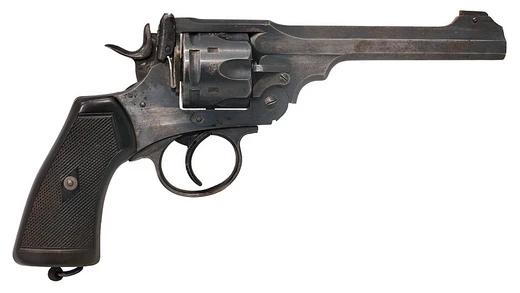
Adams (revolver)
First British-designed revolver, double-action, used in Crimea and India.

The Adams revolver, also called the Deane-Adams revolver, was a black powder, double-action, percussion revolver first made in 1851. It was the first revolver both designed and built in the United Kingdom. British officers used it extensively during the Crimean War (1853–1856) and the Indian Rebellion of 1857. It served as the basis for the more advanced Beaumont-Adams revolver, which appeared in 1856. Starting in 1867, the Adams Patent Small Arms Company began converting existing percussion Adams and Beaumont-Adams revolvers into breechloaders that fired .450 Boxer centerfire cartridges, and also produced new breechloading models. From 1872 to 1880, these converted and new breechloading revolvers became the official sidearms of the British Army and Navy, remaining in service until the 1880s.
Before 1851, Colt’s Manufacturing Company held a monopoly on revolver production in the United States and Europe, starting with its first revolvers in 1836. Between 1853 and 1857, Colt opened a factory in London, supplying cheap, mass-produced revolvers with interchangeable machine-made parts to British customers. Colt even secured government contracts, selling 4,000 revolvers to the British Navy in 1854 and 14,000 to the British Army in 1855.
When Colt’s English patents expired in 1851, British designer Robert Adams created his own revolver design, patenting it that same year and presenting it successfully at the Great Exhibition of London in 1851. The weapons were tested by the official British military commission for possible adoption, but none were selected because the revolver’s price was as high as several single-shot percussion pistols then standard in the military.
The Adams revolver had a double-action trigger: pulling the trigger cocked the hammer, rotated the cylinder, and fired the shot all at once. This self-cocking design allowed a high rate of fire, but required a heavy trigger pull, making accurate aiming possible only at point-blank range. The hammer could not be cocked manually and lacked a thumb projection. Despite this, the British military commission judged the double-action mechanism superior to Colt’s single-action system.
The revolver’s frame was a solid, one-piece construction with an integral barrel, all forged from a single piece of steel.
Quick Facts
- Origin
- United Kingdom
- Is Ranged
- yes
- Service
- 1851–1868 (percussion) / 1868–1880 (breechloader)
- Used By
- United Kingdom & Colonies / Confederate States
- Wars
- Crimean War / Indian Rebellion of 1857 / American Civil War / Anglo-Zulu War
- Designer
- Robert Adams
- Design Date
- 1851
- Manufacturer
- Deane, Adams&Deane / Robert Adams of London
- Weight
- 30 oz (0.85 kg), unloaded
- Length
- 11.5 in. (292 mm)
- Part Length
- 6.5 in. (165 mm)
- Cartridge
- .450 Adams Boxer centerfire cartridge / (conversion & variants)
Facts from the source article.
Lore & Background
The Adams revolver was patented in 1851 by British designer Robert Adams, following the expiration of Colt's English patents that same year. It was presented at the Great Exhibition of London in 1851 and tested by the British military commission, but was not adopted due to its high price, equivalent to several single-shot percussion pistols. Despite this, many British officers privately purchased the revolver, and it saw heavy combat in the Crimean War and the Indian Rebellion of 1857.
Unlike contemporary Colt revolvers, the Adams had a double-action trigger mechanism: pulling the trigger cocked the hammer, rotated the cylinder, and fired the shot. This enabled a high rate of fire, though the heavy trigger pull made aiming difficult except at point-blank range. The hammer had no thumb projection and could not be cocked manually. The revolver had a solid, one-piece steel frame with an integral barrel, which the British military commission found superior to Colt's multi-part open-frame design.
Early Adams revolvers had three reported deficiencies: no recoil shield behind the cylinder, low accuracy at medium and long distances due to the inability to cock the hammer manually, and no loading lever on early models (balls were pressed into chambers by fingers and could fall out). These issues were resolved in later models, including the addition of a loading lever on the left side of the frame.
Reader's Guide
The Adams revolver holds significance as the first revolver designed and produced in the United Kingdom, breaking Colt's monopoly on revolver production in Europe. Its double-action mechanism, while requiring a heavy trigger pull, offered a higher rate of fire than contemporary single-action Colts, a feature praised by the British military commission. The solid frame construction was considered stronger and more durable than Colt's open-frame design.
Beginning in 1867, the Adams Patent Small Arms Company converted existing percussion revolvers into breechloaders using .450 Boxer centerfire cartridges, and produced new breechloading models (Mark I, Mark II, and Mark III). From 1872 to 1880, these revolvers were adopted as official sidearms of the British Army and Royal Navy, and were used extensively in the Anglo-Zulu War of 1879. Practical use revealed that the .450 Adams cartridge was often unable to stop heavily built opponents at close range, and accuracy was poor beyond 25 yards. This led to the adoption of the .476 Enfield cartridge and the Enfield revolver in 1880, replacing the Adams in British service.
Did You Know?
- It had a double-action trigger that could not be cocked manually, and the hammer had no thumb projection.
- Early models lacked a recoil shield, exposing the shooter to hot gases and percussion cap fragments.
- From 1872 to 1880, Adams breechloading revolvers were official sidearms of the British Army and Royal Navy.
Frequently Asked Questions
What is the Adams revolver?
The Adams revolver, often called the Deane-Adams, was a black-powder, double-action percussion revolver introduced in 1851. It holds the distinction of being the very first revolver both designed and manufactured in Britain.
What made the Adams revolver mechanically distinctive?
It featured a solid one-piece frame with an integral barrel and operated strictly as a double-action-only weapon, meaning the hammer could not be cocked by hand. This design set it apart from most contemporary revolvers that offered a single-action option.
In which conflicts did British troops use the Adams revolver?
British officers carried it widely during the Crimean War of the 1850s and again during the Indian Rebellion of 1857. Its rugged, double-action design suited the harsh field conditions of both campaigns.
How does the Adams revolver relate to the Beaumont-Adams?
The original 1851 Adams design served as the direct foundation for the Beaumont-Adams revolver that appeared in 1856. The Beaumont-Adams refined and expanded upon the Adams' core architecture to produce a more advanced sidearm.
What became of Adams revolvers after the percussion era ended?
Beginning in 1867, the Adams Patent Small Arms Company took existing percussion Adams and Beaumont-Adams guns and reworked them into breechloaders chambered for the .450 Boxer centerfire cartridge. This conversion extended the service life of the original frames well into the cartridge era.
More in Revolvers, Part 2 1-24
Spotted an error? Know more?
Reader corrections go straight into our review queue. Suggest an edit · How this site is sourced