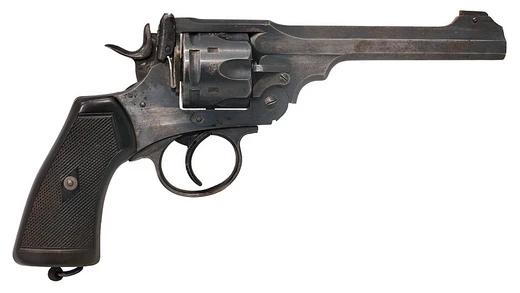
Collier's Flintlock Revolver
One of the earliest true revolvers, with a self-priming flintlock action.

Collier's Flintlock Revolver is a flintlock revolver invented by Boston-born gunsmith Elisha Haydon Collier and manufactured by John Evans & Son of London. It is notable as one of the earliest true revolvers, distinct from earlier multi-barreled pepperboxes, and introduced a self-priming mechanism that automatically released gunpowder into the pan when the hammer was cocked.
Quick Facts
- Origin
- United States/United Kingdom
- Is Ranged
- YES
- Used By
- Presidency armies
- Designer
- Elisha Collier
- Design Date
- 1818
- Manufacturer
- John Evans & Son of London
- Production Date
- 1819-1824
- Number
- 225
- Caliber
- .47 inch
- Action
- Flintlock
- Feed
- 5 or 7-round cylinder
Facts from the source article.
Lore & Background
Elisha Collier of Boston, Massachusetts, invented the flintlock revolver in 1818 in cooperation with his associates Cornelius Coolidge and Artemus Wheeler. The weapon was patented in 1818 and produced from 1819 by John Evans & Son of London. It was purchased by European officers in the presidency armies. According to Collier's testimony in the 1851 Colt vs. Massachusetts Arms Company patent infringement trial, over 10,000 pounds sterling of value (approximately 160 long guns) was supposedly to be made and contracted for India, though Collier later diminished this claim, suggesting the number was only anticipated. Known serial numbers indicate that approximately 225 Collier pistols and long guns were made between 1819 and 1824.
The revolver was not self-rotating but was self-priming: a compartment automatically released gunpowder into the pan when the hammer was cocked. Its single barrel allowed greater accuracy and faster reload time while reducing unnecessary weight. However, the flintlock action was a serious drawback: flints were unreliable and had to be changed frequently, and inferior quality powder risked a misfire.
Reader's Guide
Collier's Flintlock Revolver holds significance as one of the earliest true revolvers, marking a departure from the multi-barreled pepperbox design. Its self-priming mechanism was an innovative feature that simplified the loading process, though the weapon's flintlock action remained a liability due to unreliable flints and powder sensitivity. The revolver was produced in limited numbers—approximately 225 examples—and was purchased by European officers serving in the presidency armies. Samuel Colt saw weapons of this type while serving as a cabin boy aboard the brig Corvo in 1832, and after returning from the Far East he was inspired to create his own caplock revolver, the Colt Paterson, which eventually supplanted the Collier Flintlock Revolver. The Collier revolver thus occupies a transitional role in firearms history, bridging earlier multi-barrel designs and the later percussion revolvers that would dominate the market.
Frequently Asked Questions
Who invented the Collier's Flintlock Revolver and who made it?
Boston-born gunsmith Elisha Haydon Collier designed the firearm, patenting it in 1818. Production was handled by John Evans & Son of London, which manufactured the weapon from 1819 through 1824.
What made the Collier's Flintlock Revolver different from a pepperbox gun?
A pepperbox is essentially several fixed barrels clustered together, whereas the Collier used a true rotating cylinder to hold multiple charges. It also featured a self-priming flintlock action, a mechanical step forward that simple multi-barrel designs lacked.
How did the self-priming mechanism on the Collier's Flintlock Revolver work?
Cocking the hammer triggered an internal mechanism that automatically dropped gunpowder into the pan, so the shooter no longer had to prime each chamber by hand before firing.
How many Collier's Flintlock Revolvers were actually produced?
Roughly 225 pistols and long guns were made during the 1819–1824 production window, making it a relatively scarce piece of early revolver history.
Why do revolver collectors consider the Collier's Flintlock Revolver a landmark design?
It is widely regarded as one of the first true revolvers ever built, predating many better-known cylinder designs. Its self-priming action and rotating-chamber concept established mechanical principles that later revolver makers would build upon.
More in Revolvers, Part 2 1-24
Spotted an error? Know more?
Reader corrections go straight into our review queue. Suggest an edit · How this site is sourced