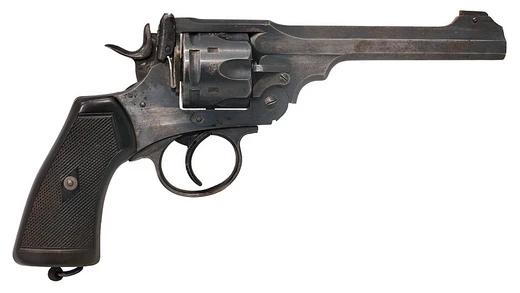
Colt Paterson
First commercial revolving-cylinder firearm, patented by Samuel Colt in 1836.

The Colt Paterson revolver was the first commercial repeating firearm employing a revolving cylinder with multiple chambers aligned with a single, stationary barrel. Its design was patented by Samuel Colt on February 25, 1836, in the United States, England and France, and it derived its name from being produced in Paterson, New Jersey. Initially produced as a 5-shot revolver in .28 caliber, a .36 caliber model followed a year later.
Quick Facts
- Origin
- United States
- Is Ranged
- yes
- Service
- 1836–1865
- Used By
- United States / Republic of Texas / Confederate States of America
- Wars
- Seminole Wars / Texas–Indian Wars / Mexican–American War / Texan Revolution / American Civil War (later models)
- Designer
- Samuel Colt
- Manufacturer
- Patent Arms Company, / Paterson, New Jersey
- Production Date
- 1836–1842
- Number
- ~2,800
- Variants
- Different calibers, sizes and configurations / <!-- parameter not supported by template
- Successor
- Walker Colt -->
- Weight
- 2 lb 12 oz (1.2 kg levered model)
Facts from the source article.
Lore & Background
Early Colt literature and later publications insist that Colt was inspired to design the revolver in 1830 by viewing the windlass mechanisms aboard the brig Corvo while bound from Boston to Calcutta. However, some believe he saw examples of the Collier Flintlock Revolver while touring the Tower of London after the Corvo docked on the River Thames. In any event, sometime while aboard the Corvo he produced a wooden model, further developing the concept during the early 1830s. Samuel Colt's first factory, the Patent Arms Company of Paterson, New Jersey, manufactured 1,450 revolving rifles and carbines, 462 revolving shotguns, and 2,350 revolving pistols between 1836 and 1842, when the business failed. A creditor and business associate, John Ehlers, continued manufacture and sale of approximately 500 of the total 2,850 pistols through 1847.
The early Colt revolvers were of single-action design, meaning the trigger functioned when the hammer was cocked back. The first Paterson Models (1836–1838) required partial disassembly for loading and had no definitive provision for safely carrying the revolver with all chambers loaded. To load, the shooter would draw the hammer to half-cock, push the barrel wedge, pull the barrel and cylinder off the central arbor, fill chambers with powder, seat balls, then reassemble and place percussion caps. Starting in 1839, a hinged loading lever and capping window became standard for new revolvers and were retrofitted to older designs, allowing reloading without disassembly. Unlike later revolvers, a folding trigger was incorporated; the trigger became visible only upon cocking the hammer.
Reader's Guide
The Colt Paterson revolver established the fundamental revolving-cylinder mechanism that defined subsequent revolver development. Its design was protected by a patent renewal in 1849, and aggressive litigation against infringements gave Colt a domestic monopoly on revolver development until the mid 1850s. The Paterson saw limited use in the Second Seminole War in Florida, where the firepower advantage was initially praised by troops, but the United States government considered the arms excessively fragile and prone to malfunction. The Republic of Texas purchased 180 revolving shotguns and rifles and a like number of handguns for the Texas Navy in 1839. When Samuel Houston disbanded the Texas Navy in 1843, Captain Jack Hays armed his company of Texas Rangers with surplus stocks of the pistols. The repeating handguns became very popular with the Rangers, providing sustained firepower against Comanche adversaries. The Paterson revolver was especially decisive in the Battle of Bandera Pass, where each Ranger had 10 shots at his disposal when armed with two pistols. Captains Jack Hays and Samuel Walker became major proponents of Colt revolvers and were successful in advocating military contracts for later models such as the Walker Colt. Zachary Taylor, as a general in command of the border with Mexico, sent Captain Walker to New York in 1846 to meet with Colt and discuss improvements to the Paterson for battle use.
Did You Know?
- The Colt Paterson revolver initially had no loading lever; users had to partially disassemble it to reload until 1839.
- The Number 5 Holster or Texas Paterson, produced in .36 caliber, is the model most identified with the Paterson Colt designation.
- The folding trigger on the Paterson became visible only upon cocking the hammer.
Frequently Asked Questions
What is the Colt Paterson revolver?
The Colt Paterson is the first commercially produced repeating firearm that used a multi-chambered revolving cylinder paired with a single fixed barrel. It was designed and patented by Samuel Colt in 1836, and it is named after the city of Paterson, New Jersey, where it was manufactured.
When and where was the Colt Paterson patented?
Samuel Colt secured patents for the design on February 25, 1836, in three separate jurisdictions: the United States, England, and France. This multi-country filing was a key step in establishing his commercial rights to the revolving-cylinder concept.
What calibers and capacity did the Colt Paterson offer?
The original model chambered five shots in .28 caliber, and a .36 caliber variant followed roughly a year later. Both versions retained the same five-chamber cylinder layout.
How many Colt Paterson revolvers were actually produced?
Between 1836 and 1842, a total of 2,350 Paterson revolvers were manufactured. This modest run reflects the model's early, experimental stage in Colt's business history.
Why does the Colt Paterson matter in firearms history?
It proved that a revolving-cylinder mechanism could be made into a practical, marketable handgun rather than just a laboratory curiosity. Its success—however limited—paved the way for the later Colt models that would define the revolver category for decades.
More in Revolvers, Part 2 1-24
Spotted an error? Know more?
Reader corrections go straight into our review queue. Suggest an edit · How this site is sourced