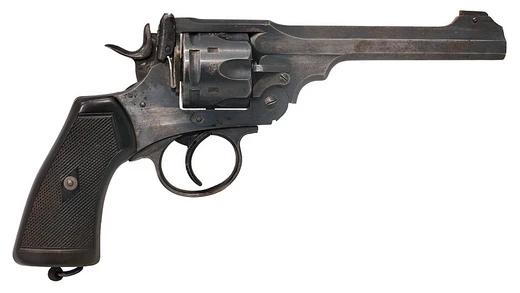
Type 26 revolver
First modern revolver adopted by the Imperial Japanese Army.

The Type 26 revolver was the first modern revolver adopted by the Imperial Japanese Army, developed at the Koishikawa Arsenal. It is named for its year of adoption in the Japanese dating system, the 26th year of the Meiji era (1893). The design is an amalgamation of features from other contemporary revolvers, including a lock similar to Galand designs, a hinged frame like Smith & Wesson revolvers, and a hinged side plate resembling the Modèle 1892 revolver.
Quick Facts
- Origin
- Japan
- Is Ranged
- yes
- Service
- 1893–1945
- Wars
- Russo-Japanese War, / Second Sino-Japanese War, / World War I, / World War II, / Korean War
- Design Date
- 1893
- Manufacturer
- Koishikawa Arsenal
- Production Date
- 1893–1935
- Number
- 59,300 to 59,900
- Weight
- 880 g (1 lb 15 oz) unloaded
- Length
- 231 mm (9.09 in)
- Part Length
- 121 mm (4.76 in)
- Height
- 130 mm (5.12 in)
Facts from the source article.
Lore & Background
Known as the Meiji 26 Nen Ken Ju, the Type 26 replaced the aging Smith & Wesson New Model No. 3 and was officially adopted on March 29, 1894. The cartridge was initially loaded with black powder, switching to smokeless powder after 1900. Production ceased after the 1923 Great Kantō earthquake destroyed much of the Koishikawa Arsenal, though assembly continued from stockpiled parts. Approximately 59,000 Type 26 revolvers were produced, with an additional 900 pre-production units. Restoration and re-issue of damaged or worn revolvers occurred over many years.
The revolver has a double-action-only mechanism with no cocking spur, intended to avoid snagging on clothing. A design flaw allows the cylinder to freewheel when not engaged, so during movement it may rotate to an already-fired chamber. The cylinder only notches while the hammer is cocked, making accidental rotation possible from brushing against an object or sudden sideways motion. The weapon is opened by lifting the top latch and swinging the barrel downward, activating the automatic ejector. Five distinct production periods are identified by differences in markings and appearance, ranging from early unmarked examples to arsenal-reworked models with serrated grips and stamps indicating Thai or Indonesian service.
Reader's Guide
The Type 26 revolver represents a significant step in Japanese pistol development, as the matchlock had been the most common domestic handgun only 40 years earlier. Despite its international influences, it was a remarkable leap for Japanese firearms. The revolver saw action in the Russo-Japanese War, World War I, and World War II, and was still in use in 1945, which firearms expert Ian Hogg considered a testament to its original workmanship and a more suitable combat weapon than later Japanese pistols. Its double-action-only mechanism made accurate shooting difficult, and the cylinder freewheeling flaw posed a danger in combat. The unique 9mm Japanese revolver ammunition was used only by this weapon. The Type 26 was eventually replaced by semi-automatic pistols such as the Nambu in the early 20th century. Later production included a tear gas grenade launcher, the Type 90, fired with a special cartridge. The revolver was also used by some Chinese warlord armies, including locally made copies, and briefly by North Korean troops in the Korean War.
Did You Know?
- The Type 26 revolver was named for the 26th year of the Meiji era, corresponding to 1893.
- Its cylinder freewheels when not engaged, allowing it to rotate to an already-fired chamber during movement.
- Approximately 59,000 Type 26 revolvers were produced, plus 900 pre-production units.
- The Type 90 tear gas grenade launcher was developed to be fired with the Type 26 revolver.
More in Revolvers, Part 2 1-24
Spotted an error? Know more?
Reader corrections go straight into our review queue. Suggest an edit · How this site is sourced