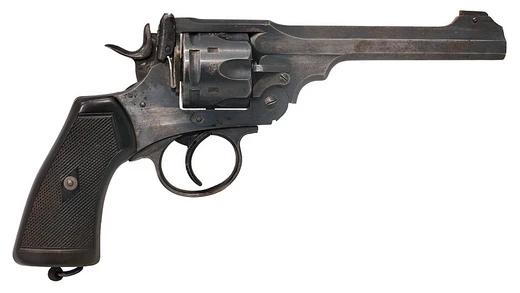
Tranter (revolver)
A solid-frame double-action revolver with a distinctive dual-trigger option.

The Tranter revolver is a double-action cap & ball revolver invented around 1856 by English firearms designer William Tranter. Early models used a distinctive dual-trigger mechanism, with one trigger to rotate the cylinder and cock the gun and a second to fire it; later models adopted a single-trigger mechanism similar to the contemporary Beaumont–Adams revolver. The revolver was a solid-frame design and saw notable use during the American Civil War, particularly by the Confederate military.
Quick Facts
- Origin
- United Kingdom
- Is Ranged
- yes
- Service
- 1855–1878
- Used By
- United Kingdom & Colonies, Confederate States, United States, Australia, Canada
- Wars
- American Civil War, Anglo-Zulu War, Fenian raids, Red River Rebellion
- Designer
- William Tranter & Robert Adams
- Design Date
- 1853
- Manufacturer
- Tranter
- Production Date
- c.1854-c.1880
- Number
- approx
- Weight
- approx 2.4lb (1.1 kg), unloaded
- Action
- Double-action
Facts from the source article.
Lore & Background
The Tranter revolver was developed from earlier Robert Adams designs, of which Tranter had produced over 8,000 revolvers by 1853. The first model of his own design used an Adams-type frame with a mechanism jointly developed with James Kerr, and was sold as the Tranter-Adams-Kerr. Over three models, the only significant change was to the ramrod attachment: detachable on the first model, attached by a hook on the second, and by a screw on the third (1856).
On the double-trigger version, a second trigger below the trigger guard cocked the gun; the hammer had no spur and could not be thumb-cocked. To fire single-action, the user pressed the lower trigger to cock and rotate the cylinder, then pulled the upper trigger. For rapid fire, both triggers could be pulled simultaneously, making it a double-action weapon.
During the American Civil War, Tranter had a contract with Hyde & Goodrich in New Orleans. After the partnership dissolved, successors Thomas, Griswold & Company and A. B. Griswold & Company continued distribution. The revolver became popular among Confederate forces. After the war, percussion models remained in production because many considered them safer and cheaper than cartridge designs. In 1863 Tranter secured the English patent for rimfire cartridges and began production using the same frame; by 1868 he also manufactured centrefire cartridge revolvers.
Reader's Guide
The Tranter revolver's significance lies in its role as a transitional design bridging percussion and cartridge eras, and its widespread use in the American Civil War and colonial conflicts. Its dual-trigger mechanism offered a unique method of operation, allowing both single-action precision and rapid double-action fire. The revolver's solid-frame construction and reliability made it a favoured sidearm for Confederate officers, European adventurers in Africa, and outlaws in colonial Australia. After Tranter's retirement in 1885, his factory was acquired by George Kynoch and renamed the Kynoch Gun Works. Kynoch produced three models of revolvers based on Tranter's design, chambered in various centrefire calibres, but only about 600 were ever made. The factory was later sold to manager Henry Schlund, who renamed it Aston Arms Co. Ltd. and marketed the Schlund Revolver before closing in 1891. The Tranter revolver's legacy endures through its appearances in literature and film, including as the sidearm of Sherlock Holmes and in the 1971 western Hannie Caulder.
Did You Know?
- The early Tranter revolver had a dual-trigger mechanism: one trigger cocked the hammer and rotated the cylinder, the other fired the gun.
- William Tranter secured 24 firearms design patents and 19 cartridge patents between 1849 and 1888.
- The Kynoch Gun Works produced only about 600 revolvers of all models before closing in 1891.
- Richard Jordan Gatling, inventor of the Gatling gun, owned an 80-bore (.38-calibre) First Model Tranter Pocket Revolver.
More in Revolvers, Part 2 1-24
Spotted an error? Know more?
Reader corrections go straight into our review queue. Suggest an edit · How this site is sourced