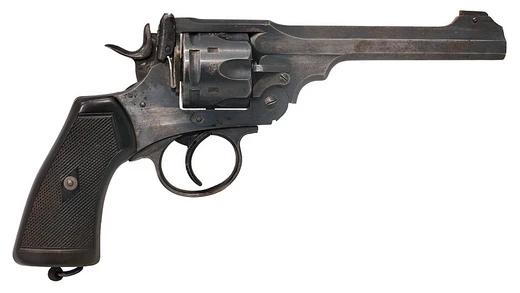
Remington Model 1858
Solid-frame percussion revolver used in Civil War and the West.

The Remington Model 1858 is a single-action percussion revolver produced by E. Remington & Sons, based on the Fordyce Beals patent of September 14, 1858. Though commonly referred to as the Model 1858 due to patent markings, wide-scale production did not start until 1861. It was used during the American Civil War and later in the American West, both in its original percussion configuration and as a metallic cartridge conversion.
Quick Facts
- Origin
- United States
- Is Ranged
- yes
- Service
- 1861–1873
- Used By
- United States / Confederate States / Native Americans / Hawaiian Kingdom / United Kingdom / Canada / Australia / France / Russian Empire / Empire of Japan / Second Mexican Empire
- Wars
- American Civil War / American Indian Wars / Fenian Raid / Red River Rebellion / Franco-Prussian War / Boshin War / Second French intervention in Mexico
- Designer
- Fordyce Beals
- Design Date
- 1858
- Manufacturer
- Remington Arms
- Production Date
- 1861 to 1875
- Number
- Over 230,000
- Variants
- 10
- Weight
- 2 lb, 13 oz (1.27 kg)
Facts from the source article.
Lore & Background
The Remington revolver was a secondary, supplemental issue firearm for the Union Army until the Colt factory fire of 1864, after which large numbers were ordered by the U.S. government. Samuel Remington offered to sell his revolvers at $15 each—$10 less than Colt's .44-cal. revolvers. By the end of March 1862, the Army had taken delivery of 7,250 .36-cal. revolvers and 850 .44-cal. Beals revolvers at $15 each.
The design features a topstrap, solid-frame construction, which contributed to its durability. The internal lockwork is simpler than that of Colt revolvers, with the cylinder stop and trigger sharing the same through-frame screw. A downside is that the barrel and receiver are a single piece, making barrel cleaning more difficult. The 1863 Model introduced safety slots milled between chambers on the cylinder, allowing the hammer to be secured between chambers for safe carry. The revolver also permitted easy cylinder removal for quick reloading with a spare pre-loaded cylinder, though spare cylinders were not provided by the Army.
Three progressive models were made: the Remington-Beals Army & Navy (1860–1862), the 1861 Army & Navy (1862–1863), and the New Model Army & Navy (1863–1875). They are nearly identical in size and appearance, with subtle differences in hammers, loading levers, and cylinders. The 1861 Remington transitioned into New Model appearance by late 1862 due to continual improvement suggestions from the U.S. Ordnance Department.
Reader's Guide
The Remington Model 1858 is significant as the beginning of a successful line of medium and large frame pistols for E. Remington & Sons. Its solid-frame design offered strength and simplicity, and the safety slots were an innovative safety feature for the era. The revolver saw use around the world, and its metallic cartridge conversions, beginning in 1868 in .46 rimfire, were the first large-caliber cartridge revolvers available, beating Smith & Wesson's .44 American to market by nearly two years. Individual gunsmiths also produced conversions in calibers such as .44-40 and .45 Colt. The design lives on in modern replicas from Italian manufacturers, popular in civil war reenacting and Cowboy Action Shooting. Drop-in conversion cylinders allow firing of low-pressure modern cartridges without altering the frame. Due to the value and delicacy of original revolvers, they are not recommended for modern shooting purposes.
Did You Know?
- Samuel Remington offered his revolvers to the U.S. government at $15 each—$10 less than Colt's .44-cal. revolvers.
- Buffalo Bill Cody used an ivory-handled New Model Army .44 from 1863 until 1906; it sold at auction in June 2012 for US$239,000.
More in Revolvers, Part 2 1-24
Spotted an error? Know more?
Reader corrections go straight into our review queue. Suggest an edit · How this site is sourced