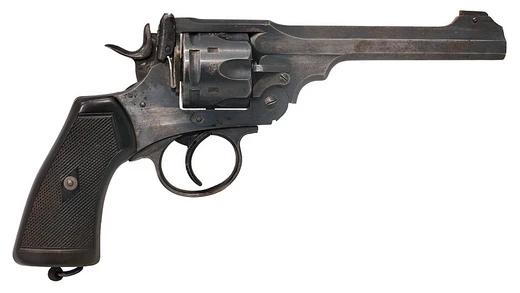
Remington-Beals Pocket Revolver
Remington's first revolver, a solid-frame .31-caliber five-shot percussion pistol.

The Remington-Beals Pocket Revolver was the first percussion revolver produced by Remington & Sons, introduced in 1857. It marked the company's entry into revolver manufacturing following the expiration of Samuel Colt's U.S. patents, and was designed by Fordyce Beals, who had previously designed a revolver for Eli Whitney's factory.
Quick Facts
- Origin
- United States
- Is Ranged
- yes
- Service
- 1857–1873
- Used By
- United States / Confederate States
- Wars
- American Civil War / American Indian Wars
- Designer
- Fordyce Beals
- Design Date
- 1856-1857
- Manufacturer
- Remington Arms
- Production Date
- 1857 to 1860
- Number
- About 7,500
- Variants
- 3
- Cartridge
- Powder & ball or Paper cartridge with conical bullet
Facts from the source article.
Lore & Background
The Remington-Beals Pocket Revolver was produced in three successive models from 1857 to 1860. The 1st Model featured a solid frame, single-action mechanism, a 3-inch octagonal barrel, and hard rubber grips made of gutta percha. It lacked a loading lever, requiring a separate bullet seater. Approximately 5,000 were manufactured in 1857 and 1858 before transitioning to the 2nd Model. The 2nd Model was a spur-trigger variant with a squared rubber grip and 3-inch barrel, with about 1,000 made between 1858 and 1860. The 3rd Model introduced a 4-inch octagonal barrel and an integral loading lever mounted under the barrel; roughly 1,500 were produced in 1859 and 1860. Despite these improvements, sales were disappointing, and the only real advantage over Colt's pocket revolvers was its solid-frame design. Production ceased in 1860, and Remington did not resume revolver manufacturing on a large scale until the outbreak of the American Civil War, with the Remington Army Model in 1861.
Reader's Guide
The Remington-Beals Pocket Revolver holds significance as Remington & Sons' first venture into revolver production, a move made possible by the expiration of Samuel Colt's patents in 1857. The company, a preeminent long rifle manufacturer since 1816, hired Fordyce Beals to design the pistol, drawing on his earlier work for Eli Whitney. The revolver's solid-frame construction was its primary distinguishing feature, offering a structural advantage over Colt's contemporary pocket revolvers. However, the initial model's lack of an integral loading lever was a drawback, addressed only in the 3rd Model. The series saw limited commercial success, with total production across all three models reaching approximately 7,500 units. The Remington-Beals line was discontinued in 1860, and the company's revolver production remained small until the Civil War created new demand. The design thus represents a transitional step, bridging Remington's expertise in long arms to the handgun market, and laying groundwork for later, more successful models like the Remington Army Model.
Did You Know?
- The 1st Model lacked a loading lever and required a separate bullet seater.
- Approximately 5,000 1st Model revolvers were manufactured in 1857 and 1858.
More in Revolvers, Part 2 1-24
Spotted an error? Know more?
Reader corrections go straight into our review queue. Suggest an edit · How this site is sourced