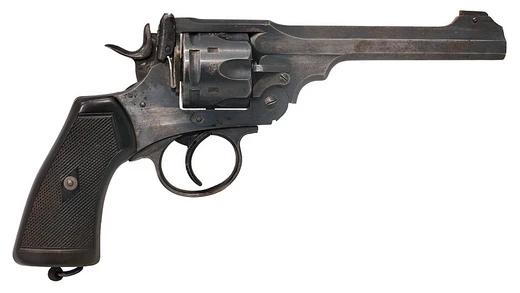
Gasser M1870
Standard cavalry revolver of the Austro-Hungarian military.

The Gasser M1870 was a revolver used by the Austro-Hungarian military, firing the 11.3×36mmR cartridge. It was first taken into service by the Austro-Hungarian cavalry in 1870 and became that branch’s standard sidearm. Its construction was an open-frame design, with the barrel assembly held to the frame by a screw located beneath the cylinder arbor. Features included a loading gate on the right side, a rod ejector mounted under the barrel, and a unique safety mechanism set into the right side of the frame. The long centerfire cartridge it used was related to ammunition previously employed in Fruwirth carbines.
The M1870 was manufactured in several variants, including a naval model. Its design served as the foundation for later Gasser revolvers intended for both military and civilian use within Austria-Hungary. It remained a significant military revolver through the late 1800s until it was replaced by newer designs.
A refinement, the Gasser-Kropatschek M1876, was adopted by Austria-Hungary in 1876. Initiated by Alfred Kropatschek, the main change was a reduction in weight achieved by reducing the caliber to 9mm.
Under the heading of “Montenegrin Gasser” fall many six-chamber, large-caliber revolvers. The standard issue for the Montenegrin military was the Austrian Gasser Model 1870 in 11.2mm, which became known as the Montenegrin Gasser. These revolvers originally appeared as open-frame models similar to the Austrian M1870, usually in 11mm nominal (11.3mm actual) calibers. They used single- and double-action locks, often had grips of ivory or bone, and frequently featured engraving and gold inlay, giving an impression of weight and bulk. Later Montenegrin revolvers used a hinged-frame construction with Galand cylinder locks and a self-extracting mechanism. Most are marked with phrases like “Guss Stahl” (crucible cast steel frame) and “Kaiser’s Patent.”
In 1910, King Nicholas I of Montenegro decreed that all male citizens were members of a national militia and were required by law to own at least one Gasser Pattern revolver. The official reason was to create an armed populace that would deter neighboring countries from attacking Montenegro, which could not field a large army. However, it was widely believed within Montenegro that the King owned shares in Leopold Gasser Waffenfabrik in Vienna, the patent holder and sole manufacturer of the pistol.
Quick Facts
- Origin
- Austria-Hungary
- Is Ranged
- yes
- Service
- 1870–1918
- Wars
- Boxer Rebellion / World War I (limited use)
- Designer
- Leopold Gasser
- Design Date
- 1870
- Manufacturer
- Leopold Gasser Waffenfabrik
- Production Date
- 1870–1919
- Variants
- Long- and short-barrel versions
- Spec Label
- Long-barrel version
- Weight
- 1.3 kg
- Length
- 375 mm
Facts from the source article.
Lore & Background
The Gasser M1870 was an open-frame design in which the barrel assembly was secured to the frame by a screw beneath the cylinder arbor. It featured a right-side loading gate, a rod ejector beneath the barrel, and a distinctive safety mechanism incorporated into the right side of the frame. Its long centerfire cartridge was related to ammunition previously used in Fruwirth carbines.
The M1870 was produced in several configurations, including naval and other variants. Its design formed the basis for later Gasser revolvers developed for military and civilian use in the Austro-Hungarian Empire. The M1870 remained an important military revolver design during the late nineteenth century before being superseded by newer models.
The standard issue in the Montenegrin military was the Austrian Gasser Model 1870 in 11.2mm, which became known as the Montenegrin Gasser. Montenegrin revolvers originally appeared as open-frame models similar to the Austrian Gasser M1870, usually in 11mm nominal (11.3mm actual) calibers. Single and double-action locks were used, grips were often in ivory or bone, and engraving and gold inlay work was common.
Reader's Guide
The Gasser M1870 holds significance as the standard cavalry revolver of the Austro-Hungarian military, adopted in 1870 and remaining an important military design through the late nineteenth century. Its open-frame construction and distinctive safety mechanism influenced later Gasser revolvers for both military and civilian use. The revolver's design also directly led to the Montenegrin Gasser pattern, which became widespread due to a 1910 decree by King Nicholas I of Montenegro mandating that all male citizens own at least one Gasser Pattern revolver. This decree, combined with heavy international demand, led to licensed production by other European firms and unlicensed local copies of varying quality. The weapon became a status symbol in Montenegro and was carried by immigrants to North America, with batches also smuggled into Mexico during the Mexican Revolution. The M1870's legacy includes its role in arming a national militia and its spread across continents through both official and unofficial channels.
Did You Know?
- The Gasser M1870 was chambered for the 11.3×36mmR cartridge, related to ammunition used in Fruwirth carbines.
- In 1910 King Nicholas I of Montenegro decreed that all male citizens must own at least one Gasser Pattern revolver under penalty of law.
- Many Gasser Pattern revolvers were smuggled into Mexico during the Mexican Revolution from 1910–1920.
- Genuine Austrian Gasser products are marked 'L. GASSER PATENT WIEN' or 'L. GASSER OTTAKRING PATENT' and often carry a heart pierced by an arrow trademark.
More in Revolvers, Part 2 1-24
Spotted an error? Know more?
Reader corrections go straight into our review queue. Suggest an edit · How this site is sourced