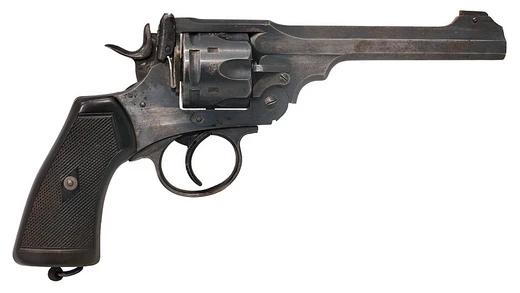
Colt Single Action Army
The iconic revolver of the American Wild West.

The Colt Single Action Army—also called the SAA, Model P, Peacemaker, M1873, or Frontier—is a single-action revolver. Colt’s Patent Firearms Manufacturing Company designed it for the 1872 U.S. government service revolver trials, and the U.S. Army issued it as its standard sidearm from 1873 until 1892. Over its production run, the revolver has been made in more than 30 calibers and several barrel lengths, but its basic look has stayed the same since 1873. Known as the “Peacemaker,” it became a lasting symbol of the American Wild West, used by ranchers, lawmen, and outlaws. Today, collectors and re-enactors mostly buy it as memorabilia, and its design has inspired many other models from other companies. The original cavalry-issue barrel measured 7½ inches, with an overall length of 13 inches.
Because of the Rollin White patent, Colt could not develop a revolver cylinder bored through for metallic cartridges until April 4, 1869, without paying a royalty to Smith & Wesson. For the design, Colt relied on two of its top engineers, William Mason and Charles Brinckerhoff Richards, who had already worked on revolvers and black-powder conversions. Their creation was entered in the 1872 government trials and adopted as the standard military revolver. Production began in 1873 with the Single Action Army model 1873, also called the “New Model Army Metallic Cartridge Revolving Pistol.”
The very first production Single Action Army, serial number 1, was thought lost for years until it turned up in a barn in Nashua, New Hampshire, in the early 1900s. That gun was chambered in .44 S&W, a centerfire round that could hold up to 40 grains of fine black powder and a 255-grain blunt round-nosed bullet. For its time, it was quite powerful at full load.
The Colt Single Action Army, along with the 1870 and 1875 Smith & Wesson American and Model 3 “Schofield” revolvers, replaced the Colt 1860 Army Percussion revolver. The Colt quickly became more popular than the S&W models and stayed the primary U.S. military sidearm until 1892, when it was replaced by the .38 Long Colt Colt Model 1892, a double-action revolver with a swing-out cylinder. By the end of 1874, serial number 16,000 had been reached; 12,500 Colt Single Action Army revolvers in .45 Colt had entered military service, and the rest were sold to civilians.
Quick Facts
- Origin
- United States
- Is Ranged
- yes
- Service
- 1873–1945
- Used By
- United States / Canada / Native Americans / Mexico / Ireland / United Kingdom / South Africa / Australia / Emirate of Afghanistan
- Designer
- William Mason and Charles Brinckerhoff Richards
- Design Date
- 1872
- Manufacturer
- Colt's Patent Firearms Manufacturing Company
- Production Date
- 1873–1941 / 1956–1974 / 1976–1982 / 1994–present
- Number
- 457,000+
- Weight
- 2.31 lbs (1.048 kg; with 7 · 1 · 2 in. barrel)
- Length
- 10.25 in. (260 mm, with 4 · 3 · 4 in. barrel) / 11 in. (279 mm, with 5 · 1 · 2 in. barrel) / 13 in. (330 mm, with 7 · 1 · 2 in. barrel)
- Cartridge
- .45 Colt / .44-40 WCF / .38-40 WCF / .32-20 WCF / .38 Long Colt / .22 Long Rifle / .38 Special / .45 ACP / .357 Magnum / .44 Special / Numerous other calibers
Facts from the source article.
Lore & Background
The Colt Single Action Army was developed after the expiration of the Rollin White patent, which had prevented Colt from producing bored-through cylinders for metallic cartridges. Engineers William Mason and Charles Brinckerhoff Richards designed the revolver for the 1872 U.S. government trials, and production began in 1873. The first production revolver, serial number 1, was found in a barn in Nashua, New Hampshire, in the early 1900s, chambered in .44 S&W. The SAA replaced the Colt 1860 Army Percussion revolver, along with Smith & Wesson models, and quickly gained favor as the primary U.S. military sidearm until 1892.
The revolver was produced in standard barrel lengths of 4.75 in, 5.5 in, and the original Cavalry 7.5 in. Shorter-barreled variants include the 'Sheriff's Model' with a sub-4-inch barrel and no ejector rod. From 1875 to 1880, Colt marketed a .44 Henry version in a separate number range. A 'Flattop Target Model' with adjustable sights was cataloged from 1890 to 1898, with 914 produced. In 1896, a spring-loaded base pin latch replaced the cylinder pin retaining screw, and by 1900 the revolver was certified for smokeless powder. Larger sights were adopted in 1920.
Military use saw the SAA inspected by Orville W. Ainsworth (OWA) for the first 13 months of production, including those used by Custer's 7th Cavalry at the Little Bighorn. Henry Nettleton (HN) inspected revolvers in 1878. The Artillery Model, a misnomer, refers to revolvers with barrels shortened to 5.5 in, issued during the Spanish–American War and Philippine–American War, including those used by Theodore Roosevelt's Rough Riders. The Colt Frontier Six-Shooter was the same model chambered in .44-40 Winchester to pair with the Winchester Model 1873 rifle.
Reader's Guide
The Colt Single Action Army holds a significant place in American history as the quintessential sidearm of the Wild West, used by ranchers, lawmen, and outlaws. Its design influenced numerous other models from various companies, and Colt has twice cancelled production only to renew it due to popular demand. Today, it is primarily bought as memorabilia by collectors and re-enactors. The revolver's military service from 1873 to 1892 saw it replace earlier percussion revolvers and later be replaced by the .38 Long Colt Colt Model 1892 double-action revolver. The SAA's compatibility with the Winchester Model 1873 rifle in .44-40 caliber made it a practical choice for frontiersmen. Collectors highly prize original U.S. Cavalry and Artillery models, especially those with OWA or Nettleton inspection marks, which can command prices exceeding $10,000. The revolver's legacy is cemented by its role in key historical events, such as the Battle of the Little Bighorn and the charge up San Juan Hill.
Did You Know?
- The revolver was offered in over 30 calibers, from .22 rimfire to .476 Eley.
- The 'Artillery Model' name is a misnomer; the War Department called it the 'Altered Revolver'.
- The Colt Frontier Six-Shooter was chambered in .44-40 Winchester to share ammunition with the Winchester Model 1873 rifle.
Frequently Asked Questions
What is the Colt Single Action Army?
It is a single-action revolver produced by Colt's Patent Firearms Manufacturing Company, first introduced as the Model P in 1873. Over time it became the most recognizable handgun of the American frontier era.
Who designed the Colt Single Action Army?
William Mason and Charles Brinckerhoff Richards developed the design at Colt's Patent Firearms Manufacturing Company. Their work was submitted for the 1872 U.S. government service revolver trials and was adopted by the Army in 1873.
What calibers was the Colt Single Action Army chambered in?
Across its production run the SAA was made in more than thirty different calibers. Common loadings included .45 Colt, .44-40 WCF, .38-40, .32-20, and .41 Colt, among many others.
How long did the U.S. Army use the Colt Single Action Army as its standard sidearm?
The Army adopted the revolver in 1873 and kept it in service until 1892, giving it roughly two decades as the official military handgun. During that span it was issued to cavalry and other branches as their primary sidearm.
Why is the Colt Single Action Army nicknamed the 'Peacemaker'?
The moniker stuck because the gun became the defining symbol of the American Wild West, carried by ranchers, lawmen, and outlaws alike. Its enduring presence in popular culture cemented 'Peacemaker' as a lasting cultural identifier for the revolver.
More in Revolvers, Part 2 1-24
Spotted an error? Know more?
Reader corrections go straight into our review queue. Suggest an edit · How this site is sourced