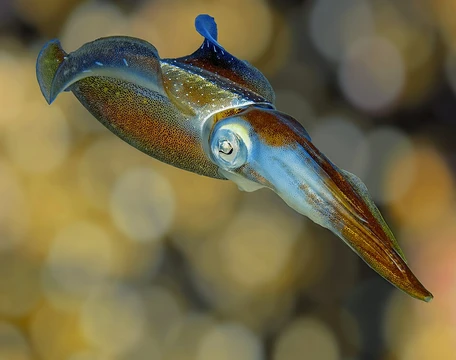
Southern blue-ringed octopus
Docile but deadly, its blue rings flash when threatened.

The southern blue-ringed octopus (*Hapalochlaena maculosa*) is one of four highly venomous blue-ringed species. It typically lives in tidal rock pools along Australia’s southern coast. Adults reach up to 20 centimeters from mantle tip to arm tip and weigh about 26 grams on average. Though normally docile, they carry venom potent enough to kill a person. Their blue rings become much more vivid when they feel threatened or agitated.
This species is the largest of the blue-ringed group, which is why it’s classified separately. At rest, its coloring is a dull, mucus-like brown. When alarmed, roughly 60 rings flash a blue-green glow. This effect comes from muscles around the rings contracting while those above relax—a mechanism not seen in other glowing animals. The rings first appear about six weeks after hatching.
The octopus lives in crevices and cracks along rocky reefs and near seagrass beds on Australia’s southern coast. It is nocturnal and generally passive, using its venom only for hunting or self-defense. It moves by jetting water and lives in burrows.
Its diet includes lobsters, crabs, shrimp, shellfish, and small fish. To feed, it pins prey and injects venom through its beak, paralyzing or killing it instantly. It can also release venom as a mist into areas where prey gathers, paralyzing them for an easy catch.
Life is short—around seven months. Sexual maturity comes at about four months, after which the octopus focuses on breeding. Both sexes are promiscuous, with limited gametes. The female often starts mating by changing color and posture. The male mounts her, inserts a hectocotylus under her mantle, and releases sperm into her oviduct. Females collect and store sperm from multiple males over about two months. She carries her eggs rather than depositing them, rarely moving and using only two arms if disturbed. She does not eat during this period and dies shortly after the eggs hatch. Males and females rarely live past one year. This maternal care is an advanced evolutionary trait, as females reproduce only once. Hatchlings grow quickly, with no planktonic stage. They are venomous from birth, though their blue rings appear at six weeks. Young begin hunting around one month old. Studies show that larger octopuses are more willing to mate, and same-sex mating attempts are common, suggesting even the octopuses struggle to tell males from females.
Quick Facts
- Genus
- Hapalochlaena
- Species
- maculosa
Facts from the source article.
Lore & Background
The blue-ringed species are known for their small size, yet the southern variety is hailed as the largest of the genus. As a result, they have been classified as their own species. From arm to arm, most of these octopuses are no larger than 20 centimeters. This is larger by roughly 5 centimeters on average with other varieties of the blue-ringed octopus. When at peace, their coloring is often a drab, mucus like color. However, once it feels sufficiently threatened, the eponymous blue-rings suddenly appear. These octopuses have an average of about 60 rings that have multilayer reflectors that allow them to flash a blue green color. These rings typically appear about 6 weeks after hatching. For the rings to illuminate and glow, the muscles around the rings must contract while the muscles above them must relax. This method of muscle contraction and relaxation has not been seen in other illuminating animals.
Found along the southern coasts of Australia, H. maculosa inhabits crevasses and cracks in the rocky reefs signature to this section of the Australian coast. In addition, the octopus enjoys a proximity to the plentiful forests of seagrass. Southern blue-ringed octopuses tend to be passive and relatively harmless: they generally use their toxins only when hunting or provoked. They are nocturnal. They expel a jet of water for propulsion. Like other members of the genus, they live in burrows.
The prey of H. maculosa consists mostly of lobsters, crabs, shrimp, and shellfish (including bivalve mollusks), as well as the occasional small fish. H. maculosa makes use of its venom for feeding purposes. It pins down and injects it through its beak. This totally paralyzes its prey, often killing it outright. Another tactic it uses to hunt is releasing its venom as a mist into a location where its prey is commonly found. Their prey swim into the venom and become paralyzed, allowing for an attack.
Reader's Guide
What makes this octopus famous is its venom. Salivary glands of the southern blue-ringed octopus produce the deadly neurotoxin, maculotoxin. The neurotoxin, tetrodotoxin (TTX), is secreted in the posterior salivary gland, which is located in the intestinal blood system of the octopus. This may provide the toxin into its bloodstream. The toxin has also been found in the eggs of this octopus. The method of poisoning is still not fully understood, but it is assumed that H. maculosa either injects the toxin into the water surrounding their prey through their saliva mixed with the toxin, or they directly bite their prey or predator with the beak-like mouth. Without immediate medical attention a bite is often fatal to humans. Various references in popular culture depict the southern blue-ringed octopus as a nefarious seadevil lying in wait to attack humans with its deadly toxins. In actuality, the venom is primarily used in hunting or for defense. There are no reported cases of unprovoked aggression towards humans. No antivenom exists.
H. maculosa has a very short life span with a large importance placed on reproduction. The average life span of a southern blue ringed octopus is around seven months. The octopus reaches sexual maturity at around four months old, at which time it focuses its last few months of life towards copulation and breeding. Both genders of this species are promiscuous, as they only have a limited set of gametes. The mating ritual usually begins with the female initiating reproduction by changing color and posture. The male then mounts the female, inserts the hectocotylus under the mantle of the female, and releases the sperm into the female's oviduct. There is approximately a two-month window in which a female acquires and stores sperm from multiple males. She then carries the eggs with her, as opposed to depositing them somewhere stationary. During this time period, the mother rarely moves unless disturbed. When she is forced to move, she uses only two arms for locomotion. The female also does not eat during this time period. Because of this, the mother dies shortly after the eggs have hatched. It is highly unlikely that the male or female would live beyond one year. This unusual octopus maternal care system seems to be an advanced evolutionary development of the species. While this may seem strange, females only reproduce once in their lifetime, so it is vital to them that their egg clutch survives. Once hatched, the H. maculosa grow very rapidly. The southern blue-ringed octopus also differs from other marine invertebrates in that there is no planktonic stage. The young begin hunting around one month of age—they are said to be venomous from birth, while their blue rings do not appear until six weeks after hatching.
Did You Know?
- The southern blue-ringed octopus is the largest of the four blue-ringed species, averaging about 5 cm longer than other varieties.
- Its blue rings appear about 6 weeks after hatching, and the muscle contraction method used to flash them has not been seen in other illuminating animals.
- Females carry their eggs with them and stop eating during brooding, dying shortly after the eggs hatch.
- No antivenom exists for the bite of the southern blue-ringed octopus.
More in Reef Cephalopods 1-24
Spotted an error? Know more?
Reader corrections go straight into our review queue. Suggest an edit · How this site is sourced