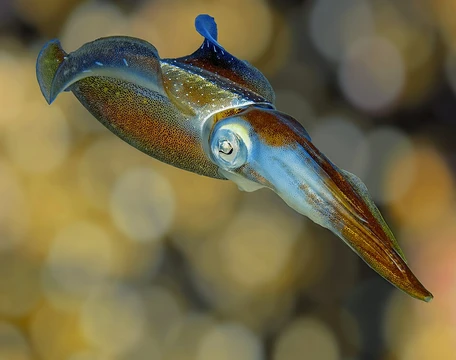
Amphioctopus
A genus of 18 octopus species in tropical and subtropical waters.

Amphioctopus is a genus of octopuses that includes about 18 species. These animals live in warm tropical and subtropical waters, mostly in the Pacific and Indian Oceans, though some can also be found in the Atlantic. Their arms are roughly two to three times as long as their mantle, and they have deep webbing on the sides of their arms but very shallow webbing on the top.
Quick Facts
- Taxon
- Amphioctopus
- Type Species
- Octopus membranaceus
- Type Species Authority
- Quoy & Gaimard, 1832
Facts from the source article.
Lore & Background
Historically, members of this genus were placed within the genus Octopus, but recognized as forming a distinct group referred to as the Octopus aegina species complex. The genus was originally described by Fischer in 1882, who assigned Octopus membranaceus as the type species. Robson in his 1929 review regarded Amphioctopus membranaceus as a nomen dubium, referring it to his newly named 'aegina species complex', and the genus Amphioctopus was subsequently considered invalid. In 2002, Gleadall suggested the aegina species group represents a distinct genus with Amphioctopus being the senior name. In 2004, Gleadall resurrected the genus Schizoctopus and assigned Octopus fangsiao as the type species. In 2005, Huffard and Hochberg, arguing that Robson's designation of Octopus membranaceus as a nomen dubium was premature, resurrected the genus name Amphioctopus for the Octopus aegina species complex, and found Schizoctopus to be a junior synonym.
Reader's Guide
The genus Amphioctopus is notable for its complex taxonomic history, having been moved between genera and considered invalid before being resurrected. Its significance lies in clarifying the classification of the Octopus aegina species complex, a group of octopuses that form a distinct constellation. The genus includes both ocellate and non-ocellate subgroups, and its members are found across tropical and subtropical waters of the Pacific, Indian, and Atlantic Oceans. The resurrection of Amphioctopus by Huffard and Hochberg in 2005 resolved a long-standing taxonomic dispute, establishing it as the valid name for this group and recognizing Schizoctopus as a junior synonym. The genus currently comprises 18 species, including the veined octopus (Amphioctopus marginatus), and several taxa inquirenda, reflecting ongoing uncertainty in some species. Its legacy is as a stable taxonomic unit for a morphologically distinct group of octopuses.
Did You Know?
- The genus Amphioctopus was originally described by Fischer in 1882.
- Members of this genus have arms about two or three times their mantle length.
- The genus can be divided into ocellate and non-ocellate subgroups.
- Huffard and Hochberg resurrected the genus name in 2005, finding Schizoctopus to be a junior synonym.
Distributed Cognition & Neural Architecture
The Veined octopus operates on a cognitive architecture with no parallel in the vertebrate world. Rather than routing every decision through a single centralized processor, Amphioctopus spreads its neural processing across its entire body. Roughly two-thirds of its neurons reside not in the brain but in the nerve cords threading through each arm, granting those limbs a degree of autonomous function that permits complex reflexive actions without any signal from the central brain. The brain itself, while compact, carries a brain-to-body mass ratio that falls squarely between endothermic and ectothermic vertebrates — a striking figure for an invertebrate. Its mantle houses large-diameter nerve fibers that, owing to the absence of a myelin sheath, have long served as a staple experimental material in neurophysiology laboratories. This distributed, non-vertebrate nervous system makes Amphioctopus a critical subject in comparative cognition: it demonstrates that sophisticated information acquisition, storage, and retrieval can evolve along a completely independent neural pathway.
Tool Use & Shelter Engineering
Perhaps no behavior captures the ingenuity of Amphioctopus marginatus more vividly than its use of discarded coconut shells. At least four individuals of the Veined octopus have been documented retrieving empty coconut husks from the sea floor, hauling them across the substrate, and reassembling the halves into a portable shelter. Researchers theorize that before human activity scattered coconut fragments across tropical seabeds, these octopuses likely relied on seashells for the same purpose. What distinguishes this behavior from a hermit crab settling into a discarded snail shell is the deliberate sequence of picking up a tool, transporting it over a distance, and deploying it later — a pattern that implies planning. Beyond shelter, octopuses in the broader Coleoidea subclass can unscrew container lids, unlatch acrylic boxes, and solve multi-step puzzles involving pushing and pulling, then recall those solutions when the puzzle is reconfigured. The sensitive suction cups and prehensile arms make such fine manipulation possible, turning each limb into a versatile instrument.
Predatory Strategy & Spatial Problem-Solving
The relentless pressure of hunting has likely been the primary evolutionary engine behind the cognitive sophistication seen in Amphioctopus and its cephalopod relatives. Unlike most molluscs, cephalopods are active predators, and for octopuses the favorite quarry — crabs — presents a formidable challenge: powerful pincers that can injure the hunter and a pursuit that risks exhausting the cephalopod's respiration system. Rather than simply outlasting a crab in a chase, the Veined octopus employs tactical workarounds. It has been observed raiding lobster traps to steal the bait inside, and even climbing aboard fishing vessels to slip into containers holding dead or dying crabs. In captivity, the problem-solving extends further: octopuses have escaped their own tanks, traveled a measurable distance, infiltrated a neighboring aquarium to feed, and then navigated back to their original enclosure. These episodes of spatial learning, route planning, and adaptive foraging underscore a cognitive toolkit shaped by the demands of predation.
Visual Communication & Social Complexity
Long characterized in textbooks as solitary and asocial, Amphioctopus and its cephalopod kin are increasingly recognized as possessing a richer social repertoire than previously assumed. Researchers including David Scheel, Peter Godfrey-Smith, Roy Caldwell, and Christine Huffard have challenged the standard narrative, pointing to behaviors that fit poorly with a strictly asocial model. Cephalopods communicate visually through a sophisticated vocabulary built from four channels: chromatic shifts in skin coloration, changes in surface texture, body posture, and locomotion patterns. Rapid color and pattern changes, produced by chromatophores, iridophores, and leucophores, originally evolved for camouflage but have been co-opted for social signaling. Some squid and cuttlefish species use flashing displays in courtship, and Caribbean reef squid can even send different color-pattern messages to two neighbors simultaneously. When isolated from conspecifics, some cephalopods will shoal with fish, and experimental exposure to the psychoactive compound MDMA has been shown to increase octopus sociability — evidence that social capacity exists but is gated by context.
Frequently Asked Questions
Who is Amphioctopus?
Amphioctopus is a genus of reef-dwelling octopuses that currently encompasses roughly 18 species. It was formally named by Fischer in 1882, with Octopus membranaceus (Quoy and Gaimard, 1832) designated as the type species anchoring the lineage.
What are Amphioctopus's key physical traits?
Members of this genus have arms that stretch to about two or three times the length of their mantle, giving them a distinctly elongated silhouette. Their webbing is asymmetric: deep along the lateral sides of the arms but very shallow on the dorsal surface.
Where do Amphioctopus species live?
The genus is primarily a Pacific and Indian Ocean group, favoring warm tropical and subtropical waters. A handful of species also range into the Atlantic, but the core distribution remains firmly Indo-Pacific.
How are the 18 Amphioctopus species grouped?
Fans and taxonomists often split the genus into two informal subgroups: ocellate (eye-spot-bearing) and non-ocellate forms. This division helps hobbyists and researchers quickly narrow down which species they are observing on a reef.
Why is Amphioctopus important to reef cephalopod enthusiasts?
With 18 species spanning both ocellate and non-ocellate morphologies, the genus offers a rich variety for studying arm webbing, coloration, and reef ecology. Its broad Indo-Pacific range also makes it one of the most accessible octopus genera for field observation and aquaristics.
More in Reef Cephalopods 1-24
Spotted an error? Know more?
Reader corrections go straight into our review queue. Suggest an edit · How this site is sourced