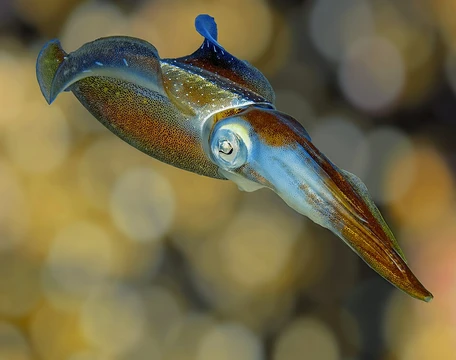
Amphioctopus aegina
A bottom-dwelling octopus with unique egg-cradling behavior.

Amphioctopus aegina, known as the marbled octopus or sandbird octopus, lives on the seafloor along the coasts of the Indo-West Pacific. It is a moderate-sized cephalopod with a mantle (the main body hump) measuring 4 to 10 centimeters long. A white stripe runs down the center of the mantle, and another horizontal stripe sits between the eyes. Its arms are about twice the length of the head, with the lateral arms being the longest. Males have a specialized third right arm used for reproduction (hectocotylized). Each arm has two rows of suckers and can regrow if damaged or lost.
This species is carnivorous, feeding on small fish, shrimp, and crabs. It hunts in shallow subtidal areas with soft, muddy bottoms. Reproduction can happen year-round, but egg-laying peaks in January and October. Unlike most octopuses, which attach their eggs to hard surfaces with strings, the female sandbird octopus cradles the egg cluster in her arm web—a behavior called egg cradling. However, this has only been observed in captivity for experiments, so it may be due to a lack of preferred substrates. The mother does not eat while brooding and eventually dies of starvation. After hatching, the planktonic paralarvae spend about a month in the open water (pelagic phase) before settling into muddy subtidal zones.
The sandbird octopus is widespread across the Indian Ocean and Northwest Pacific, from China to India. It is heavily caught by fishing industries, especially in the Gulf of Thailand and Chinese coastal waters, because of its high protein and low-fat content. Trawl fishing and trapping are common methods. Despite its popularity as food, very little is known about its basic biology and taxonomy due to limited study. In southern Thailand, locals call it *wui*, *wai*, or *woi wai*. It is sometimes caught on beaches at low tide using simple homemade poles baited with crab meat—when the octopus bites, the fisher quickly spears it with the sharpened pole.
Quick Facts
- Genus
- Amphioctopus
- Species
- aegina
Facts from the source article.
Lore & Background
The sandbird octopus is moderately sized, with a mantle 4–10 cm long. It typically displays a white stripe down the midline of the mantle and another horizontal stripe between the eyes. Its arms are twice the length of its head, with the lateral arms being the longest, and males possess a hectocotylized third right arm. Each arm has two rows of suckers and can regenerate if lost or damaged.
Females lay eggs year-round, with peaks in January and October. After spawning, the female broods the egg cluster in her arm web, a behavior known as egg cradling. This is unique compared to most octopod species, which attach eggs to hard surfaces via strings. However, egg spawning has only been closely observed in captivity, so it is possible that preferred substrates were lacking, resulting in unnatural brooding habits. The mother does not eat during brooding and eventually dies from starvation. The planktonic paralarvae undergo a pelagic phase after hatching, then after about a month migrate to muddy substrates in the sub-tidal zone.
The sandbird octopus is widely distributed throughout the Indian Ocean and Northwest Pacific waters, from China to India. It is bottom dwelling and resides in muddy substrates within coastal waters.
Reader's Guide
The sandbird octopus is a common victim of fishing industries, heavily caught along the Gulf of Thailand and in Chinese coastal waters. Its high protein and low-fat content have made it a popular target for trawl fishing and trapping. Despite its popularity as a food source, very little is yet known about its basic biology and taxonomy, as it has not been extensively studied. In southern Thailand, local terms for this octopus include wui, wai, or woi wai. It is sometimes caught by traditional methods on the beach at low tide, using simple homemade poles baited with crab meat. When an octopus bites the bait, the fisher quickly thrusts the sharpened pole down to spear and capture it. The species' unique egg-cradling behavior and the uncertainty around whether it is natural or captivity-induced highlight gaps in scientific understanding.
Did You Know?
- The female sandbird octopus broods eggs in her arm web, a behavior called egg cradling.
- Eggs are laid year-round, with peak reproduction in January and October.
- In southern Thailand, it is known locally as wui, wai, or woi wai.
Frequently Asked Questions
What is Amphioctopus aegina?
Amphioctopus aegina, commonly called the marbled octopus or sandbird octopus, is a moderate-sized bottom-dwelling cephalopod of the Indo-West Pacific. It is easily spotted by a white stripe running down the center of its mantle and a second horizontal stripe positioned between its eyes.
How big does Amphioctopus aegina grow?
The mantle, or main body hump, of this species typically measures between 4 and 10 centimeters in length. Its arms reach roughly twice the length of the head, with the lateral arms being the longest of the set.
What does Amphioctopus aegina eat?
This octopus hunts smaller fish, shrimp, and crabs in its muddy coastal surroundings. It manipulates and secures prey using the two rows of suckers lining each of its arms.
Where can you find Amphioctopus aegina in the wild?
The species is restricted to muddy seafloor habitats in shallow coastal waters, ranging from the Indian Ocean across to the Northwest Pacific as far north as China. It is strictly benthic and does not wander into open water.
What is unique about Amphioctopus aegina's breeding?
Males carry a specialized third right arm, the hectocotylus, used exclusively for sperm transfer during mating. The species is also noted for a distinctive egg-cradling behavior, and its peak reproductive activity falls in January and October.
More in Reef Cephalopods 1-24
Spotted an error? Know more?
Reader corrections go straight into our review queue. Suggest an edit · How this site is sourced