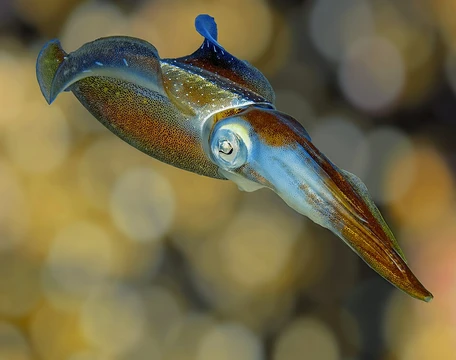
Amphioctopus marginatus
A tool-using octopus that walks on two arms.

The coconut octopus, or veined octopus, is a medium-sized cephalopod living in the tropical waters of the western Pacific and Indian Oceans. It favors sandy seafloors where shells or debris are plentiful. Its diet mainly consists of shrimp, crabs, and clams. This species is one of only two octopuses known to walk on two arms, and it is also recognized for gathering and using tools—such as coconut halves and seashells—as portable shelters.
Classified under the family Octopodidae, the species was first described in 1964 by Japanese malacologist Iwao Taki, who named it *Octopus marginatus*. The name *marginatus* (meaning “margined”) refers to the pale border around its eyes. It was later moved to the genus *Amphioctopus*. A 1976 description by Dong Zhengzhi, *Octopus striolatus*, is not considered taxonomically valid.
The octopus’s main body typically measures 5 to 10 centimeters long, and with arms extended it can reach about 30 centimeters. It can weigh up to 400 grams. Its usual coloring features dark, branching lines that resemble veins; the arms are dark with contrasting pale suckers, and a lighter triangular patch often appears just below the eye. In 2017, the complete mitochondrial genome was sequenced, revealing a close relationship with *Amphioctopus aegina*.
This species preys mostly on crustaceans like *Calappa* crabs and on bivalves. Females lay clutches of about 100,000 eggs, each 3 millimeters long, woven into long chains. The eggs are deposited inside a shelter—such as a coconut shell—where the female guards them until they hatch; like most octopuses, she starves to death during brooding. Eggs take 15 to 17 days to hatch, and the paralarvae are planktonic.
In March 2005, researchers from the University of California, Berkeley, reported in *Science* that *A. marginatus* can walk bipedally, a behavior they called “stilt-walking.” The octopus rolls two arms to move while using the other six to disguise itself, possibly to mimic a rolling coconut. This was first observed off Sulawesi, Indonesia, where coconut shells are common. Dr. Crissy Huffard noted that octopuses are the only animals without a rigid skeleton that can walk on two limbs. *A. marginatus* and *Abdopus aculeatus* are the only two octopus species known to do this. The species also crawls in the typical octopus fashion.
Quick Facts
- Taxon
- Amphioctopus marginatus
Facts from the source article.
Lore & Background
The species was first described in 1964 by Japanese malacologist Iwao Taki as Octopus marginatus, later transferred to the genus Amphioctopus. Taki chose the Latin name marginatus (meaning margined) due to the pale border around the eyes. In 1976, Dong Zhengzhi described the species Octopus striolatus, but this name is not recognized as taxonomically valid. The main body is typically between 5 and 10 cm long, with arms extending total length to about 30 cm. The octopus displays a typical color pattern with dark branching lines similar to veins; arms are usually dark with contrasting light suckers, and a lighter triangular area can be seen below the eye. In 2017, the complete mitochondrial genome was sequenced, showing close relation to Amphioctopus aegina.
Reader's Guide
The coconut octopus is significant for its unusual behaviors, which challenge traditional views of invertebrate intelligence. In March 2005, researchers at the University of California, Berkeley, published an article in Science reporting bipedal locomotion, or 'stilt-walking', where the octopus rolls two arms to walk while using the other six to disguise itself, possibly mimicking a rolling coconut. This behavior was first observed off Sulawesi, Indonesia, where coconut shell litter is common. In 2009, researchers from the Melbourne Museum in Australia filmed the octopus collecting coconut half-shells from the sea floor, carrying them up to 20 meters, and arranging them into a spherical hiding place. This was described as the first evidence of tool use in invertebrates, as the shells were prepared and collected for later use. The species preys on crustaceans such as Calappa crabs and bivalves. Eggs are laid in clutches of 100,000 as long chains, guarded by the female until she starves to death. The species is listed as Least Concern on the IUCN Red List, with fishing as the primary threat.
Did You Know?
- Amphioctopus marginatus is one of only two octopus species known to exhibit bipedal walking.
- It was the first invertebrate observed using tools, specifically carrying and arranging coconut shells for shelter.
- The female starves to death while brooding her eggs, which hatch after 15–17 days.
Frequently Asked Questions
What is Amphioctopus marginatus?
It is a medium-sized octopus commonly known as the coconut or veined octopus, native to tropical waters of the western Pacific and Indian Oceans. The species was formally described in 1964 by Japanese malacologist Iwao Taki, who originally assigned it to the genus Octopus before it was reclassified into Amphioctopus.
What makes Amphioctopus marginatus unique among octopuses?
It is one of only two octopus species that regularly walks along the seafloor using two of its arms rather than relying solely on jet propulsion. It also carries portable shelters—such as coconut halves or broken shells—over its body, a form of tool use that is exceedingly rare in the animal kingdom.
Where does Amphioctopus marginatus live?
It favors sandy seafloors in tropical regions of the western Pacific and Indian Oceans, specifically areas littered with shells, coconut fragments, and other debris. Those scattered pieces of material serve as both hunting grounds and the raw resources it collects for its portable shelters.
What does Amphioctopus marginatus eat?
Its diet centers on small benthic invertebrates, primarily shrimp, crabs, and clams. It forages along the sandy bottom where it typically walks and hunts.
How big does Amphioctopus marginatus get and how does it reproduce?
The mantle measures roughly 5 to 10 cm, full arm span can reach about 30 cm, and the animal weighs up to around 400 g. A single female produces a clutch of approximately 100,000 eggs, each only about 3 mm long, with an incubation period of roughly 15 to 17 days.
More in Reef Cephalopods 1-24
Spotted an error? Know more?
Reader corrections go straight into our review queue. Suggest an edit · How this site is sourced