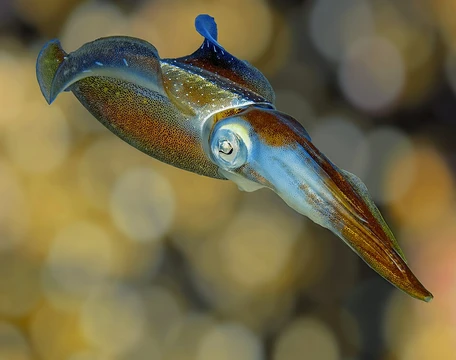
Robsonella huttoni
A small octopus with a planktonic paralarval stage.

The club pygmy octopus, *Robsonella huttoni*, is found in the waters of New Zealand and Australia. It was first formally described in 1943 by zoologist William Benham, who named it after Frederick Hutton, a prominent New Zealand naturalist. Adults display reddish, orangish, and greenish colouration and can grow to a length of 240 millimetres. The species is widespread across New Zealand, but in Australia it is restricted to southern regions. Its habitat includes tidal and subtidal reefs, reaching depths of 386 metres. The octopus’s distribution along the shore seems to shift with age, a pattern known as an ontogenetic niche shift. Unlike many octopus species, it has a paralarvae stage that lasts between 40 and 70 days. While records show individuals living up to 250 days, they likely survive longer. Information on conservation needs is scarce, though climate change may affect their range.
In terms of taxonomy, Benham, then a professor emeritus at Otago University, originally classified it as *Octopus huttoni* based on specimens from New Zealand’s Otago region. The specific name honours Frederick Hutton, who had earlier described New Zealand’s first octopus species, *Macroctopus maorum*. The species was most recently redescribed in 1999 by marine biologist Steve O’Shea. Its common name is the club pygmy octopus.
Phylogenetic work in 2020, using genetic data from cytochrome oxidase I, cytochrome oxidase III, and 16s rRNA, moved the species into the genus *Robsonella*. Researchers pointed to skin texture and radula morphology as supporting this placement. They also suggested the species likely evolved after the Antarctic Circumpolar Current formed during the Cenozoic era.
Adults reach up to 240 millimetres in total length, with especially large individuals recorded from Fiordland and smaller ones from southern Australia. The mantle is about 57 millimetres long. Living animals vary in colour, appearing reddish, orangish, or greenish. The head is well developed and covered in small, rounded papillae, with one or two hair-like appendages above each eye called occular cirri. The arms are also papillose. In adults, the tenth to thirteenth suckers are noticeably enlarged. The male’s third arm is hectocotylised, modified for storing and transferring spermatophores, and bears 69 to 74 suckers.
Quick Facts
- Genus
- Robsonella
- Species
- huttoni
Facts from the source article.
Lore & Background
Robsonella huttoni was first described in 1943 by zoologist William Benham, who named it Octopus huttoni after Frederick Hutton, a prolific New Zealand naturalist. It was most recently redescribed in 1999 by New Zealand marine biologist Steve O'Shea. In 2020, based on genetic data, the species was transferred to the genus Robsonella, with skin texture and radula morphology supporting the move. Adults reach up to 240 mm in length, with a mantle about 57 mm long, and display reddish, orangish, and greenish colour patterns. The head and arms are papillose, and the third arm of the male is hectocotylised with 69 to 74 suckers. Paralarvae are roughly 3 mm long, semitransparent, and covered in Kölliker’s organs and 29 to 50 chromatophores. Eggs are white, 2.5 mm long, and linked by strands up to 25.8 mm long. The species occurs throughout New Zealand and in southern Australia, inhabiting intertidal and subtidal reefs to depths of 386 metres.
Reader's Guide
Robsonella huttoni is significant as one of the few octopus species with a planktonic paralarvae stage, lasting 40 to 70 days, which contrasts with many other octopus that lack such a stage. Its distribution along the shore appears to depend on age, suggesting an ontogenetic niche shift: near-shore populations tend to be older, while younger individuals are found further offshore, likely transported by currents. The species is listed as Data Deficient by the IUCN as of 2018, with little data on conservation needs. However, experimental studies show that paralarvae avoid temperatures below 15°C and above 23.1°C, and temperatures around 25°C appear to be a major barrier, indicating that climate change may impact its distribution. Although not fished commercially, it is sometimes caught as bycatch. The species was originally described by William Benham in 1943 and later transferred to the genus Robsonella in 2020 based on genetic and morphological evidence.
Did You Know?
- The paralarvae stage lasts 40 to 70 days, unlike many other octopus species.
- Adults can reach up to 240 mm in length and display reddish, orangish, and greenish colours.
- Eggs are laid in clumps of 50 to 125, with females producing 3800 to 6500 eggs.
- The species was first described in 1943 by William Benham and named after Frederick Hutton.
More in Reef Cephalopods 1-24
Spotted an error? Know more?
Reader corrections go straight into our review queue. Suggest an edit · How this site is sourced