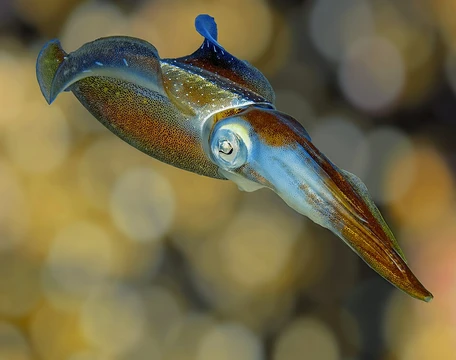
Pinnoctopus cordiformis
A common New Zealand reef octopus with disputed taxonomy.

Pinnoctopus cordiformis is a species of octopus belonging to the family Octopodidae, found primarily around the coasts of New Zealand. It is one of the most common octopus species in the country, though its taxonomic validity is disputed, with some authorities considering it conspecific with Macroctopus maorum or a synonym of Enteroctopus zealandicus.
Quick Facts
- Taxon
- Pinnoctopus cordiformis
Facts from the source article.
Lore & Background
Pinnoctopus cordiformis was first formally described in 1832 by French naturalists Jean René Constant Quoy and Joseph Paul Gaimard as Octopus cordiformis. The holotype has been lost, and a neotype was designated in 1999 from a specimen collected in New Zealand waters in 1997. The genus Pinnoctopus was proposed by Alcide d'Orbigny in 1845 with O. cordiformis as its type species, but this was subsequently considered a junior synonym of Octopus. Some authorities recognize Pinnoctopus as valid, while others treat P. cordiformis as conspecific with Macroctopus maorum, with the latter as the junior synonym; yet other authorities suggest it is a synonym of Enteroctopus zealandicus.
The species is identifiable by its orange-brown or purple-grey colouration with iridescent white spots on the arms and web, but no white spots on the mantle. It has a globe-shaped mantle, a sharp beak, smooth skin that can change colour slightly, and can release ink for self-defense. It is primarily nocturnal and has highly developed eyes. It is closely related to Robsonella huttoni, but can be distinguished by its larger size and two rows of oppositely-arranged suckers, compared to R. huttoni's single row.
Pinnoctopus cordiformis is found around New Zealand from Stewart Island (47°S) to south of Leigh (36°S), and in the Chatham Islands. It has also been recorded off the coast of South Australia. It inhabits waters as deep as 300 m, but also shallow coastal waters, tidal rock pools, subtidal reefs, seagrass, and seaweed beds. Its life cycle is short: males die after mating, females brood eggs for about 80 days without feeding, then die shortly before the eggs hatch. The eggs are pear-shaped and intermediate in size, hatching into planktonic paralarvae.
Reader's Guide
Pinnoctopus cordiformis is notable as one of the most common octopus species in New Zealand, yet its taxonomic status remains unresolved, reflecting broader challenges in cephalopod systematics. The species was first described in 1832, but the loss of the holotype and subsequent neotype designation in 1999 highlight the difficulties in establishing stable nomenclature. The ongoing dispute over whether it is conspecific with Macroctopus maorum or a synonym of Enteroctopus zealandicus means that much of the biological information attributed to it may apply to other taxa.
Ecologically, it is a significant predator in subtidal reefs, feeding on crayfish, crabs, shellfish, rock lobster, and blue cod. Its ability to enter fishing pots and consume catch has been noted, with a reported 35% increase in mortality for blue cod and rock lobster in spring 1970 at Hokianga. It is preyed upon by New Zealand sea lions, Buller's albatross, sharks, and whales. The species is difficult to study in the wild due to its ability to avoid towed nets and escape confined spaces.
Culturally, a Maori legend tells of the navigator Kupe pursuing a giant octopus, Te Wheke-o-Muturangi, which ate fish needed by the tribe; Kupe eventually killed it in Cook Strait. Early Maori caught octopus by hand, using one hand as bait and the other to pick it up and kill it. These cultural references underscore the long-standing human interaction with this species in New Zealand.
Did You Know?
- Pinnoctopus cordiformis can reach over 1 m in length and 9 kg in weight, though such large specimens are seldom seen as they reside in deeper waters.
- The species has a fecundity range of 56,000 to 232,000 eggs, which are pear-shaped and of intermediate size.
- A Maori legend states that the navigator Kupe killed a giant octopus, Te Wheke-o-Muturangi, in Cook Strait.
More in Reef Cephalopods 1-24
Spotted an error? Know more?
Reader corrections go straight into our review queue. Suggest an edit · How this site is sourced