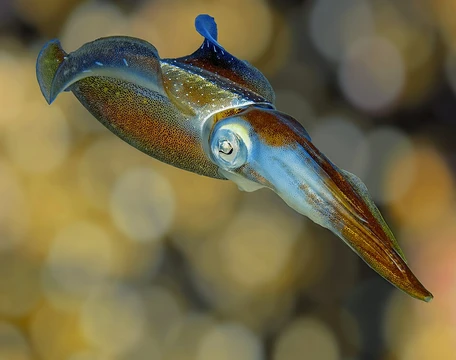
Pinnoctopus bunurong
Southern white-spot octopus, found in Australian sandy substrates.

Pinnoctopus bunurong, commonly known as the southern white-spot octopus, is a species of octopus in the family Octopodidae found in Australian waters. It is notable for its distinctive red, orange, and white coloration with white spots covering the body and transverse bands of smaller white spots along the arms.
Quick Facts
- Taxon
- Pinnoctopus bunurong
Facts from the source article.
Lore & Background
Pinnoctopus bunurong was originally placed in the genus Octopus under the scientific name Octopus bunurong, but has since been moved to the genus Callistoctopus and subsequently to Pinnoctopus. Its body shape is oval, with long arms that have narrow tips. The coloration includes red, orange, and white hues, with white spots covering the entire body and transverse bands of smaller white spots along the arms. A white coloration of skin extends along the mantle on each side, and the mantle can grow up to 48 centimeters in length. The webs are short and almost transparent.
The species inhabits Australian waters off the coasts of Western Australia, Southern Australia, Victoria, northern Tasmania, and southern New South Wales, at depths from 1 to 130 meters. It buries in sand and seagrass areas and emerges at night to feed. When threatened, it can dig into the sand quickly. Females lay eggs that develop well into young, which settle to the seafloor after hatching. At night, it searches for small crustaceans to eat.
There are no specific threats to this species, and it has been listed as 'Least concern' by the IUCN Red List due to its wide range, though further research is needed on its population size, life history, and ecology.
Reader's Guide
Pinnoctopus bunurong is a species of octopus in the family Octopodidae, originally described as Octopus bunurong before being reclassified into the genera Callistoctopus and then Pinnoctopus. Its significance lies in its distinctive appearance—oval body, long arms with narrow tips, and a coloration of red, orange, and white with white spots covering the body and transverse bands of smaller white spots along the arms. The mantle can reach up to 48 centimeters in length, and the webs are short and nearly transparent.
Its range extends across Australian waters from Western Australia to southern New South Wales, including Southern Australia, Victoria, and northern Tasmania, at depths of 1 to 130 meters. It inhabits sandy and seagrass substrates, burying itself during the day and emerging at night to feed on small crustaceans. When threatened, it can rapidly dig into the sand. Females lay eggs that develop into young that settle to the seafloor after hatching.
The species is listed as 'Least concern' on the IUCN Red List due to its wide range, with no specific threats identified. However, the article notes that further research is needed to understand its population size, life history, and ecology. This entry summarizes the known facts from the source article without adding external information.
Did You Know?
- Pinnoctopus bunurong was originally placed in the genus Octopus as Octopus bunurong before being moved to Callistoctopus and then to Pinnoctopus.
- It buries in sand and seagrass areas and comes out at night to feed on small crustaceans.
More in Reef Cephalopods 1-24
Spotted an error? Know more?
Reader corrections go straight into our review queue. Suggest an edit · How this site is sourced