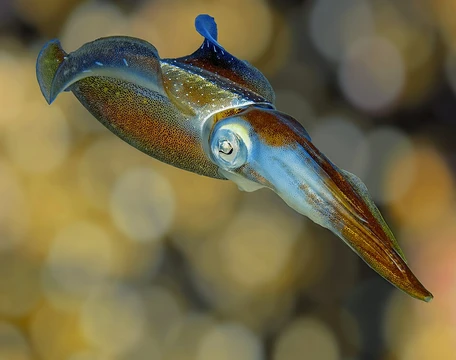
Octopus pallidus
A pale octopus endemic to southern Australia, studied for age determination.

Octopus pallidus, called the pale octopus, is a medium-sized species found only in the temperate coastal waters of southern Australia. It supports a commercial trap fishery in Bass Strait and has been studied extensively for insights into cephalopod reproduction, eyesight, and how to determine age.
British zoologist W. E. Hoyle first described the species in 1885, using specimens gathered during the Challenger expedition.
The pale octopus reaches an arm span of about 60 cm, with an adult mantle length between 70 and 110 mm. Its body is uniformly pale—off-white, cream, or light pink-orange—and lacks the bold patterns seen in some other Australian octopuses.
It lives in shallow shelf waters off southern Australia, including Tasmania, Victoria, South Australia, and occasionally southern New South Wales. The octopus favors soft-bottom habitats like sand and shell-grit, often near sponge or sea squirt beds. In Bass Strait, it is commercially caught at depths of 15 to 85 m.
Mostly nocturnal, the pale octopus ambushes prey from rubble or burrows. Hatchlings start hunting right away, feeding mainly on bivalves. Females attach relatively large eggs to hard surfaces, and the young are benthic from birth—they skip the planktonic paralarva stage. Vision experiments show both sexes can tell vertical from horizontal rectangles and can distinguish gradient greys from a uniform grey background.
Female maturation depends on both age and season, with breeding concentrated in cooler months. The species is short-lived, typically surviving one to two years, and reproduces once before dying (semelparity), as is typical for the genus *Octopus*. Because octopus soft tissues lack countable growth bands, aging them is difficult. Researchers at the University of Tasmania have validated two methods: counting growth increments in the stylet (a small internal shell remnant) and measuring the age-pigment lipofuscin in brain tissue.
The pale octopus is the main target of southeastern Australia’s commercial octopus fishery, the Tasmanian Octopus Fishery (TOF), which operates in Bass Strait and east of Flinders Island under a state license. Targeted fishing began around 1980, and since December 2009 a specific octopus license has been required.
Quick Facts
- Taxon
- Octopus pallidus
Facts from the source article.
Lore & Background
The pale octopus was described in 1885 by the British zoologist W. E. Hoyle from material collected during the Challenger expedition. As its common name suggests, the body is uniformly pale, ranging from off-white through cream to light pink-orange, and lacks the strongly contrasting patterning found in some other Australian octopus species. It inhabits soft-bottom habitats such as sand and shell-grit substrates, often near beds of sponges or sea squirts, and is taken commercially from depths of 15 to 85 m in Bass Strait.
The species is largely nocturnal and ambushes prey from rubble or burrow refuges. Hatchlings begin foraging immediately and feed primarily on bivalves. Females lay relatively large eggs that are attached to a hard substrate, and the hatchlings are benthic from the outset rather than passing through a planktonic paralarva stage. Experimental studies of vision have shown that both sexes can discriminate vertical from horizontal rectangles and can distinguish gradient greys from uniform grey backgrounds.
Female maturation depends on both age and season, with reproduction concentrated in cooler months. The species is short-lived, with a typical adult lifespan of one to two years and a single terminal reproductive event (semelparity). Researchers at the University of Tasmania have validated counts of growth increments in the stylet as a reliable ageing method, and have separately validated quantification of the age-pigment lipofuscin in brain tissue as a complementary tool.
Reader's Guide
The pale octopus supports the principal commercial octopus fishery in southeastern Australia, the Tasmanian Octopus Fishery (TOF), which operates in Bass Strait and waters east of Flinders Island under licence from the Tasmanian Department of Natural Resources and Environment. Targeted fishing for pale octopus in Tasmanian waters dates to about 1980, and since December 2009 a specific octopus licence has been required to participate. The fishery uses unbaited moulded plastic 'shelter pots' attached to demersal longlines up to 3–4 km in length, set on the sea floor at depths of 15 to 85 m. Octopus enter the unbaited pots seeking shelter, and pots are typically hauled after a soak time of 3–6 weeks. Annual catches have ranged from 55 to 132 tonnes since the early 2000s, fluctuating around 80 tonnes for much of the 2010s. Smaller catches of pale octopus are taken in Victorian state waters under the Octopus Eastern Zone Fishery. The species has become a focal species for the development of age-determination techniques in octopuses, which are difficult to age because their soft tissues do not deposit countable growth bands.
Did You Know?
- The pale octopus was described in 1885 by British zoologist W. E. Hoyle from Challenger expedition material.
- Hatchlings are benthic from the outset, not passing through a planktonic paralarva stage.
- Researchers at the University of Tasmania validated stylet growth increments and brain lipofuscin as ageing methods.
- The commercial fishery uses unbaited plastic shelter pots soaked for 3–6 weeks.
More in Reef Cephalopods 1-24
Spotted an error? Know more?
Reader corrections go straight into our review queue. Suggest an edit · How this site is sourced