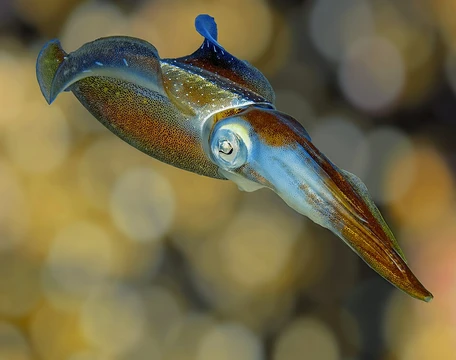
Octopus cyanea
A diurnal reef octopus known for rapid camouflage and cooperative hunting.

Octopus cyanea, commonly known as the big blue octopus or day octopus, is a species in the family Octopodidae found on coral reefs and in shallow waters across the Indo-Pacific, from Hawaii to the eastern coast of Africa. It is notable for its diurnal hunting behavior and extraordinary camouflage abilities, including the ability to change color, pattern, and skin texture nearly instantaneously.
Quick Facts
- Genus
- Octopus
- Species
- cyanea
Facts from the source article.
Lore & Background
Octopus cyanea was initially described by the British zoologist John Edward Gray in 1849, with the type specimen collected off Australia and housed at the Natural History Museum in London. Living on coral reefs and hunting by day, it is adept at camouflage, changing its color, patterns, and skin texture frequently; one researcher observed it change its appearance 1,000 times in seven hours. As it moves across the seabed, it matches the substrate beneath, with color changes controlled by chromatophores under direct brain control. It sometimes produces a 'passing clouds' display when stationary near prey, mimicking a dark shadow to encourage the prey to move incautiously.
Reader's Guide
Octopus cyanea is significant as one of the few diurnal octopus species, active mostly at dawn and dusk, and it maintains a den for shelter and feeding. It preys on fish, crabs, shrimp, and molluscs, using toxic saliva to kill crabs and drilling mollusc shells to predigest the animal. Notably, it engages in cooperative hunting with fish such as the roving coral grouper, blacktip grouper, and goatfish, and has been observed punching or striking groupers—theorized as a 'discipline' response toward fish that exploit the hunt or steal prey, and speculated to occur out of spite. In captivity, it breeds year-round, and while mating may become cannibalistic, individuals can socially tolerate others by sharing tanks and dens. The male mates with multiple females, then his suckers enlarge, and he declines and dies within two to three months; the female tends her eggs and dies soon after hatching. In Hawaii, the day octopus was traditionally eaten and captured using a cowrie shell lure.
Did You Know?
- Octopus cyanea can change its appearance up to 1,000 times in seven hours.
- It sometimes produces a 'passing clouds' display to mimic a shadow and startle prey.
- It engages in cooperative hunting with roving coral grouper, blacktip grouper, and goatfish.
- In Hawaii, it was traditionally captured using a cowrie shell lure.
More in Reef Cephalopods 1-24
Spotted an error? Know more?
Reader corrections go straight into our review queue. Suggest an edit · How this site is sourced